Monday, March 23, 2009

Links To WKRP Episodes Posted So Far


I thought I should do a post collecting links to the various uncut, original-music WKRP in Cincinnati episodes that have been exhumed on this blog. Here they are in order of production (not the same as airing order); further episodes added on the blog will be added to the list. A few of these clips have been tweaked since they were first posted to include bits of music that weren't available at the time; "God Talks To Johnny" now includes the scene that was cut in syndicated versions.

If there are any episodes where the embedded clips don't work, let me know. (And again, if you have a copy of the season 3 episode "The Baby" that is a complete original 24-minute version, please let me know. That's the one episode I don't have complete.)

Season 1

- "Pilot"

- "Pilot, Part 2"

- "Preacher"

- "Hoodlum Rock"

- "Bailey's Show"

- "Hold-Up"

- "Turkeys Away"

- "Goodbye, Johnny"

- "Johnny Comes Back"

- "I Want to Keep My Baby"

- "Fish Story"

- "The Contest Nobody Could Win"

- "A Date With Jennifer"

- "Tornado"

- "Young Master Carlson"

- "Never Leave Me, Lucille"

- "A Commercial Break"

- I Do, I Do... For Now"

- "Who Is Gordon Sims?"

Season 2

- "Baseball"

- "Jennifer Falls In Love"

- "Carlson For President"

- "For Love Or Money" (parts 1 & 2)

- "Bad Risk"

- "Put Up Or Shut Up"

- "Baby, If You've Ever Wondered"

- "Patter of Little Feet"

- "God Talks To Johnny"

- "Bailey's Big Break"

- "Mike Fright"

- "Les's Groupie"

- "A Family Affair"

- "Jennifer's Home For Christmas"

- "Sparky"

- "The Americanization of Ivan"

- "Herb's Dad"

- "The Doctor's Daughter"

- "Venus Rising"

- "In Concert"

- "Filthy Pictures"

- "Most Improved Station"

Season 3

- "The Airplane Show"

- "Jennifer Moves"

- "Real Families"

- "Hotel Oceanview"

- "The Baby"

- "Bah, Humbug"

- "A Mile In My Shoes"

- "Baby, It's Cold Inside"

- "The Painting"

- "Daydreams"

- "Frog Story"

- "Dr. Fever and Mr. Tide"

- "Venus and the Man (Venus Flytrap Explains the Atom)"

- "Ask Jennifer"

- "I Am Woman"

- "Secrets of Dayton Heights"

- "Out To Lunch"

- "A Simple Little Wedding"

- "Nothing To Fear But..."

- "Till Debt Do Us Part"

- "Clean Up Radio Everywhere"

Season 4

- "The Union"

- "An Explosive Affair" (parts 1 & 2)

- "Rumors"

- "Straight From the Heart"

- "Who's On First?"

- "Three Days of the Condo"

- "Jennifer and the Will"

- "The Consultant"

- "Love, Exciting and New"

- "You Can't Go Out of Town Again"

- "Pills"

- "Changes"

- "Jennifer and Johnny's Charity"

- "I'll Take Romance"

- "Fire"

- "Dear Liar"

- "Circumstantial Evidence"

- "The Creation of Venus"

- "The Impossible Dream"

- "To Err Is Human"

- "Up and Down the Dial"

Sunday, March 22, 2009

The Warner Archive, Another Thing That Isn't Available In Canada


Warner Brothers has set up something called The Warner Archive, an online-order program where they send out manufactured-on-demand DVDs of movies that aren't going to be relased to stores.

Ronald Epstein at the Home Theater Forum has more about this program. Apparently the widescreen movies will be in 16:9 format, and the individual titles have video clips online that indicate the print/transfer quality; it seems generally good from the clips I've seen. They have 140 titles up on the site, and are planning to add more.

Most of the titles they have at the moment can be described as minor films of major stars: lots of not-yet-on-DVD movies by popular stars with huge filmographies, like Cary Grant, Norma Shearer, Clark Gable. There are a bunch of films that were relased on VHS but never made it to DVD, and some real curios like The Grasshopper, a remarkably cheesy low-budget sexual-revolution melodrama starring Jacqueline Bisset (as an innocent Canadian girl who comes to mean, sexy L.A.) and made by... director Jerry Paris and writers Jerry Belson and Garry Marshall, exactly the people you'd expect to portray the wild world of sex and drugs.


Also, as an Ann-Margret fan, I'm glad they've included Made In Paris, a "family" film that's incredibly sleazy even by Joe Pasternak's standards, and one of the two 1966 star vehicles that basically wrecked her movie career (the other being The Swinger).

When I can figure out where to have them shipped (they're not shipping to Canada) I'll definitely be getting Once Upon a Honeymoon, though I'm surprised it wasn't considered a candidate for general-release DVD, considering that it stars Cary Grant and Ginger Rogers. It's Leo McCarey's anti-Nazi comedy in the vein of The Great Dictator and (from the same year) To Be Or Not To Be, and its mix of comedy, drama and propaganda is weirder and more controversial than either of those films. It's not very satisfying as a whole, but some of its parts are extraordinary.

Friday, March 20, 2009

WKRP Episode: "Goodbye, Johnny"

While I still can, I'm going to try and present a few season 1 episodes that are shown with the original music. This episode was the ninth in production order, though it wasn't aired until the show came back from hiatus. (The first half was originally written as one long act, but was split into two for the show's new, post-hiatus format of a teaser followed by a shorter first act.)

The main musical content of the episode is "Surfin' U.S.A." by the Beach Boys. There's also a song Johnny plays in the opening scene; I don't know what the song is, but when it was dubbed over, Les's dialogue was also (poorly) redubbed. Though the sound quality here is a little fuzzy, this is the original music/dialogue.

In terms of its spot in the production order, this (Blake Hunter's first episode) was a pretty important episode for the show's transition to a full-blown ensemble show; most of the second act gathers all eight regulars together at a testimonial dinner, and they start to assume almost equal importance. It also introduced such future running themes as Les's obsession with Communism, and Bailey's crush on Johnny. And in addition to frequent MTM guest player Janet Meshad, the episode features the first appearance of Edie McClurg as Lucille, playing a character she had been doing on stage for the Groundlings -- the chirpy, "uh-huh"-ing Midwestern wife. She's been playing different versions of this character, brilliantly, for the last 30 years.

Cold Open and Act 1


Act 2 and Tag


Fishermen Are Kind People... They'd Make Good Cats.

I didn't pick up the second collection of Little Archie stories because, according to the list of stories, they gave over most of the volume to Dexter Taylor* stories, and didn't include the really great Bob Bolling stories that were left out of the first volume. No The Long Walk or the story about the race of sophisticated, monocle-wearing alien frogs or the other stories that made Bolling one of the great under-valued treasures of kids' comics.

So I thought I would scan an old digest copy of a story that should have been collected but wasn't, "Caramel Has a Tale," a story that is sort of halfway between Bolling's domestic-comedy style and his action-adventure style. It's devoted to a character he created for the comics, Betty's cat Caramel. He actually gave Betty a whole family, creating her sister Polly and her brother Chick, though they don't appear in this story. (One of the many things that made Bolling's semi-autonomous instead of just a watered-down version of the main Archie title was that he was basically free to create new characters who had no equivalents in the main comic, and were often a lot better than the characters the "regular" Archie artists were working with.)

The story is basically an answer to the old question about what kind of stories cats could tell if they could talk; Caramel, taking advantage of her last chance to talk to children before they're too old to understand her, tells Betty and Veronica the story of her journey across America with her three kittens, and how she gave up each of them to new owners before nearly freezing to death in an attempt to find a home for herself. Bolling's drawing style is a wonderful mix of cartooniness and realism, his writing style never talks down to kids but never goes over their heads, either (and even includes a little shot at Those Clowns In Congress).

Click on the thumbnails to enlarge.


*(Taylor was the other Little Archie artist/writer, working on the title at the same time as Bolling. Like Bolling, he did both comedy and action/adventure stories. And while he wasn't as good as Bolling, he did some very good mystery-suspense stories in a different, more realistic style from Bolling's fanciful adventures. After Bolling left and Taylor took over the title full-time, the head office demanded that the Little Archie be brought in line with the regular Archie comics, with Little Archie, Betty and Veronica acting exactly like their older counterparts, and with "The Little Archies" and "Little Sabrina" joining the mix. Both the stories and Taylor's artwork got very bland after that.)


Thursday, March 19, 2009

A Phallic Joke I Somehow Missed

Every time I watched this scene from "Steal Wool," I would be so focused on Treg Brown's famously incongruous sound effects (this was one of the scenes where he experimented with using sounds that had literally nothing to do with the object on the screen, like locomotive noises) that I missed the obvious phallic joke. It took this video to point it out to me:


And yes, I assume that any such joke in a cartoon is intentional.


Tuesday, March 17, 2009

More On Meta-Strips (Or, Because It's Fearless Fosdick, "Moron" Meta-Strips)


In my post about meta-strips, I somehow forgot to mention the Fearless Fosdick strips from Li'l Abner, even though those are some of the most interesting meta-humor in any comic strip. Al Capp didn't just use Fearless Fosdick to make fun of Dick Tracy and action-adventure strips; by having Li'l Abner read the strip and discuss it with Daisy Mae, he used it to comment on his own strip and his readers.

The greatest of all Capp's self-reflexive stories is of course the story where Abner promises to marry Daisy Mae if Fosdick gets married: Abner explains all the ruses that Fosdick's creator uses to make it look like the hero will have to get married (including making the whole thing a dream, something that many people probably thought Capp would resort to), and Daisy Mae meets the Fosdick artist and complains that he's setting a bad example for American men by having a hero who never marries his faithful girlfriend. The way Capp used Fosdick is an early example of a type of humor that became more popular later on, where a show-within-a-show parallels and parodies the show itself. The Simpsons used to do this all the time with Itchy and Scratchy.

Comics.com recently re-started the "Fosdick vs. the Chippendale chair" storyline, which rivals only the "poisoned can of beans" story for the sheer amount of destruction caused by Fosdick. They re-started it at this link and are still going on with it at this writing; they reran the whole thing last year, but I can't find them online. I wish the syndicate would put all the Abner strips online the way they've done for Peanuts, but I'm not pretending that that would be feasible.

Sunday, March 15, 2009

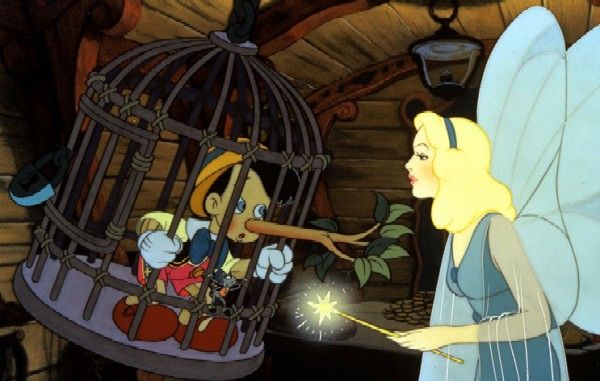
Grudge Match: Glinda vs. the Blue Fairy


The otherwise placid, uneventful world of 1939-40 is rocked by war: a battle, wando-a-wando, between two smiling, didactic fairies: Glinda the Good Witch (Billie Burke, The Wizard of Oz) vs. The Blue Fairy (Pinocchio).

Both smile and laugh way too much. Both are sucked up to by the other characters. And both are basically sadistic creeps who take delight in putting kids through horrible torture in order to "teach them a lesson." (And as a bonus, they both seem perfectly happy to stand by happily while others suffer: Glinda apparently did nothing about the enslavement of the Munchkins, and the BF clearly has the ability to save those kids who got turned into donkeys and sold for slave labor, but she couldn't care less.) But which of these two evil, wand-wielding maniacs will out-zap the other?


I personally lean toward the BF here for sheer volume of cruelty. Glinda was an asshole for not telling Dorothy how to get home, but at least she didn't physically torture the girl herself, whereas the BF specializes in mutilating and mutating Pinocchio's body. Plus, because Glinda is vain about her looks, one elongated-nose spell will completely shut her down and prevent her from thinking clearly.

(We're talking here about the 1939-40 movie versions, rather than the books they're based on or other versions of the same stories.)

Friday, March 13, 2009

WKRP Episode: "The Impossible Dream"

By request, here is the 20th episode of the fourth and final season, written by Richard Sanders and Michael Fairman (their fifth script for the series).

This one, according to the book America's Favorite Radio Station, was almost completely rewritten from beginning to end. It was originally conceived in 1981 when Walter Cronkite announced that he was leaving CBS Evening News; Sanders' idea was that Les would want to go to New York, with his mother's prodding, to try and replace Cronkite. But the script was written around the idea of getting Cronkite to appear as himself, and CBS decided against having Cronkite do another scripted TV cameo (he hadn't done one since The Mary Tyler Moore Show seven years earlier). So the episode was delayed and finally rewritten into its current form, where Les wants to go to New York for reasons that aren't altogether clear, and the surprise cameo at the end is not Walter Cronkite but Richard Sanders in drag as Les's mother, a gag I've never been wild about.

The episode feels kind of choppy, and felt that way to me even before I knew about all the revision, but the first act does end with a great line delivery from Loni Anderson, making a huge laugh out of a line that probably didn't look like much on the page. (I've said this before but it's unfair to lump Anderson in with Suzanne Somers and other '70s TV bombshells; in terms of comic timing she was probably the strongest link in this whole cast.) Also, Les says in 1982 that "newspapers have had it," and 27 years later he'd be saying the exact same thing.

Cold Opening and Act 1


Act 2


Thursday, March 12, 2009

Flooding the Movie Theatre With Color

Eric Goldberg points out on the DVD commentary for Pinocchio that the famous "They never come back... as boys!" shot is especially scary on a big screen. While I've never seen Pinocchio in a movie theatre, I can believe it: one of the things the shot depends on is the idea that on a big screen in a darkened theatre, a sudden change in color will have an almost physical impact on the audience; you can almost feel the color changing.


Another shot that does that, though it's not meant to be scary, is the bit near the end of "What's Opera, Doc?" where Elmer vows to kill the wabbit, and the entire screen (including Elmer) goes red. On the small screen, especially when the lights are on, this is just a nice shot; on the big screen in a dark theatre, the change in color is startling and, again, almost physical.

I haven't seen a lot of color movies on the big screen that use color in that way, making the audience jump with a sudden color change, but obviously there must be others. I suspect that this effect is easier to achieve in animation, where you can actually change the color of somebody's face as he leans into the shot, than in live action, where color manipulation is harder to do without it looking artificial.

Tuesday, March 10, 2009

It's An Addendum, Charlie Brown

It'll be an annoyance to people who have to buy certain specials twice, but I'm still glad that the first six Charlie Brown specials will be released on DVD in a two-disc collection on July 7.

The non-seasonal specials aren't seen very often because they don't have a holiday peg, but the second special, "Charlie Brown's All-Stars," is actually my favorite of the specials. Bill Melendez and his animators had learned a few things from "Charlie Brown Christmas," so it's a bit more polished in animation and writing, but it's still early enough that it retains the awkward, rough charm of the first special. And the baseball theme allows them to use many of the best jokes from the strip without losing the story thread. (Almost any baseball-themed strip fits in with the theme of the special, whereas in other specials and movies, the repurposed strips can seem shoehorned in or awkwardly re-assigned.) And the baseball theme has one more advantage: on the baseball field, Snoopy can be a purely physical character and his lack of a voice, or any way of expressing his thoughts, isn't really a problem. In other specials, especially some of the later ones where they gave Snoopy a bigger part, he's severely weakened as a character by the decision to keep him silent. (I understand why they did it, and I think it worked for the first two specials, but by "Great Pumpkin," his World War I Flying Ace routine is just not as much fun without Snoopy narrating it himself.)

It might be nostalgia talking, because my introduction to Charlie Brown in other media was an audio record based on Charlie Brown's All Stars, but I really do think it's the best of the Melendez/Mendelson specials.


Was This The Worst Show of the '90s?

While looking at the Spinoff/Crossover site, I came across this page about a 1997 show called Meego, which the author provocatively calls "The worst show of all time." I thought I had seen or at least heard of all the cheesy shows from the Miller-Boyett factory, but I missed this one, which ran after Family Matters when it moved to CBS in 1997-8 (and started, of course, with two crossover appearances by Urkel). He makes a pretty convincing case for its horribleness:

It was a cross between Alf and Charles In Charge. Start crying now. But allow me to expand on that description. Meego starred Perfect Stranger's Bronson Pinchot as Meego, a nanny who was really a space alien with magical powers watching over a family of kids that included Jerry Maguire's Jonathan Lipnicki.
....
If you are a fan of Meego and I have grossly offended you I am very sor... oh heck I can say it. I'm NOT sorry. IT WAS MEEGO FOOL!!!


By this point, Miller-Boyett had actually changed its name to Miller-Boyett-Warren, having absorbed half of the Bill Bickley/Michael Warren team that wrote and produced most of its shows. (Bill Bickley, apparently sensing that the bottom was about to fall out of the cheesy family comedy market, had retired.) CBS picked up the M-B shows that ABC had dropped, plus this new one, and tried to go head to head with TGIF.

I remember at the time I was still watching Sabrina (in its second season) and would sometimes check out the other supernatural comedies ABC ordered in a desperate attempt to cash in on the success of Sabrina, Al Jean and Mike Reiss's Teen Angel and Michael Jacobs' You Wish, but I never watched a moment of Meego, presumably because I wasn't watching Family Matters either.

Anyway, Meego was clearly a CBS attempt to pull a Sabrina by doing a supernatural comedy of their own, and M-B did their usual thing, borrowing heavily from previous shows they'd been involved with (Mork and Mindy, Perfect Strangers). As always, they put together a decent supporting cast (including Michelle Trachtenberg, available after the cancellation of The Adventures of Pete & Pete). But the title sequence is terrible, and the theme song kind of sounds like a Mork knockoff too.


I phrased the subject heading as a question because, having never seen a full episode of this series, I have no idea if it really was the worst show of its era. It seems like a good candidate, though, based on the few clips I've seen. One clip appears to be from an episode where the teenage boy uses some kind of alien gizmo to force a girl to like him. And then the Valuable Lesson is that people should like you for who you are, whereas the Valuable Lesson should be that this character is basically a rapist.


I'm so disgusted by that clip that I will stop there. So I have no desire to see more of this to find out if it's truly the worst show of the '90s, but at the very least, I think it's clearly worse than You Wish or Teen Angel or any of the other Sabrina ripoffs.

Friday, March 06, 2009

WKRP Episode: "Young Master Carlson"

Here by request is a season 1 episode that has been hacked to death in every version since it first aired. Even in the original syndication version, the theme from Patton was removed from the cold opening (though, strangely enough, it was kept when it recurs near the end of the episode). The '90s version removed Van Morrison's "Caravan" and also Herb humming "Anchors Aweigh," and the DVD version cut the entire scene where Mr. Carlson and his son listen to "Soul Man," thereby ruining the ending (since there was no scene where we get to see them bond). In this version all the original music has been reinstated. Herb humming "Anchors Aweigh" doesn't actually match his mouth movements, but that's the way it was in the original version.

The episode, written by Hugh Wilson and directed by Will Mackenzie, seems to have been inspired by a throwaway line in an earlier episode where Carlson mentions that he has a son in military school. It's Carol Bruce's second episode as Carlson's mother. And the actor who plays Carlson's son, Sparky Marcus, had appeared the season before on an episode of The Bob Newhart Show, playing the son of a guest character played by Loni Anderson. (She claimed that he was Mr. Carlin's son; complications ensued.)

Cold Opening (Music: Theme from Patton)


Act 1 (Music: "Caravan" by Van Morrison)


Act 2 and Tag (Music: "Soul Man")


Thursday, March 05, 2009

Meta-Strips

Today's Peanuts reprint, from March 8, 1962 (they're now actually showing the original publication date at the comics.com website, by the way), is one of my favorite examples of a self-aware, self-referential strip. I'm not sure if it was one of the strips that was not reprinted before The Complete Peanuts; I think I saw it in a Peanuts book once, but I can't be certain. (Click to enlarge)


This is one of the very few self-referential strips Peanuts ever did. One of the other ones is also from 1962 (and which I'm almost certain I never saw before The Complete Peanuts), where Charlie Brown turns off the TV in disgust and wonders "what would happen if comic strips showed nothing but reruns all summer?" And an early strip has a very rare open breach of the fourth wall, where Schroeder says "sometimes I think I should put in a transfer to a new comic strip!"

Of course Bill Watterson was presumably tipping his hat to the strip reprinted above when he did virtually the same strip for Calvin and Hobbes: four panels of Calvin and Hobbes from the neck up, never changing expression or doing anything, as Calvin explains that "Grandpa says the comics were a lot better years ago when newspapers printed them bigger. He says comics now are just a bunch of Xeroxed talking heads because there's no space to tell a decent story or to show any action. He thinks people should write to their newspaper and complain."

Though the two strips are a little different in their potential targets. Schulz seems like he's making a bit of fun of his own strip as well as its critics, since the scene is only a slight exaggeration of what happens in a typical Peanuts strip (two characters leaning on a wall and talking for four panels). Watterson is the "grandpa" that Calvin talks about, the guy who crusades against small-print comics and talking heads; he's making fun of the kind of strip he hates and also making a bit of fun of himself in the punchline. ("Your grandpa takes the funnies pretty seriously." "Yeah, mom's looking into nursing homes.")

Walt Kelly in Pogo did a lot more meta-strips than either Schulz or Watterson, or indeed just about anybody else; he would do deadpan jokes about the art of comics or newspapers that had threatened to drop the strip, and he'd also have the characters break the fourth wall and admit they were in a comic strip. (One of my favorites was when Pogo started to say something that was mildly suggestive and Albert stopped him: "It's Sunday!" A reference to Kelly's belief that Sunday strips should be family-friendly because they had a younger readership.)

Wednesday, March 04, 2009

Disney, Buena Vista and 1957


One more item from my attempts to search the Boxoffice magazine archives: Jerry Beck recently had a post where he talked about the brief period in the late '50s where Disney's distribution company, Buena Vista, distributed non-Disney films. I found a couple of items from Boxoffice magazine in 1957 that mention this. It seems to have been part of an attempt by Disney to fill out Buena Vista's release schedule by distributing foreign and domestic films that (as Jerry said) fit in with the type of movies that Disney produced himself.

One item I found was from October 5, 1957, and mentions that Disney was actively looking for foreign films to distribute:

German Film to BV

LOS ANGELES - Walt Disney's Buena Vista Film Distribution Corp. in boosting its foreign film releases, and has acquired the rights to "The Story of Vickie," a German-made film which will be dubbed into English and released next year. It's understood that Disney, now in Europe, is looking over other foreign pictures to import. Buena Vista currently is distributing two foreign imports in the western hemisphere and previously released "If All the Guys in the World," a French film, and "Most Noble Lady," a Japanese production.


And this one, from a few weeks earlier (September 14, 1957), mentions Disney's acquisition of two Americana films from the C.V. Whitney stable. (As the linked post mentions, the second film, The Young Land, was not actually released by BV.) The list of planned BV releases also mentions Disney's intention to do "The Rainbow Road to Oz" as a feature, something that also didn't turn out as planned.


15 From Buena Vista in Next 18 Months

HOLLYWOOD -- Buena Vista Distribution Co. will release 15 full-length color films within the next 18 months, according to Leo F. Samuels, general sales manager.

The new releasing schedule, the biggest yet for the Disney distributing company which was formed four years ago, was determined at an international sales conference last week at the Disney Studio in Burbank.

Included in the 15 Buena Vista releases, with four titles yet to be announced, will be the following Walt Disney productions:

"Perri," Disney's first True-Life Fantasy, which has received tremendous acclaim in reviews from the trade and the press of Los Angeles, where it has just begun its first engagement.
"Old Yeller," a live-action feature based on Fred Gipson's best-selling novel, starring Dorothy McGuire, Fess Parker, Jeff York, Tommy Kirk, and Kevin Corcoran.
"The Light In the Forest," based on Conrad Richter's great adventure novel, featuring James MacArthur, Wendell Corey, Joanne Dru, Jessica Tandy, Fess Parker, and introducing Carol Lynley.
"The Rainbow Road To Oz," Disney's first live-action musical, with an all-star cast, including the most popular of the talented and famous Mousketeers.
"Arctic Wilderness," feature-length True-Life Adventure.
"Sleeping Beauty," Disney's most expensive all-cartoon feature, produced in Technirama and Technicolor.
"Snow White and the Seven Dwarfs," reissue.
"Peter Pan," a reissue of James Barrie's classic.
"Banner in the Sky," based on James Ramsey Ullman's novel, with a distinguished cast.

In addition to the Disney features, Buena Vista will distribute two major Technicolor productions of C.V. Whitney Pictures, Inc., "The Missouri Traveler" and "The Young Land." "The Missouri Traveler," based on the popular novel by John Burress, costars Brandon DeWilde, Lee Marvin, Gary Merrill and Paul Ford, and introduces Mary Hosford. "The Young Land," an action drama of California's early days, will star John Wayne's son, Pat Wayne, and Dennis Hopper and Dan O'Herlihy, and will introduce Patricia Craig.


Monday, March 02, 2009

DUCK AMUCK Goes Over Big In Rural America


Issuu.com has a complete or near-complete run of Boxoffice magazine, a publication aimed at movie exhibitors. The site is extremely difficult to search -- the only effective way is through Google, and even that only turns up partial results, and sometimes creates dead links that have to be revived through guesswork -- but at least it's an online resource for information about the movie business through the years. (Registration is free for the site.)

Boxoffice had monthly reviews of short films, including cartoons, though they weren't really "reviews" so much as summaries: the reviewer would recount the whole plot from beginning to end (for the benefit of people who wanted to know whether the films were worth showing in their theatres) and give a rating of "Good" or "Fair" or "Very Good" or "Excellent."


But I did find one item about a short cartoon that went beyond a mere plot synopsis. One of the features in the magazine was "The Exhibitor Has His Say," where owners and operators of movie theatres around the country (often in rural areas) would write in about how a particular movie was doing in their theatres. (I recall that an article on Citizen Kane quoted from this or some similar magazine to show just how badly Kane bombed in rural theatres; anybody outside the urban centres was saying that this was a good picture and their audiences hated it.) And in the issue of May 8, 1954, among all the feature films, I found this blurb:


Duck Amuck (WB) -- Cartoon Short. One of the best comedies we have shown in a long time. A little out of the ordinary in story and very entertaining. The audience liked it. Played Fri., Sat. Weather: Good. -- Paul Ricketts, Charm Theatre, Holyrood, Kas. Small-town and rural patronage.


Chuck Jones made an unusual, experimental film that was a big hit with all audiences, everywhere. That's why Duck Amuck is so great; it's a film that's very self-consciously about the very nature of filmmaking and storytelling, but it doesn't come off as too good or smart to be a regular entertaining cartoon.

Here are two examples of "reviews" from the Shorts-in-Review section:


Bad Luck Blackie
MGM (Cartoon) 7 Mins.
Very good.
Blackie, a jet black cat, befriends a white kitten being tormented by a bulldog. Every time the dog crosses Blackie's path, practically everything falls on him out of the sky, from bricks to pianos. When the dog finally removes the spell on him by painting Blackie white, the kitten goes in for black paint, and assorted articles as large as airplanes rain down on the dog. Well drawn and really funny.


And:

Bugs and Thugs
Warner Bros. (Looney Tune) 7 Mins.
Good.
Fast-moving, funny film about Bugs Bunny and bank robbers. He gets in the car in which they are making a getaway and is taken for a ride, but as they are about to rub him out, he mimics the voices of approaching cops and they take refuge in a kitchen oven. Then he turns on the gas and ignites it. Real cops then arrive.


Friday, February 27, 2009

JTS, RIP

The other day I clicked on Jumptheshark.com, looking for a comment I'd seen there many years ago. The site hadn't been much good for years, and was going downhill even before it was sold to TV Guide, but now it's gone. TV Guide has eliminated the site, and all the thousands of comments. They still have the basic descriptions for the main types of JTS moments, but when you click on one, you get only the description followed by TV Guide posts that contain those specific keywords. It's a shame to lose the comments and arguments; there were even some comments from people on the actual shows. The Jump the Shark site was the only place where you could find a note from Randall Carver confirming that he was in fact alive and well.

Yes, the site was not well managed, never had a good system for organizing or navigating comments, and was a victim of its own success: once the term "Jump the Shark" entered the language, becoming a phrase we use without thinking (there's no point in saying that the phrase itself has jumped the shark; once a term becomes that common, there's really no going back), it didn't need one specific website for arguments about what makes a particular show JTS. Every discussion forum had JTS arguments of its own.

Still, it was fun to go there and see the voting patterns and comments; sometimes they could be surprising. The moment that got the most votes for Happy Days was not the actual shark jump, nor Ted McGinley, nor any of the other JTS moments, but the switch to a live studio audience.


WKRP Episode: "Fire"

By request, another episode from the fourth season, combining two old-reliable sitcom staples: the "disaster" episode and the "stuck in an elevator" episode. In this case, Herb and Jennifer are stuck in an elevator while the building is on fire. WKRP had already done the disaster story in the first season with "Tornado," but this one is more low key and subdued; there's no live audience, and most of the episode takes place in real time.

Venus plays a song by Luther Vandross (I forget the name) and Johnny sings "Over the Rainbow."

Cold Opening and Act One


Act Two


Thursday, February 26, 2009

A Cross-Post With a Purpose

I posted this on my other blog already, but I felt I should post it here too. After proposing that Kenneth on 30 Rock has become the "Urkel" of that show, I decided to imagine what would happen if 30 Rock were in fact re-tooled by television's most ruthless re-toolers.

This isn't a fully authentic-looking main title because it doesn't have a scene where the whole cast is together at an outing, and they're not looking into the camera and smiling/waving/mugging -- but at least the theme song is an authentic Jesse Frederick, from the short-lived show Going Places.


Tuesday, February 24, 2009

Grudge Match: Mr. Belvedere vs. Mr. French

I have a cold and my mind is working strangely, so you know what that means: another pointless pop-culture fight that WWWF Grudge Match never got around to doing.


In honor, if that's the word for it, of the upcoming DVD release of Mr. Belvedere -- by the way, did you know that the three showrunners of Mr. Belvedere were all veteran writer-producers of Barney Miller? -- I'm sponsoring a fight between two proper English butlers forced to work as glorified nannies for bratty American children: Mr. Belvedere (Christopher Hewett) vs. Mr. French (Sebastian Cabot, Family Affair). The winner gets to go and work in Buckingham Palace or some other place where people like Bob Uecker don't live.

(The Belvedere from the Clifton Webb movies doesn't count here; this is the TV version.)


Belvedere has two obvious advantages. One is that he's been toughened up by dealing with Wesley, who is by far the worst human being among the six kids on these two shows. (It's eerie, looking at that show again, to be reminded that Wesley was basically Bart Simpson before Bart Simpson existed, except in live-action and with poorer writing.) Being forced to live with this destructive scene-stealing idiot has given Mr. Belvedere the all-important RAGE™. The other is that he has a considerable height advantage over French.

On the other hand, Mr. French has probably learned a thing or two from the stoic and bad-ass Uncle Bill, and Mr. French is just cooler: working for wealthy Brian Keith in a swanky New York apartment is a way more enviable life than working for Bob Uecker in Pittsburgh. Still, I have to think that Belvedere will grab French's umbrella, bash his head in, and write about it all in his diary that night.

Friday, February 20, 2009

WKRP Episode: "To Err Is Human"

A reader requested this episode; it was the next-to-last episode of the fourth (and final season) in production and airing order, but by some accounts it was the last to actually be taped. Tom Sullivan guest stars as the blind business tycoon. Written by Lissa Levin.

I've also heard it suggested, but never confirmed, that if the show had been picked up for a fifth season, it would have been held over for that season -- the regular season had already ended when this and other episodes were burned off, so I guess that could be true. In any case, it does give a sense of what a fifth season of WKRP might have been about. The station spends the fourth season becoming more and more successful until it was the # 6 station in town and Johnny was the # 1 morning man. If they had gone on for another season, the premise would have had to evolve, because this is no longer a struggling station. This episode asks the question: what happens when a station that was set up to fail becomes successful? What you have in this case is Herb, someone who kept his job primarily because the owner wanted the station to fail, working with deals and clients that he's completely unqualified to handle. He should be fired, as everyone including him acknowledges in the episode, but Jennifer doesn't want him fired because she kind of likes him, and because she doesn't want Mr. Carlson turning into a typical "prudent businessman." It's sad that there wasn't a fifth season, because there was a lot of material to be gotten from watching these mostly incompetent employees deal with success (and one of the problems of "The New WKRP" was that they brought the station back to square one as a failure, which made it feel like a rehash of the first season of the original).

Music: "Do You Believe In Love" by Huey Lewis and the News; "Shotgun" by Junior Walker and the All-Stars.

Cold Open and Act 1


Act 2 and Tag