Wednesday, March 04, 2009

Disney, Buena Vista and 1957


One more item from my attempts to search the Boxoffice magazine archives: Jerry Beck recently had a post where he talked about the brief period in the late '50s where Disney's distribution company, Buena Vista, distributed non-Disney films. I found a couple of items from Boxoffice magazine in 1957 that mention this. It seems to have been part of an attempt by Disney to fill out Buena Vista's release schedule by distributing foreign and domestic films that (as Jerry said) fit in with the type of movies that Disney produced himself.

One item I found was from October 5, 1957, and mentions that Disney was actively looking for foreign films to distribute:

German Film to BV

LOS ANGELES - Walt Disney's Buena Vista Film Distribution Corp. in boosting its foreign film releases, and has acquired the rights to "The Story of Vickie," a German-made film which will be dubbed into English and released next year. It's understood that Disney, now in Europe, is looking over other foreign pictures to import. Buena Vista currently is distributing two foreign imports in the western hemisphere and previously released "If All the Guys in the World," a French film, and "Most Noble Lady," a Japanese production.


And this one, from a few weeks earlier (September 14, 1957), mentions Disney's acquisition of two Americana films from the C.V. Whitney stable. (As the linked post mentions, the second film, The Young Land, was not actually released by BV.) The list of planned BV releases also mentions Disney's intention to do "The Rainbow Road to Oz" as a feature, something that also didn't turn out as planned.


15 From Buena Vista in Next 18 Months

HOLLYWOOD -- Buena Vista Distribution Co. will release 15 full-length color films within the next 18 months, according to Leo F. Samuels, general sales manager.

The new releasing schedule, the biggest yet for the Disney distributing company which was formed four years ago, was determined at an international sales conference last week at the Disney Studio in Burbank.

Included in the 15 Buena Vista releases, with four titles yet to be announced, will be the following Walt Disney productions:

"Perri," Disney's first True-Life Fantasy, which has received tremendous acclaim in reviews from the trade and the press of Los Angeles, where it has just begun its first engagement.
"Old Yeller," a live-action feature based on Fred Gipson's best-selling novel, starring Dorothy McGuire, Fess Parker, Jeff York, Tommy Kirk, and Kevin Corcoran.
"The Light In the Forest," based on Conrad Richter's great adventure novel, featuring James MacArthur, Wendell Corey, Joanne Dru, Jessica Tandy, Fess Parker, and introducing Carol Lynley.
"The Rainbow Road To Oz," Disney's first live-action musical, with an all-star cast, including the most popular of the talented and famous Mousketeers.
"Arctic Wilderness," feature-length True-Life Adventure.
"Sleeping Beauty," Disney's most expensive all-cartoon feature, produced in Technirama and Technicolor.
"Snow White and the Seven Dwarfs," reissue.
"Peter Pan," a reissue of James Barrie's classic.
"Banner in the Sky," based on James Ramsey Ullman's novel, with a distinguished cast.

In addition to the Disney features, Buena Vista will distribute two major Technicolor productions of C.V. Whitney Pictures, Inc., "The Missouri Traveler" and "The Young Land." "The Missouri Traveler," based on the popular novel by John Burress, costars Brandon DeWilde, Lee Marvin, Gary Merrill and Paul Ford, and introduces Mary Hosford. "The Young Land," an action drama of California's early days, will star John Wayne's son, Pat Wayne, and Dennis Hopper and Dan O'Herlihy, and will introduce Patricia Craig.


Monday, March 02, 2009

DUCK AMUCK Goes Over Big In Rural America


Issuu.com has a complete or near-complete run of Boxoffice magazine, a publication aimed at movie exhibitors. The site is extremely difficult to search -- the only effective way is through Google, and even that only turns up partial results, and sometimes creates dead links that have to be revived through guesswork -- but at least it's an online resource for information about the movie business through the years. (Registration is free for the site.)

Boxoffice had monthly reviews of short films, including cartoons, though they weren't really "reviews" so much as summaries: the reviewer would recount the whole plot from beginning to end (for the benefit of people who wanted to know whether the films were worth showing in their theatres) and give a rating of "Good" or "Fair" or "Very Good" or "Excellent."


But I did find one item about a short cartoon that went beyond a mere plot synopsis. One of the features in the magazine was "The Exhibitor Has His Say," where owners and operators of movie theatres around the country (often in rural areas) would write in about how a particular movie was doing in their theatres. (I recall that an article on Citizen Kane quoted from this or some similar magazine to show just how badly Kane bombed in rural theatres; anybody outside the urban centres was saying that this was a good picture and their audiences hated it.) And in the issue of May 8, 1954, among all the feature films, I found this blurb:


Duck Amuck (WB) -- Cartoon Short. One of the best comedies we have shown in a long time. A little out of the ordinary in story and very entertaining. The audience liked it. Played Fri., Sat. Weather: Good. -- Paul Ricketts, Charm Theatre, Holyrood, Kas. Small-town and rural patronage.


Chuck Jones made an unusual, experimental film that was a big hit with all audiences, everywhere. That's why Duck Amuck is so great; it's a film that's very self-consciously about the very nature of filmmaking and storytelling, but it doesn't come off as too good or smart to be a regular entertaining cartoon.

Here are two examples of "reviews" from the Shorts-in-Review section:


Bad Luck Blackie
MGM (Cartoon) 7 Mins.
Very good.
Blackie, a jet black cat, befriends a white kitten being tormented by a bulldog. Every time the dog crosses Blackie's path, practically everything falls on him out of the sky, from bricks to pianos. When the dog finally removes the spell on him by painting Blackie white, the kitten goes in for black paint, and assorted articles as large as airplanes rain down on the dog. Well drawn and really funny.


And:

Bugs and Thugs
Warner Bros. (Looney Tune) 7 Mins.
Good.
Fast-moving, funny film about Bugs Bunny and bank robbers. He gets in the car in which they are making a getaway and is taken for a ride, but as they are about to rub him out, he mimics the voices of approaching cops and they take refuge in a kitchen oven. Then he turns on the gas and ignites it. Real cops then arrive.


Friday, February 27, 2009

JTS, RIP

The other day I clicked on Jumptheshark.com, looking for a comment I'd seen there many years ago. The site hadn't been much good for years, and was going downhill even before it was sold to TV Guide, but now it's gone. TV Guide has eliminated the site, and all the thousands of comments. They still have the basic descriptions for the main types of JTS moments, but when you click on one, you get only the description followed by TV Guide posts that contain those specific keywords. It's a shame to lose the comments and arguments; there were even some comments from people on the actual shows. The Jump the Shark site was the only place where you could find a note from Randall Carver confirming that he was in fact alive and well.

Yes, the site was not well managed, never had a good system for organizing or navigating comments, and was a victim of its own success: once the term "Jump the Shark" entered the language, becoming a phrase we use without thinking (there's no point in saying that the phrase itself has jumped the shark; once a term becomes that common, there's really no going back), it didn't need one specific website for arguments about what makes a particular show JTS. Every discussion forum had JTS arguments of its own.

Still, it was fun to go there and see the voting patterns and comments; sometimes they could be surprising. The moment that got the most votes for Happy Days was not the actual shark jump, nor Ted McGinley, nor any of the other JTS moments, but the switch to a live studio audience.


WKRP Episode: "Fire"

By request, another episode from the fourth season, combining two old-reliable sitcom staples: the "disaster" episode and the "stuck in an elevator" episode. In this case, Herb and Jennifer are stuck in an elevator while the building is on fire. WKRP had already done the disaster story in the first season with "Tornado," but this one is more low key and subdued; there's no live audience, and most of the episode takes place in real time.

Venus plays a song by Luther Vandross (I forget the name) and Johnny sings "Over the Rainbow."

Cold Opening and Act One


Act Two


Thursday, February 26, 2009

A Cross-Post With a Purpose

I posted this on my other blog already, but I felt I should post it here too. After proposing that Kenneth on 30 Rock has become the "Urkel" of that show, I decided to imagine what would happen if 30 Rock were in fact re-tooled by television's most ruthless re-toolers.

This isn't a fully authentic-looking main title because it doesn't have a scene where the whole cast is together at an outing, and they're not looking into the camera and smiling/waving/mugging -- but at least the theme song is an authentic Jesse Frederick, from the short-lived show Going Places.


Tuesday, February 24, 2009

Grudge Match: Mr. Belvedere vs. Mr. French

I have a cold and my mind is working strangely, so you know what that means: another pointless pop-culture fight that WWWF Grudge Match never got around to doing.


In honor, if that's the word for it, of the upcoming DVD release of Mr. Belvedere -- by the way, did you know that the three showrunners of Mr. Belvedere were all veteran writer-producers of Barney Miller? -- I'm sponsoring a fight between two proper English butlers forced to work as glorified nannies for bratty American children: Mr. Belvedere (Christopher Hewett) vs. Mr. French (Sebastian Cabot, Family Affair). The winner gets to go and work in Buckingham Palace or some other place where people like Bob Uecker don't live.

(The Belvedere from the Clifton Webb movies doesn't count here; this is the TV version.)


Belvedere has two obvious advantages. One is that he's been toughened up by dealing with Wesley, who is by far the worst human being among the six kids on these two shows. (It's eerie, looking at that show again, to be reminded that Wesley was basically Bart Simpson before Bart Simpson existed, except in live-action and with poorer writing.) Being forced to live with this destructive scene-stealing idiot has given Mr. Belvedere the all-important RAGE™. The other is that he has a considerable height advantage over French.

On the other hand, Mr. French has probably learned a thing or two from the stoic and bad-ass Uncle Bill, and Mr. French is just cooler: working for wealthy Brian Keith in a swanky New York apartment is a way more enviable life than working for Bob Uecker in Pittsburgh. Still, I have to think that Belvedere will grab French's umbrella, bash his head in, and write about it all in his diary that night.

Friday, February 20, 2009

WKRP Episode: "To Err Is Human"

A reader requested this episode; it was the next-to-last episode of the fourth (and final season) in production and airing order, but by some accounts it was the last to actually be taped. Tom Sullivan guest stars as the blind business tycoon. Written by Lissa Levin.

I've also heard it suggested, but never confirmed, that if the show had been picked up for a fifth season, it would have been held over for that season -- the regular season had already ended when this and other episodes were burned off, so I guess that could be true. In any case, it does give a sense of what a fifth season of WKRP might have been about. The station spends the fourth season becoming more and more successful until it was the # 6 station in town and Johnny was the # 1 morning man. If they had gone on for another season, the premise would have had to evolve, because this is no longer a struggling station. This episode asks the question: what happens when a station that was set up to fail becomes successful? What you have in this case is Herb, someone who kept his job primarily because the owner wanted the station to fail, working with deals and clients that he's completely unqualified to handle. He should be fired, as everyone including him acknowledges in the episode, but Jennifer doesn't want him fired because she kind of likes him, and because she doesn't want Mr. Carlson turning into a typical "prudent businessman." It's sad that there wasn't a fifth season, because there was a lot of material to be gotten from watching these mostly incompetent employees deal with success (and one of the problems of "The New WKRP" was that they brought the station back to square one as a failure, which made it feel like a rehash of the first season of the original).

Music: "Do You Believe In Love" by Huey Lewis and the News; "Shotgun" by Junior Walker and the All-Stars.

Cold Open and Act 1


Act 2 and Tag


Thursday, February 19, 2009

Critter Casts, Continued

(Following up on my earlier post about human characters vs. humanized animals in cartoons...)


This Mytoons article by Rusty Mills, about unused artwork and develpment for Animaniacs reveals that the Ben Stein character in the cartoon "Chairman of the Bored" (co-directed by Mills) was originally drawn as a dog. In the final version, the character, who won't stop following the Warners until he's finished telling them his entire rambling story about how he met Bob Barker, was a human. A few Animaniacs cartoons actually had them going up against humanized animals, like a bear who owns a house and a garage in "Garage Sale of the Century," and it never worked quite as well as having them interact with humans.

Although the three lead characters on Animaniacs were not exactly animals -- they were supposed to be animal-like characters with no particular species like some of the early imitators of Mickey Mouse -- they were clearly characters who functioned best in a human world, because they were supposed to be the only crazy characters in a world that otherwise takes itself seriously., and because their behavior only made sense if their antagonists were the kind of people we'd like to see taken down a peg in real life (in other words, humans like the ones we know).

But another character on the show, Slappy Squirrel, was just the opposite; she was at her best in cartoons where her antagonists were cartoon animals (dogs, wolves, chipmunks). Her specialty was taking delight in inflicting violence, often without provocation, and demonstrating her knowledge of cartoon conventions; that often seemed too cruel and nasty when she was up against a human, whereas inflicting violence on a cartoon animal seems less harsh. (That's why Wile E. Coyote can take more of a beating than a human like Elmer Fudd or even Yosemite Sam; there's a limit to how much you can hurt them without the audience realizing that there's a human being there, even a cartoon human being, getting sliced in half or squished.) Though the one where she was fighting Daniel Boone worked very well, so there goes that rule. The point is just that whether a cartoon uses a human or animal antagonist is a tricky question that depends on the nature of the story, the characters and the conflict.


Wednesday, February 18, 2009

John McGlinn, 1953-2009


(Cross-post from TV Guidance.)

I’m surprised and saddened to read of the death of conductor and musical-theatre archivist John McGlinn, of an apparent heart attack. He was 55.

McGlinn was essentially a Broadway musicologist, someone who studied and brought to light the traditions of Broadway musical performance. He was particularly interested in original orchestrations, and the idea that the classic songs of the Broadway musical should be performed not with new arrangements, but with the orchestrations that were used in the original productions (and, while usually not done by the composer, at least done with the composer’s approval). He helped reconstruct the orchestrations of various shows after 1982 brought about the theatrical equivalent of a great archeological find: people were looking into the contents of a warehouse in Secaucus, New Jersey, and discovered that it had been used to store the original manuscript scores of many Broadway musicals from the ’20s, ’30s and ’40s — including the original parts used by the orchestra. Suddenly an “authentic” performance of an old Broadway musical was potentially a reality.

McGlinn was one of the people who helped turn it from a potential reality into a, well, real reality. He took up conducting in 1984 for a Reader’s Digest album called “Songs of New York” (Reader’s Digest used to have its own recording label for subscribers, and made many excellent recordings of classical music and show tunes) and led concert performances in New York of some original scores by Jerome Kern, his favourite composer. In the ’80s, after the success of Leonard Bernstein’s recording of West Side Story with opera singers, other record companies were looking to do the same thing, and McGlinn sold EMI on the idea of doing Kern’s Show Boat — arguably the greatest American musical — with a mostly operatic cast and the original orchestrations. Furthermore, he talked the company into making a recording of every note of the score, including all the songs that had been cut before the premiere or written for later productions: the whole recording was three full-priced discs, each running over 70 minutes.

The recording sold extremely well; it came along at just the right time, when Broadway was booming and the relatively new format of the compact disc had increased sales of recorded music all over the world. McGlinn was signed to a contract with EMI, recording show tunes with the original orchestrations in London (where recording fees were cheaper) but with mostly American singers, a mix of opera singers (Frederica Von Stade, Thomas Hampson) and New York theatre singers who had the purity of style that McGlinn was looking for (Rebecca Luker, Brent Barrett, George Dvorsky, and above all Kim Criswell, an Ethel Merman-ish belter who had had limited success in New York but became famous in London). The recordings included the complete original scores, with the original orchestrations, of Anything Goes, Annie Get Your Gun, Kiss Me, Kate, and Brigadoon, plus various highlights recordings: a recital of Rodgers and Hart songs by Von Stade, a Cole Porter album for Hampson, and a “Broadway Showstoppers” and “Jerome Kern Treasury” potpourri. The last recording he made for EMI was an album of Kurt Weill rarities, including a huge chunk of Weill and Ira Gershwin’s bizarre flop operetta The Firebrand of Florence. His biggest ambition was to record Love Life, a 1948 flop written by Kurt Weill and Alan Jay Lerner that helped create the “experimental” musical, but EMI dropped plans for the recording after it became clear that the CD boom was over and they couldn’t spend a ton of money on rarities any more.

His advocacy for original orchestrations did musical theatre fans a tremendous service. It used to be assumed that the great standards of musical theatre, particularly the ones that came from ’20s and ’30s shows, needed to be “updated,” either performed as jazz standards or given a more up-to-date sound. But while that’s a legitimate way to do them, it’s not the only way. Jerome Kern hated jazz and railed against the way jazz musicians and dance bands distorted and changed the melodies he worked so hard on; Rodgers and Hart wrote a song called “I Like to Recognize the Tune” where they complained in song about wanton re-interpretation of their songs. Hearing the songs of Anything Goes with the original orchestrations, the original, un-cleaned-up lyrics, and no interpolated songs from other Cole Porter musicals, was a revelation: it was like being taken back in time to understand what these songs were like to the audiences that first heard them. These recordings also made people aware of the work of some of the great Broadway orchestrators, like Frank Saddler, Robert Russell Bennett, and particularly Hans Spialek (an immigrant who orchestrated Rodgers and Hart and Porter in a gossamer-light, almost Mendelssohnian style). Some of the post-Oklahoma! musicals, though, had less of a point to them, because there were already cast albums available to give a sense of the "authentic" style; all the new recordings did was give somewhat more music in better sound but with less interesting performances. But as I understand it, EMI demanded more post-1943 musicals because they were better-known.

The downside was that McGlinn wasn’t exactly a great conductor. He was a great advocate for these songs, but his execution was only so-so. You could hear that more clearly when other people started doing recordings and performances with the original orchestrations, like the people who conduct for the City Center Encores! series: people with more orchestra-pit experience were able to produce a sound with more bite to it than McGlinn did, as well as giving more room for the singers to interpret the songs (without actually allowing them to change the notes). McGlinn’s recordings are often great as sheer sound, but don’t really make these songs sound like theatre — and so something of the original is lost, even with the orchestrations intact.

If there’s one album of his I’d recommend getting above all if you can find it, it’s the Broadway Showstoppers album, which features two long songs from Leonard Bernstein’s last Broadway musical (the Bicentennial bomb 1600 Pennsylvania Avenue, written with Alan Jay Lerner), original-orchestration versions of standards like “Tea For Two” and “September Song,” and a ton of rare Jerome Kern, including four astounding numbers from his first post-Show Boat score, Sweet Adeline.

There was an announcement a few years back that McGlinn had received a grant to record previously-unrecorded scores by Jerome Kern; apparently he actually did record some of them, but none of the recordings have ever been released. Maybe they’ll turn up sometime, or maybe not.


Tuesday, February 17, 2009

McCarey Masterpiece Mayhem!


This has been rumored for a while, but a Criterion representative has confirmed that the company has licensed Leo McCarey's Make Way For Tomorrow and they'll be releasing it on DVD, though they don't have a release date set yet.

You know how I was saying that directors' serious dream projects almost always turn out to be disappointing? Well, Make Way For Tomorrow kind of proves me wrong. That is a classic "Oh, Brother, Where Art Thou?" project. McCarey was one of the world's best directors of light comedy, with masterpieces like Duck Soup and Ruggles of Red Gap (where is that on DVD?) to his credit. He fought Paramount to get the go-ahead for a downbeat drama with no stars that would highlight a social problem (the treatment of the elderly). When he won the Oscar for directing his other movie of 1937, the equally great light comedy The Awful Truth,, he said that the Academy had given him the award for the wrong picture. He was a John L. Sullivan and this was his "Oh, Brother, Where Art Thou?" -- but it was every bit as great as he believed it was. I know that Tokyo Story, which it influenced, is the more famous movie, but this one hits me much harder, and I think it's the greater film.

What sets it apart is that instead of toning down his usual style the way directors usually do when they approach serious subjects (Spielberg, for example, or Lubitsch when he made the unbearable The Man I Killed), McCarey ws completely himself in the making of Make Way For Tomorrow. The improvisation, broad sense of humor and sentimentality are all there as usual, they're just applied to a story that can't have a happy ending.
And it always puts story and character before the message, something that can't be said, for, say, In Cold Blood (I just bring it up because I saw it on TCM yesterday, and was reminded again that it's one of the last of the well-made, well-meaning, slightly dead Hollywood movie that wants to teach us Important Lessons). The ending is heartbreaking because we've grown to know these two people as people, which includes showing their flaws.

Usually when a Hollywood director wants to make a downbeat movie on a very serious subject, he puts the subject before anything else; it's like those guys in The Player whose entire concept for a "serious" movie is based on the proposition that there should be no stars and an unhappy ending that shows the evils of capital punishment. (It's part of my backlash against The Player that I'm now convinced that the movie the studio finally ends up making -- where Bruce Willis saves Julia Roberts from being executed -- would be much better than what was originally pitched.) In Mark Harris's book "Pictures at a Revolution," about the movies of 1967, he quotes Stanley Kramer as saying that Sidney Poitier's character in Guess Who's Coming To Dinner had to be inhumanly perfect, otherwise the message of the movie would not have worked, because there would have been some legitimate excuse for the parents to be against him. McCarey doesn't work that way; he makes the Victor Moore character a man who's tough to live with and put up with, who shouts insults at and eventually bites his doctor. McCarey gives the children legitimate reasons for not wanting to take both of their parents in. And the movie's emotional impact is greater because there was no easy way out for anybody.

Monday, February 16, 2009

Third Time's Not Particularly Charming

The news that MPI will be releasing season sets of Here's Lucy (along with a more interesting show, Desi Arnaz's The Mothers-in-Law) reminded me of some lyrics I used to sing to the theme song when it was played over the closing credits:


Here's Lucy,
Over the top,
Here's Lucy,
Why won't she stop?
Once she used to be funny;
Now she's here for the money.
No passion,
All that she does
Is rehashin'
All that she was.
When you see
Here's Lucy
You'll never know why Lucy is here.


I'm always glad when any show gets season sets -- every show has fans, and fans deserve the chance to get complete sets -- but the best-of set is enough for me. And yet I've always liked the concept behind Here's Lucy; her kids were both good-looking and had potential as actors (Lucie became a fairly successful stage actor, and Desi Jr. played the groom in Robert Altman's A Wedding). The Lucy Show suffered from not having the kind of solid, believable relationship that she had with Desi on the original show, the kind of thing that could give some kind of emotional foundation to the comedy. The presence of her kids could, theoretically, have brought that back, but the show wasn't written that way; it was the same show as The Lucy Show, only with teenagers.

That was enough to make it a top ten hit for the first few years, and it's a tribute to Ball's star power that she was able to keep her ratings so high that CBS couldn't cancel her, even as they canceled all their other older-skewing shows.

There's also a theory among some Lucille Ball fans that Milt Josefsberg, the head writer of Here's Lucy and the later years of The Lucy Show, was a jinx (despite his success writing for Jack Benny); not only did Ball's shows go downhill after he joined, but he ran Laverne and Shirley in the season where they moved from Milwaukee to California, and was a big presence in the later, worser seasons of All in the Family (and Archie Bunker's Place). I'm not sure how much of this can actually be blamed on him, but he's arguably the Ted McGinley of comedy writing.

Friday, February 13, 2009

WKRP Episode: "Secrets of Dayton Heights"

This is episode # 16 of the third season. (With this I have posted all but one episode from the third season; the other one, "The Baby," is the only episode I don't have uncut. If I give up on looking for an uncut copy I may give up and post the cut syndication version, but I'm still hoping to find someone who taped the episode off E! or any other channel that used to have some of the missing scenes.)

In this episode, the Red-baiting Les discovers that his real father was a Communist barber (and that that's why his mother taught him to be obsessed with Communism). This being from the last third of the third season, the final scene is played very downbeat and sad, but the comedy is more solid than in the similarly downbeat "Till Debt Do Us Part," because of the subplots, some of the lines ("I attend all the meetings...") and the presence of ever-reliable Sam Anderson, playing the third of four different characters on the series. Also, after this episode, the show actually dropped the running gag about Les's fear of an imminent Communist invasion -- so he does sort of grow in this episode, at least a little.

Also, since I don't know where else to put this, a 1983 article from TV Guide, long after WKRP had been canceled, had a little glimpse of the behind-the-scenes life on the show. The show did not have many major cast conflicts, but the writers' room was apparently the really messy place:

Rod Daniel, another WKRP producer who has directed episodes of Newhart (both are MTM productions), remembers that "working on WKRP was very chaotic, a combination of energy, anxiety, anger and alcohol, the antithesis of Newhart." [Steve] Kampmann, he contends, "has learned to channel some of the impulses that could be self-destructive, which was a problem for all of us on that show.”

Kampmann thinks self-destructive is too strong a word, but admits that the WKRP group "was like the bad fraternity on campus. On a typical day, you might have found us working hard to meet a script deadline, or engaged in a loud poker game, or in a shouting argument that resulted in a couple of guys crashing through a glass-topped table, or commandeering a security vehicle for a drunken, late-night tour of the studio. But out of that charged atmosphere came a lot of creativity and some very good shows. Nonetheless, "it got to be too much,” and he didn't return the next year.


The security vehicle story was also told by another writer on the show; apparently some of the writers got drunk after a late-night rewrite, stole a security guard's cart and crashed it into a fountain on the MTM lot. And yet of the semi-hit sitcoms that premiered in the 1978-9 season, WKRP probably had the least chaotic set (but only because the others included Taxi and Mork and Mindy).

The music in the first scene is the familiar "Green Onions" by Booker T. and the MGs; I don't know about the song in the tag.

Act 1


Act 2 and Tag


Céline, Julie and Their Confusing Magic


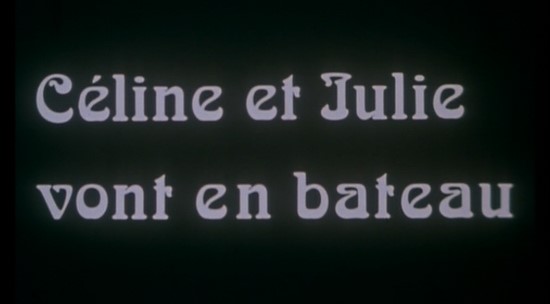
I still can't understand why Jacques Rivette's Céline et Julie Vont En Bateau is not available on region 1 DVD. I now find that it's been uploaded to YouTube, but without English subtitles. Still, it at least there to look at.

Céline et Julie is a hard film to describe, though the Wikipedia entry actually does a pretty good job of it. It's a "magical realism" movie combined with a cinéma vérité style and blown up to epic length. The silent opening scene has a gritty, real look to it, but it's also very long and deliberately confusing, and it's a direct reference to the opening of Alice in Wonderland with Céline following Julie the way Alice followed the rabbit.

Rivette also was the only person in the history of the world more obsessed with Artists and Models than I am, and he said that >Céline et Julie was partly inspired by that movie: you can see it in the personalities of the leads (similar to both the male and female leads of Models), in the idea that someone's crazy stories can become real and intrude into the "real" world, and in the dream-logic of starting with a somewhat normal story and getting more and more outlandish as the film goes on. It's a difficult movie and I'm not sure if I could take it in one 200-minute sitting, but it's worth checking out as an example of the way Rivette took the New Wave style to places that the better-known New Wave directors either couldn't or wouldn't go. (Godard may have kept on experimenting, but after a certain point he completely stopped caring about his characters as people. It was up to Rivette and a few others to make unusual, frustrating movies that were about human beings.)


Wednesday, February 11, 2009

Shorter Main Titles (No, This Isn't a "Shorter..." Post, It's Really About Making Things Shorter)

A while back I made, but never got around to doing anything with, some 20-to-30-second "condensed" versions for intros from older TV shows. The idea was to see if I could get as much of the gist of the original sequence as possible while keeping it under 30 seconds (since no show today, except on premium cable, is permitted to have an intro that's longer than 30 seconds).

All I discovered, really, is that a longer intro is usually more effective than a short one. And we already knew that. But the one that I thought worked pretty well was The Rockford Files: with just the answering-machine message followed by the last few notes of the theme song, it has the most important part of the intro intact and still has musical punctuation for the joke.


I also tried to come up with a short Laverne And Shirley that would keep the most important bits from the intro (the introduction, Lenny and Squiggy, the glove, the girls looking dreamy, the girls running off to work) while shortening the theme song and, in the modern fashion, putting the show title at the end.


I also tried to do a really short Mary Tyler Moore, shorter even than the shorter title sequence that they sometimes used on the actual show. This is just too short for it to make any sense, I think. I sometimes feel like a show would be better off having no title sequence rather than a 15-20 second one; it just feels like a buildup to something that never comes.


Other older shows, like Bob Newhart, actually alternate intros that ran 30 seconds or a little more, which they would use in episodes that ran long (so they could take time out of the main title instead of cutting the episode proper). And other shows actually did have very short intros, like The Dick Van Dyke Show.


Tuesday, February 10, 2009

Proof Of STEP BY STEP Sleaziness

I asserted in an earlier post that Step By Step was the sleaziest "family" show ever. (By "family" show I mean shows that qualify as "family entertainment," not necessarily shows about families; there are shows like Roseanne that are about families but aren't supposed to be kid-friendly.) What I remember about that show is that while nobody ever got laid except the parents, and it always came down on the side of purity and virtue, every episode was filled with leering, sex jokes, anatomy jokes and assorted creepiness (Sasha Mitchell constantly hitting on his step-cousin). I'm told that late-period TGIF entry The Hughleys, which I never saw, was sleazier, but in the "golden age" of TGIF, Step trounces its competition for greatest number of moments that the parents'-group watchdogs inexplicably missed.

I couldn't find the examples I remember most on YouTube, but here's one fairly representative example: the youngest girl (Christine Lakin, The Hottie and the Nottie) decides to become an actress, so her brother signs her up for a commercial where girls pose in bathing suits for a sleazy director. Then it turns out it's a commercial for a sex hotline. I guess there's a pro-social message in there somewhere about not signing up for things without reading the fine print.


Or this fantasy sequence, helpfully subtitled in Norwegian Danish. Credit where it's due, though: "Take me upstairs and ravish me in a way that's romantic, yet appropriate for children during a family viewing hour" is more meta than I would have expected from this show. (Though no TGIF show can compare to Boy Meets World for meta jokes: when the hero's sister reappeared -- as a different actress -- after being forgotten for over a year, she said that she'd been sent to her room for "the longest time-out ever.")


Update: This isn't worth a separate post (and I'd probably be hunted down if I did a third Step By Step post ), but I was sent this other Christine Lakin clip, which seems to sum up the weird kiddie-porn vibe that this show so frequently gave off:


Monday, February 09, 2009

Grudge Match: Souled Spike vs. Wuss-Boy Angel


This one is mostly for Buffy the Vampire Slayer viewers. In the first three seasons of Buffy, it was widely believed that no vampire could possibly be a bigger wuss than Angel. When he went over to his own show, free from the emasculating influence of Buffy, he became less of a wuss. However, after Spike got a soul, he became just as wussy as Angel had been (and he'd been trending that way even before the ensoulment; simply having a crush on Buffy turns any vampire into a pathetic wimp). He, too, became less of a doormat after he was shoehorned into Angel.

So the question is, who would win a fight between these two vampires who have souls but no cojones: Angel from the early seasons of Buffy, or the souled Spike from the final season of Buffy?

Spike from the earlier seasons, or Angel from his own show, do not count here; it's just these specific versions of the characters fighting. Who will be better able to escape the curse of loving a WB network (or UPN, if you count that as a network) heroine?

(The only person who ever managed to love Buffy and not lose all trace of self-respect? Xander from the first couple of seasons. Even as the show's resident doofus, he was still cooler than Angel.)


Friday, February 06, 2009

WKRP Episode: "The Union"

The third episode of season 4. Music: "Promises in the Dark" by Pat Benatar; "Start Me Up" by the Rolling Stones.

Update: As pointed out in comments, I left out the commentary with the original version of this post. This episode, written by Blake Hunter -- who wrote for the show for its entire run, was the resident continuity expert, and was the second-most important contributor after Hugh Wilson -- is part of what is essentially a season-long story arc, or at least story thread, about the station becoming more successful. "An Explosive Affair" already established that Andy has decided to turn the events of the third-season finale (where most of the advertisers cancel due to a boycott by the Moral Majority) to advantage by running fewer commercials, and making that a selling point.

In "The Union," we find that the station has risen to tenth place in the 18-station Cincinnati market, and the employees consider joining a union. The episode avoids coming down one way or another on unionization as an issue, and doesn't even answer the question of who voted for or against the union. It's necessary for the sake of the show that WKRP remain an old-fashioned "family" business, but the episode makes it pretty clear that there's some dubious morality involved in keeping it that way (the paternalism of Mr. Carlson congratulating himself on his "generosity" in giving employees the raises they deserve; Andy cutting deals behind his employees' backs). The episode also establishes a surprisingly strong part for Andy, who hadn't been doing a whole lot ever since the first season proved that he couldn't be the true lead of the show; in the fourth season there are several good episodes focusing on him, and he takes on the role of the guy trying to keep the station's personality intact, while also trying to get more money to run it. He's one of the characters who changed the most from the first season, and it would be really interesting to see where they would have gone with him if they'd gotten a fifth season.

Cold Open and act 1


Union Act 1
Uploaded by tvrarities. - Watch more comedy videos and sitcoms.

Act 2 and Tag


Union Act 2
Uploaded by tvrarities. - See more comedy videos.

Thursday, February 05, 2009

You Don't Get To Decide What You're Remembered For

Though I commend Time for making their old articles available for free, I sometimes have trouble finding articles that are a) really quotable and b) haven't been quoted from a thousand times before. So this 1959 article on Jerry Lieber and Mike Stoller had a quote that kind of stood out, both because I like it and, having Googled it, it only seems to have been quoted once before:


The youthful (both are 25) writing pals are now living in Manhattan brownstones on incomes of about $75,000 a year (cash), but to hear them tell it, they are laboring on a Jailhouse rock. "At least 60% of our stuff is rock 'n' roll," laments Leiber, "and we're sick of it. But consumers dictate the market: kids nine to 14 make up our market, and this is the stuff they want." In massive doses, this is just what the pair has been giving them: Love Me (2,000,000 copies sold), Loving You (2,000,000), Searching (1,250,000), Jailhouse Rock (2,000,000), King Creole (1,000,000).


Lieber and Stoller, like a lot of songwriters, thought that rock n' roll would be one fad among many, and that eventually they would write "grown-up" songs that would endure. I'm sure neither of them have any complaints about the way their careers turned out; it's just another reminder among many that the stuff people write when they're selling out sometimes turns out to be their most important work.

I also like Lieber's explanation that "The thing to remember is you're not writing a song but a record. What you gotta do is get these kids to identify." What they got that a lot of rock n' roll songwriter/producers didn't was that the song no longer existed as an independent thing, whose success could be measured by how many people bought the sheet music. (In his 1959 book "Lyrics On Several Occasions," Ira Gershwin keeps mentioning how many or how few copies a song sold, and he's talking about sheet music; for his kind of song, the records were almost a secondary thing.) What mattered most was the recording, and whether it had an appealing concept and story.


Aspect Ratio Random Weirdness

Since I was talking earlier about how most movies today use the 2.35:1 'Scope aspect ratio, I wanted to bring up the one and only thing worth mentioning in connection with Pink Panther 2 (apart from the obvious, that with his disappointing 30 Rock and SNL appearances and now this, Steve Martin has gone from a performer who makes things better to one who actually makes everything worse). Both Pink Panther 2 and Martin's first Pink Panther, from a different director, are shot in the "flat" 1.85:1 aspect ratio. The movie series it's based on, of course, was all shot in 'Scope and features some of the most 'Scope-dependent comedy in movie history. (The dentist scene in Pink Panther Strikes Again, for example: the punchline, "he's pulled the wrong tooth," gets its laugh from the fact that Dreyfus is in the foreground while Clouseau is in the background on the other side of the wide frame. I can't really explain why that makes it funny, but the scene isn't funny at all when panned and scanned.) So Martin and his Pink Panther team couldn't even get the shape of the screen right.


Monday, February 02, 2009

Anybody Remember "Willo the Wisp?"

I think every TV-viewer in North America has encountered English cartoons at one time or another, but different cartoons, at different times, on different channels. The place where I got most of my exposure to British TV cartoons was on TVOntario, which used to show a lot of 5- and 10-minute Brit-toons in between the Canadian shows. The ones I saw a lot were "Jamie and the Magic Torch" (a psychedelic, Sid and Marty Krofft-ish cartoon; I lost interest when I realized the hero's name was spelled differently than mine), and the semi-famous "Simon in the Land of Chalk Drawings." The stop motion show "(Most Surprising) Gran" also turned up sometimes. And of course they had the full half-hour cartoon "Dr. Snuggles," though that was a British-Dutch co-production.

My favorite show of this bunch was not British at all, but a U.K.-dubbed version of the French stop-motion show Colargol. The version I saw, and loved, was the second dubbed version, where he was named "Jeremy."

Of the U.K. cartoons, my favorite was Willo the Wisp, with Kenneth Williams doing all the voices and the late Nick Spargo writing and directing. I still like that one. British TV cartoons had their ups and downs, but at their best they had a trippy absurdity that U.S. kids' cartoons weren't allowed to have at the time, and they could even fit in a little bit of political and social commentary: "Evil Edna," the most popular and famous character, was both a parody of Margaret Thatcher and a warning of the dangers of letting TV control your life.

This is the episode I watched most often as a kid, and the Pong joke still works for me. Pong jokes usually do.


What Is the Most Horrific Rendition of "I'm So Excited" In '90s Television?

This isn't a Grudge Match (tm), though raising this question may provoke more violence than the average Grudge Match (tm). What is the most horrific Pointer Sisters rendition in the history of '90s television?

Was it Jessie, Kelly and Lisa on "Saved By the Bell?"

Or Suzanne Somers and the three Step By Step girls? (You think Ginger and Mary Ann arguments are something; have you ever listened in on '90s guys arguing over the relative merits of Danaburger, Karen and "Al?")


On the merits, the Step By Step quartet is probably worse than the SBTB trio, but on the other hand, the Step By Step rendition didn't drive anyone to drug addiction, whereas...


Final questions:

1. Was there ever a sleazier "family" show than Step By Step?

2. What is it about "I'm So Excited" that attracts such tragic TV renditions? Apart from, I suppose, being cheap to license.

Saturday, January 31, 2009

WKRP Episode: "Who's On First?"

This is episode # 6 of season 4, and it's a sequel of sorts to the previous episode (it starts with Herb in the hospital after the events of last week). This is the "mistaken identity" episode that every comedy is required by law to do at least once in its run.

I think this is also the last episode to feature the long-standing running gag that Jennifer can always see Johnny coming without turning around.

Cold Open and Act 1


Act 2 and tag


Thursday, January 29, 2009

"Out Come Pagliacci, Also Liberace"

Here's another song from Harold Arlen and Yip Harburg's score for Jamaica, this one involving not the late Ricardo Montalban but the show's top-billed star, Lena Horne. This was her show-stopping number (though her attempt to record it as a single was not a success, and I don't think I've ever even heard the single version). The lyric is Harburg's usual tweaking of American commercialism -- '50s-style, rather than the '40s-style commercialism satirized in Finian's Rainbow. And Arlen, as he often did, creates a long song with a complicated structure; no two sections of the refrain are really the same, and a section of the slow, dreamy verse becomes the energetic middle section of the refrain.

Because Horne wasn't really a theatre singer and had a relatively small-sized voice (great, but not big), she reportedly used amplification for her numbers; she also got her husband, arranger Lennie Hayton, to re-do the orchestrations for her songs so they were more congenial to her voice. The result was perfectly defensible, but reinforced the feeling that the show was more a pop showcase than a play.


Wednesday, January 28, 2009

Odd.


I'd heard, as had other people, that there were interviews done for the Tiny Toons DVDs that weren't used on the first set -- yet the back of the box doesn't list any special features. Either they're saving them for a future volume (if any), or Warners' legal department got a hold of them, or maybe the company just thinks that in tough economic times the smart thing to do is to spend money on video interviews and then not use them.

Oh, well, at least the second volume of Freakazoid! will have interviews (people interviewed for this volume included Rugg, McCann, Ruegger, announcer Joe Leahy and producer/director Rich Arons; hopefully they'll all turn up in the final edit). Never thought that F! would wind up getting the best DVD treatment, special-feature-wise, of any of the Spielberg cartoons, but I guess it's the cult flops that often get the most care taken with them in DVD releases. (I consider myself a part of that cult, of course.)

Friday, January 23, 2009

WKRP Episode: "Straight From The Heart"

In this episode (episode 5 of season 4), written by Dan Gunzelman (who also directed), Herb secretly goes to the hospital for heart tests, which leads to him and most of the rest of the cast watching a movie in a 3-D porn theatre. (This was from 1981, when 3-D was making a comeback in theatres.) The scene of the characters wearing 3-D glasses, and trying to dodge whatever's coming at them from the screen, is one of the scenes that people especially seem to remember from watching WKRP in syndication. The guy in the theatre is the late John Brent, yet another guy from The Committee.


Thursday, January 22, 2009

"Future Classics" That Turn Out To Be Classics


Just to do a less negative follow-up to my previous post: Because I can't predict what movies will become classics -- though it's easy enough to predict that certain kinds of movies will not (mostly inspirational historical movies or anything that has a family sitting around a dining-room table and shouting at each other a lot) -- I rarely have the experience of thinking that I've just seen a classic, and finding out that I agree with that evaluation a decade later.

Sometimes I'll think I've seen a masterpiece, and then decide, on revisiting it, that I was wrong. When I saw The Player in theatres, I thought I'd seen one of the best satires ever; now I don't think it holds up very well.

There is one movie that I thought of at the time, and still think of now, as a classic: Groundhog Day. I remember thinking the first time I saw it that this was going to be one of the all-time comedy classics. (I'm not claiming special powers of perception here, of course: it was widely considered a future classic from the moment it opened.) One other movie that I considered a classic then and there, and still consider one of the greatest light comedies, is Clueless -- but you could argue over whether that movie really has been canonized the way Groundhog Day has been.

The point is, and this is why watching old movies is no substitute for keeping up with current ones (I say this as someone who doesn't do enough to keep up with current movies, but should), is that sometimes you catch a movie that you think is great, and ten years later you see it again and find out you were right. That's a real thrill, finding out that something is as good as or better than you remembered it. And finding out that a movie is not as good as it seemed at the time -- well, that's interesting too.

What are some movies that you had pegged as "classics" when they were new, and that either did or didn't live up to that judgment over the years?

Oh Brother, Where Art Thou? Syndrome

Sorry for the absence of posts lately. This isn't exactly a full-fledged post either, but: after the Oscar nominations are announced, with their yearly celebration of what Hollywood insiders think of as a great movie, I always think of what might be called the Oh, Brother, Where Art Thou? rule. This is named not for the Coen Brothers movie but the serious social-problem movie Joel McCrea was trying to make in Sullivan's Travels. And the rule is basically this:

If a Hollywood movie is the dream project of a successful commercial filmmaker, writer or actor who wants to do something "smart," "provocative," or "meaningful," it's not a great movie and may not even be watchable.

Yes, that's glib and reductive, but it explains so much. It explains Crash. That movie is exactly what you'd expect to get if the creator of Walker, Texas Ranger got to make his dream project. But the problem isn't Paul Haggis; as we saw from the simple fact that it won Best Picture, a majority of Hollywood people really think that aspiration = achievement, that all you really need to do to make a great movie is to tackle important issues. (The late Manny Farber built his whole career as a critic on trying to teach people that this ain't so.) It's not like Preston Sturges invented the Joel McCrea character out of thin air.

Another reason why "dream" projects turn out so boring so much of the time is that the filmmakers spend so much time trying to get them made that they over-think them. I don't have the exact quote, but Frank Capra once said that the reason for his decline after It's a Wonderful Life (a movie that actually does hold up as having something important to say, but not a "big issue" type of movie) was that he started over-thinking things, that because directing involves making so many decisions so fast, the key to directing is the ability to make snap decisions and not worry too much over each one. "Prestige," "issue" or "dream" movies all imply that the filmmaker has been thinking way too much about what he wants to say with this film, which leads to boredom or, worse, Gandhi.

A related point I've been thinking of lately is that I tend to think that we won't know what the great movies of our time really are until ten, twenty, maybe even more years have passed. Who really knew in the '40s that the enduring classics included a bunch of low-budget crime dramas with dim lighting, or that It's a Wonderful Life (nominated, but lost) would be the most culturally significant movie of 1946? I don't know what the new classics are, but I doubt that most of them are Oscar winners or even nominees. I actually like that a lot. It's great to watch a movie gain near-classic status (who knew The Big Lebowski would be the Coen Brothers' most famous movie?) and watch another, big, prestigious picture fall off the face of the earth. It's like watching cultural history develop in front of us, instead of having it get written by the critics and award-givers of the time.

Monday, January 19, 2009

"I Never Felt Better" from ATHENA (1954)

I was glad to see this song, from the 1954 Joe Pasternak production Athena, finally get uploaded to YouTube. It's sung by Debbie Reynolds with a few interjections by Jane Powell, and it was written by the team of Hugh Martin and Ralph Blane, and while I don't love it quite as much as their "An Occasional Man," I think it's one of the best songs they wrote for MGM. They specialized in happy, peppy songs propelled by Martin's jazzy vocal arrangements, and this song -- in the time-honored "I have no money but I'm happy anyway" genre -- is so full of charm and wit and energy that it always cheers me up when I'm in a bad mood.

The movie it's from, Athena, is not very satisfying as a whole; Esther Williams came up with the idea for the story, about a woman raised by health/fitness nuts, but the studio took the idea and gave it to Jane Powell instead. It would have made more sense with Williams, and Edmund Purdom and Vic Damone are just about the deadliest team of leading men you can imagine. But it's still more fun than a lot of better-known MGM musicals, and it deserves a DVD release.


Friday, January 16, 2009

WKRP Episode: "Till Debt Do Us Part"

Not a strong episode, but the backstory is fairly interesting. The episode has Johnny meeting his first ex-wife (Ruth Silveira) and her obnoxious husband-to-be Buddy (Hamilton Camp). Howard Hesseman co-wrote the script with writer-producer Steven Kampmann (his last script before leaving the show, eventually turning up as Kirk on Newhart, and he wrote it for Silveira, one of his colleagues from The Committee, and his friend John Matuszak, the pro football player turned actor. In the book America's Favorite Radio Station Hesseman recalls that Matuszak bombed out at the table read and and had to be replaced; he and Hugh Wilson decided that the best person to take over the part on short notice was Hamilton Camp, a familiar TV face and another Committee guy.

But you can see how the original casting idea would have made this a less depressing episode. Buddy, the guy Johnny's ex-wife is going to marry, was intended to be a big, strong, athletic, good-looking guy whose bad qualities aren't instantly clear (and Paula, the ex-wife, was to bring him around to show off his apparent superiority to Johnny). With Hamilton Camp in the part, the guy has no redeeming qualities, and Paula becomes a pathetic character. Also, Ruth Silveira demonstrates why she's not one of the better-known Committee alumni; she doesn't do that well. With the miscasting, the downbeat story and the downbeat tone of the last part of the third season, this is probably the most depressing episode of the whole series, and there's something a little "off" about a lot of it.

Les has some good lines, though; I think it was Kampmann who got the idea to write him as a total psycopath who semi-deliberately messes with Johnny's mind (here and in "Frog Story" and a few other episodes). There's also one line, "I make money, you make money and no one knows the difference," that's lifted from the SCTV Cisco Kid redub that Kampmann and Peter Torokvei made with Martin Short.

The music in the opening scene is "Book of Love" by the Monotones; I've forgotten what song is playing in the closing scene.


Thursday, January 15, 2009

I'm Holding Norm Abram Above My Head!

The second and final season of Freakazoid! will finally get a DVD release on April 21, on the same day as the second half of Tiny Toons season 1. (Let's hope the rest of Tiny Toons doesn't meet the same fate as the rest of Animaniacs; as I've said many times, my favorite episodes of Tiny Toons are from the later seasons on Fox.) That means we'll finally get to have a DVD version of scenes like this:


The late Ricardo Montalban was a guest star on both seasons of Freakazoid! as the Khan-like villain Guitierrez. Paul Rugg, writer and voice of Freakazoid, shares his memories of how Montalban got cast and how much fun he was to work with. Read the whole thing, but here's an excerpt, followed by the "bloopers" scene he describes.


Perhaps my fondest memory was when he had to come and do addition dialogue for the episode HERO BOY. For reasons we couldn't figure out...the episode came up about 3 minutes short. So, John and I devised a solution in which Guitierrez would show Freakazoid his favorite bloopers. Our editor found some of the dumbest, old, live action black&white footage I've ever seen. We cut it together and I wrote some dialogue to cover the footage. When Ricardo arrived he had neither seen the footage nor his dialogue. I explained the setup to him. "Guitierrez is crazy about these bloopers and he really thinks they are funny and he really wants to show them to Freakazoid and..."

"Ahhh, yes. I see. I see. Yes. Let's do it." Ricardo and I went into the booth. We ran the footage and he made me laugh so much that I didn't do my lines. The sound guys were rolling. Andrea was in hysterics. Bruce Timm popped his head into the room and started laughing.


Wednesday, January 14, 2009

Ricardo Montalban Sings "The Monkey In the Mango Tree"


This is eerie. I sat down intending to post a song from the musical Jamaica, "The Monkey In the Mango Tree," sung by Ricardo Montalban -- and then I see that Ricardo Montalban died today at the age of 88. Of course the eeriness isn't what's important; what matters is that he was an excellent actor and personality who was always a pleasure to see, regardless of the project. He gave a lot of good performances at MGM despite the limited range of roles available to him (he got more diverse roles in television, where he was able to play parts like Khan that weren't specifically ethnic). He just kept on giving entertaining performances, year after year, decade after decade, onscreen and in voice-over almost literally right up until the end of his long life.

He got a Tony nomination for Jamaica, one of the most obscure hit musicals ever: it ran over 500 performances back when that was still a highly successful, profit-making run, but the version that came onto Broadway (after much rewriting and recasting) basically had no script left, and ran on the strength of Lena Horne, Montalban, and the sets and songs and choreography. There's been no revival of it because there's nothing left to revive, but the Harold Arlen/Yip Harburg score produced one of my very favorite cast albums. Arlen and Harburg weren't exactly at their best -- Horne expressed disappointment that none of the songs became classics -- but I can't resist the mixture of calypso-flavored tunes and satirical lyrics by two of the all-time great songwriters.

In this song, the most calypso-influenced and satirical in the whole show, Montalban is given a song and a role that was intended for Harry Belafonte. (When he didn't do the show but Lena Horne was available, the whole thing was rewritten around the character of the hero's girlfriend; that's why it was such a mess.) He manages to do well with it, as he always did with whatever he was given.


Saturday, January 10, 2009

The Good Old Days of Massive Cartoon Cuts

One thing about Warner Brothers cartoon packages on Teletoon Retro is that they provide kind of a historical overview of how cartoons have been cut up at different times. Warners' Canadian distributor doesn't like sending out uncut, complete cartoons if there's a "Bugs Bunny and Tweety Show" or "Road Runner Show" tape available, but at least that provides a chance to see what was considered offensive at different times.

For example: in the "Merrie Melodies" package from the '90s (being run alternately with the "Merrie Melodies Show" from the '70s), all gun gags are cut out by means of freeze-framing, so in "Hillbilly Hare" or "Duck! Rabbit, Duck!" they just freeze-frame on Bugs while the shots occur offscreen. But that same package from the '90s included "Caveman Inki," because the Inki cartoons were not yet considered taboo for TV viewing. But Warners left "Caveman Inki" out of the package of "Porky Pig Show" cartoons they prepared for Teletoon (the only package of uncut cartoons, and that only because the '60s "Porky Pig Show" tapes don't exist any more), because they substituted black-and-white cartoons for any color cartoons that they had marked as potentially offensive.

And, of course, the "Bugs Bunny and Tweety Show" is like a primer on what networks considered to be unacceptable. For comparison purposes, here's "Big House Bunny" complete:


And here's a version that (I think) used to run on network TV, where fully one-third of the cartoon is cut, eliminating all the execution gags.


Thursday, January 08, 2009

Duck-Cuts


I mentioned elsewhere that Paramount's DVD release of Duckman seasons 3 and 4 contains more music cuts than the first set. Here are the ones I've been able to find so far. It's a short list, but an annoying one, especially since it affects several of my favorite episodes. If I find more examples while going through the set, I'll add them here.

- In "Aged Heat 2: Women In Heat" (Duckman goes to a women's prison, which somehow winds up as a parody of Ann-Margret movies), a scene that was originally accompanied by "Powerhouse" now just uses generic music.

- In "Ebony Baby" (a great blaxploitation parody), a song by Montell Jordan has been replaced, and Jordan's guest appearance has been cut.

- In "Role With It," the DVD cuts a scene of Fluffy and Uranus singing "Abba Dabba Honeymoon."

- In "Where No Duckman Has Gone Before," the scene of Duckman singing "Mr. Tambourine Man" is cut.

- The episode with Fluffy and Uranus turning into monsters runs short; probably one of the songs sung by guest star Jim Bailey has been edited out.

I can't regret buying the set, because there are too many good episodes I hadn't seen in years, and many of them are complete (the season 4 episodes seem to have been hit harder in terms of music cuts, or episodes that mysteriously run a few seconds short, than the season 3 ones). I appreciated the chance to see the Russian Literature episode again and find it was just as funny as I remembered. Duckman in these episodes had more silliness and less social satire, which suits me fine. Maybe by the final batch of episodes, with the increasingly cartoony plots and the network-mandated addition of a new, nicer character (Beverly, the previously-unknown but nice twin sister), it had gotten too soft; one episode, a Red River parody with catfish instead of cattle -- really -- is just too much like a Saturday morning cartoon (it was written by Jed Spingarn of Pinky and the Brain, but his P&B scripts were quite a bit edgier). But generally, the episodes on these discs are the funniest of the series. They're also more pleasant to look at, within the limits of the design style, than the early ones.

But CBS/Paramount has absolutely no method, no understandable pattern, to which songs it will pay for and which ones it won't, which bits it will leave in and which it will cut. (Sometimes, as with Happy Days, they'll cut a song in one season and pay for the very same song in the next season.) They're not actually the worst studio in terms of music replacement, since they will sometimes pay for an expensive song -- but they're the most ruthless and generally weird in terms of cutting random music-related scenes from their episodes.

Interestingly, Duckman sort of anticipated this in advance, because one of the episodes in this set (not, ironically, one of the ones that got cut) began with this caption:


The following program has been altered from its original format.

If you have any idea who altered it, please let us know.

We're really mad.


Oh, well, at least this scene from Ebony, Baby is still uncensored. So to speak.


Tuesday, January 06, 2009

The Budd Boetticher/Randolph Scott/Burt Kennedy Drinking Game


The other night I watched Comanche Station, the last of the Boetticher/Scott movies and one of the best even though (or perhaps because) it recycles a key scene from their first movie together, Seven Men From Now. The scene where Claude Akins tells an insinuating story about Scott and The Married Woman is nowhere near as good as the same scene with Lee Marvin in Seven Men, but somehow the very act of looking for parallels and differences between the two scenes is interesting in itself. That's part of what makes these movies a true cycle, instead of just a bunch of movies with similar plots; part of the interest is in seeing variations on the themes introduced in earlier movies. The ending of Comanche Station only attains its full impact as a surprise ending if you've seen Seven Men From Now and The Tall T and become used to the way The Married Woman's Husband was characterized in those movies.

But obviously, since these movies have so much in common, they also lend themselves to drinking games, and I'm surprised no movie buff has tried to come up with one. Most obviously, any time Randolph Scott or some other character answers someone else's statement with a two-word question, you need to take a shot. Burt Kennedy, the writer of most of these films (and later a director of some pretty good Westerns and Western comedies, though he was a better writer than director), obviously loved that kind of dialogue and peppers every one of his scripts with bits like:


CLAUDE AKINS: Killin' Indians was what we was there for, wasn't it?
RANDOLPH SCOTT: Was it?

RICHARD RUST: But we ain't got a long gun, Ben.
CLAUDE AKINS: Ain't we?

RICHARD BOONE (The Tall T): Sometimes you don't have a choice.
RANDOLPH SCOTT: Don't you?

ROSCO P. COLTRANE (in Ride Lonesome): You're bluffin'.
RANDOLPH SCOTT: Am I?

GUY IN SEVEN MEN FROM NOW: Well, then, we agree.
RANDOLPH SCOTT: Do we?


Other drinkable moments include every time the following happens:

- The bad guy makes a disparaging remark about the courage or manliness of The Woman's husband.

- Scott has the drop on the bad guy, who stands with his back to Scott and mentions that he saved Scott's life earlier in the film.

- Bad guy says something flowery and semi-poetic about The Woman's looks.

- Someone tells the story of how Scott had a tragic past involving his dead wife.

- Scott stops at a remote outpost (station, shack, whatever) early in the film.

- The movie introduces two young bad-guy henchmen, one more worldly-wise, the other gentler or dumber.

- Scott has a conversation with the head bad guy that ends with the bad guy saying something threatening, but with a smile ("I'd hate to have you try," Lee Marvin in Seven Men; "Like me in particular," Akins, Comanche Station)

- Scott says "There are some things a man can't ride around."

There are others, but that's a start. Further suggestions welcome in comments. And yes, most of these things happen in other Westerns, including others Kennedy wrote, but because the Boetticher movies are so ritualized, the repetition stands out, like the leitmotifs in Wagner's Ring (though I'd rather watch the complete cycle of Boetticher/Scott movies than the complete Ring).

Sunday, January 04, 2009

The First Accusations of Surrealism

I was thinking about Green Acres the other day, mostly to be P.O.'d that the last three seasons seem to be stuck in DVD limbo, and I got to wondering who was the first person to advance the idea that the show was "surrealistic." It didn't seem to be very common when the show was on the air -- though I get the impression that it was considered a cut above the usual rural show, and Jay Sommers, the creator, said at the time that he considered it "a fairly sophisticated show" -- but it was only after it went into syndication that critics and fans started comparing it to surrealism and theatre of the absurd and so forth. The comparison is valid, even a lot of it is only surrealistic by comparison with other TV comedy of the time; fans of radio comedy were less surprised by it. (Most episodes of Green Acres used the old "Fibber McGee and Molly" structure where each supporting character drops by to give his point of view on the problem of the week.)

But then I found that the first person to call Green Acres "surrealistic" was probably Eddie Albert himself, in a New York Times article from near the end of the show's first season. The article, by Judy Stone, ran on April 10, 1966, and featured interviews with the two stars of the series. At one point, Albert uses the s-word to describe the show and its writing -- and then, even better, realizes that he shouldn't be over-analyzing a show that is meant only to entertain. So in one fell swoop he anticipates the show's cult following and lectures people who (and I sometimes do this) use fancy words and critical terms to justify watching the show. Eddie Albert rocked.


A great deal of revision takes place on most TV shows, Albert said, but this isn't true of "Green Acres," written and produced by Jay Sommers. The show ranked tenth in the latest Nielsen rating. "Everything Jay writes is beautifully done. A lot of people think the script is corny because it's laid in a rural community, but some of it is wonderfully surrealistic stuff. I'm in an apple orchard, wondering if the apples will keep falling and I look at one and it's an orange. I consider that very funny. Part of the show's great value is its irrelevance."

Albert suddenly looked very irritated. "This whole talk about surrealism -- in a way I'm just answering the critics about whom I don't give a damn. I'm wasting my time because I don't care what they think. I absolutely love the fact that the kids come up to me -- as thousands did at the Thanksgiving Day parade in Philadelphia -- and ask about Elinor, the cow. They love the show. If you want to say there is more to life than this, that's a philosophical question.


Speaking of Green Acres, I've also realized that this is one of those shows where the character you identify with can change over time. I used to identify more with Oliver, the one person on the whole show who tries to hang on to the rules of real-world logic. But now I think I identify more with Lisa, because in reality, she's more logical and sensible than her husband: she accepts the ways of Hooterville and just tries to enjoy herself wherever she happens to be, while Oliver simply can't let go of his idiotic fantasy about what rural life should be like. I think I'd rather be a "Lisa" person, trying to make the best of any situation, than an "Oliver" person, trying to force the world to be something it isn't. (However, I have the opposite reaction to Moonlighting, where I completely sympathize with Maddie and consider David an asshole. And I also have a certain sympathy for the early Hot Lips on M*A*S*H, but let's not even get into that.)

Thursday, January 01, 2009

Lucy Has a Point

No matter what year the strip is from (why doesn't the Peanuts website print the dates of the comics? I guess this is 1961), you can depend on Lucy Van Pelt to make a good point about the New Year.