This one is mostly for Buffy the Vampire Slayer viewers. In the first three seasons of Buffy, it was widely believed that no vampire could possibly be a bigger wuss than Angel. When he went over to his own show, free from the emasculating influence of Buffy, he became less of a wuss. However, after Spike got a soul, he became just as wussy as Angel had been (and he'd been trending that way even before the ensoulment; simply having a crush on Buffy turns any vampire into a pathetic wimp). He, too, became less of a doormat after he was shoehorned into Angel.
So the question is, who would win a fight between these two vampires who have souls but no cojones: Angel from the early seasons of Buffy, or the souled Spike from the final season of Buffy?
Spike from the earlier seasons, or Angel from his own show, do not count here; it's just these specific versions of the characters fighting. Who will be better able to escape the curse of loving a WB network (or UPN, if you count that as a network) heroine?
(The only person who ever managed to love Buffy and not lose all trace of self-respect? Xander from the first couple of seasons. Even as the show's resident doofus, he was still cooler than Angel.)
The third episode of season 4. Music: "Promises in the Dark" by Pat Benatar; "Start Me Up" by the Rolling Stones.
Update: As pointed out in comments, I left out the commentary with the original version of this post. This episode, written by Blake Hunter -- who wrote for the show for its entire run, was the resident continuity expert, and was the second-most important contributor after Hugh Wilson -- is part of what is essentially a season-long story arc, or at least story thread, about the station becoming more successful. "An Explosive Affair" already established that Andy has decided to turn the events of the third-season finale (where most of the advertisers cancel due to a boycott by the Moral Majority) to advantage by running fewer commercials, and making that a selling point.
In "The Union," we find that the station has risen to tenth place in the 18-station Cincinnati market, and the employees consider joining a union. The episode avoids coming down one way or another on unionization as an issue, and doesn't even answer the question of who voted for or against the union. It's necessary for the sake of the show that WKRP remain an old-fashioned "family" business, but the episode makes it pretty clear that there's some dubious morality involved in keeping it that way (the paternalism of Mr. Carlson congratulating himself on his "generosity" in giving employees the raises they deserve; Andy cutting deals behind his employees' backs). The episode also establishes a surprisingly strong part for Andy, who hadn't been doing a whole lot ever since the first season proved that he couldn't be the true lead of the show; in the fourth season there are several good episodes focusing on him, and he takes on the role of the guy trying to keep the station's personality intact, while also trying to get more money to run it. He's one of the characters who changed the most from the first season, and it would be really interesting to see where they would have gone with him if they'd gotten a fifth season.
Though I commend Time for making their old articles available for free, I sometimes have trouble finding articles that are a) really quotable and b) haven't been quoted from a thousand times before. So this 1959 article on Jerry Lieber and Mike Stoller had a quote that kind of stood out, both because I like it and, having Googled it, it only seems to have been quoted once before:
The youthful (both are 25) writing pals are now living in Manhattan brownstones on incomes of about $75,000 a year (cash), but to hear them tell it, they are laboring on a Jailhouse rock. "At least 60% of our stuff is rock 'n' roll," laments Leiber, "and we're sick of it. But consumers dictate the market: kids nine to 14 make up our market, and this is the stuff they want." In massive doses, this is just what the pair has been giving them: Love Me (2,000,000 copies sold), Loving You (2,000,000), Searching (1,250,000), Jailhouse Rock (2,000,000), King Creole (1,000,000).
Lieber and Stoller, like a lot of songwriters, thought that rock n' roll would be one fad among many, and that eventually they would write "grown-up" songs that would endure. I'm sure neither of them have any complaints about the way their careers turned out; it's just another reminder among many that the stuff people write when they're selling out sometimes turns out to be their most important work.
I also like Lieber's explanation that "The thing to remember is you're not writing a song but a record. What you gotta do is get these kids to identify." What they got that a lot of rock n' roll songwriter/producers didn't was that the song no longer existed as an independent thing, whose success could be measured by how many people bought the sheet music. (In his 1959 book "Lyrics On Several Occasions," Ira Gershwin keeps mentioning how many or how few copies a song sold, and he's talking about sheet music; for his kind of song, the records were almost a secondary thing.) What mattered most was the recording, and whether it had an appealing concept and story.
Since I was talking earlier about how most movies today use the 2.35:1 'Scope aspect ratio, I wanted to bring up the one and only thing worth mentioning in connection with Pink Panther 2 (apart from the obvious, that with his disappointing 30 Rock and SNL appearances and now this, Steve Martin has gone from a performer who makes things better to one who actually makes everything worse). Both Pink Panther 2 and Martin's first Pink Panther, from a different director, are shot in the "flat" 1.85:1 aspect ratio. The movie series it's based on, of course, was all shot in 'Scope and features some of the most 'Scope-dependent comedy in movie history. (The dentist scene in Pink Panther Strikes Again, for example: the punchline, "he's pulled the wrong tooth," gets its laugh from the fact that Dreyfus is in the foreground while Clouseau is in the background on the other side of the wide frame. I can't really explain why that makes it funny, but the scene isn't funny at all when panned and scanned.) So Martin and his Pink Panther team couldn't even get the shape of the screen right.
I think every TV-viewer in North America has encountered English cartoons at one time or another, but different cartoons, at different times, on different channels. The place where I got most of my exposure to British TV cartoons was on TVOntario, which used to show a lot of 5- and 10-minute Brit-toons in between the Canadian shows. The ones I saw a lot were "Jamie and the Magic Torch" (a psychedelic, Sid and Marty Krofft-ish cartoon; I lost interest when I realized the hero's name was spelled differently than mine), and the semi-famous "Simon in the Land of Chalk Drawings." The stop motion show "(Most Surprising) Gran" also turned up sometimes. And of course they had the full half-hour cartoon "Dr. Snuggles," though that was a British-Dutch co-production.
My favorite show of this bunch was not British at all, but a U.K.-dubbed version of the French stop-motion show Colargol. The version I saw, and loved, was the second dubbed version, where he was named "Jeremy."
Of the U.K. cartoons, my favorite was Willo the Wisp, with Kenneth Williams doing all the voices and the late Nick Spargo writing and directing. I still like that one. British TV cartoons had their ups and downs, but at their best they had a trippy absurdity that U.S. kids' cartoons weren't allowed to have at the time, and they could even fit in a little bit of political and social commentary: "Evil Edna," the most popular and famous character, was both a parody of Margaret Thatcher and a warning of the dangers of letting TV control your life.
This is the episode I watched most often as a kid, and the Pong joke still works for me. Pong jokes usually do.
This isn't a Grudge Match (tm), though raising this question may provoke more violence than the average Grudge Match (tm). What is the most horrific Pointer Sisters rendition in the history of '90s television?
Or Suzanne Somers and the three Step By Step girls? (You think Ginger and Mary Ann arguments are something; have you ever listened in on '90s guys arguing over the relative merits of Danaburger, Karen and "Al?")
On the merits, the Step By Step quartet is probably worse than the SBTB trio, but on the other hand, the Step By Step rendition didn't drive anyone to drug addiction, whereas...
Final questions:
1. Was there ever a sleazier "family" show than Step By Step?
2. What is it about "I'm So Excited" that attracts such tragic TV renditions? Apart from, I suppose, being cheap to license.
This is episode # 6 of season 4, and it's a sequel of sorts to the previous episode (it starts with Herb in the hospital after the events of last week). This is the "mistaken identity" episode that every comedy is required by law to do at least once in its run.
I think this is also the last episode to feature the long-standing running gag that Jennifer can always see Johnny coming without turning around.
Here's another song from Harold Arlen and Yip Harburg's score for Jamaica, this one involving not the late Ricardo Montalban but the show's top-billed star, Lena Horne. This was her show-stopping number (though her attempt to record it as a single was not a success, and I don't think I've ever even heard the single version). The lyric is Harburg's usual tweaking of American commercialism -- '50s-style, rather than the '40s-style commercialism satirized in Finian's Rainbow. And Arlen, as he often did, creates a long song with a complicated structure; no two sections of the refrain are really the same, and a section of the slow, dreamy verse becomes the energetic middle section of the refrain.
Because Horne wasn't really a theatre singer and had a relatively small-sized voice (great, but not big), she reportedly used amplification for her numbers; she also got her husband, arranger Lennie Hayton, to re-do the orchestrations for her songs so they were more congenial to her voice. The result was perfectly defensible, but reinforced the feeling that the show was more a pop showcase than a play.
I'd heard, as had other people, that there were interviews done for the Tiny Toons DVDs that weren't used on the first set -- yet the back of the box doesn't list any special features. Either they're saving them for a future volume (if any), or Warners' legal department got a hold of them, or maybe the company just thinks that in tough economic times the smart thing to do is to spend money on video interviews and then not use them.
Oh, well, at least the second volume of Freakazoid! will have interviews (people interviewed for this volume included Rugg, McCann, Ruegger, announcer Joe Leahy and producer/director Rich Arons; hopefully they'll all turn up in the final edit). Never thought that F! would wind up getting the best DVD treatment, special-feature-wise, of any of the Spielberg cartoons, but I guess it's the cult flops that often get the most care taken with them in DVD releases. (I consider myself a part of that cult, of course.)
In this episode (episode 5 of season 4), written by Dan Gunzelman (who also directed), Herb secretly goes to the hospital for heart tests, which leads to him and most of the rest of the cast watching a movie in a 3-D porn theatre. (This was from 1981, when 3-D was making a comeback in theatres.) The scene of the characters wearing 3-D glasses, and trying to dodge whatever's coming at them from the screen, is one of the scenes that people especially seem to remember from watching WKRP in syndication. The guy in the theatre is the late John Brent, yet another guy from The Committee.
Just to do a less negative follow-up to my previous post: Because I can't predict what movies will become classics -- though it's easy enough to predict that certain kinds of movies will not (mostly inspirational historical movies or anything that has a family sitting around a dining-room table and shouting at each other a lot) -- I rarely have the experience of thinking that I've just seen a classic, and finding out that I agree with that evaluation a decade later.
Sometimes I'll think I've seen a masterpiece, and then decide, on revisiting it, that I was wrong. When I saw The Player in theatres, I thought I'd seen one of the best satires ever; now I don't think it holds up very well.
There is one movie that I thought of at the time, and still think of now, as a classic: Groundhog Day. I remember thinking the first time I saw it that this was going to be one of the all-time comedy classics. (I'm not claiming special powers of perception here, of course: it was widely considered a future classic from the moment it opened.) One other movie that I considered a classic then and there, and still consider one of the greatest light comedies, is Clueless -- but you could argue over whether that movie really has been canonized the way Groundhog Day has been.
The point is, and this is why watching old movies is no substitute for keeping up with current ones (I say this as someone who doesn't do enough to keep up with current movies, but should), is that sometimes you catch a movie that you think is great, and ten years later you see it again and find out you were right. That's a real thrill, finding out that something is as good as or better than you remembered it. And finding out that a movie is not as good as it seemed at the time -- well, that's interesting too.
What are some movies that you had pegged as "classics" when they were new, and that either did or didn't live up to that judgment over the years?
Sorry for the absence of posts lately. This isn't exactly a full-fledged post either, but: after the Oscar nominations are announced, with their yearly celebration of what Hollywood insiders think of as a great movie, I always think of what might be called the Oh, Brother, Where Art Thou? rule. This is named not for the Coen Brothers movie but the serious social-problem movie Joel McCrea was trying to make in Sullivan's Travels. And the rule is basically this:
If a Hollywood movie is the dream project of a successful commercial filmmaker, writer or actor who wants to do something "smart," "provocative," or "meaningful," it's not a great movie and may not even be watchable.
Yes, that's glib and reductive, but it explains so much. It explains Crash. That movie is exactly what you'd expect to get if the creator of Walker, Texas Ranger got to make his dream project. But the problem isn't Paul Haggis; as we saw from the simple fact that it won Best Picture, a majority of Hollywood people really think that aspiration = achievement, that all you really need to do to make a great movie is to tackle important issues. (The late Manny Farber built his whole career as a critic on trying to teach people that this ain't so.) It's not like Preston Sturges invented the Joel McCrea character out of thin air.
Another reason why "dream" projects turn out so boring so much of the time is that the filmmakers spend so much time trying to get them made that they over-think them. I don't have the exact quote, but Frank Capra once said that the reason for his decline after It's a Wonderful Life (a movie that actually does hold up as having something important to say, but not a "big issue" type of movie) was that he started over-thinking things, that because directing involves making so many decisions so fast, the key to directing is the ability to make snap decisions and not worry too much over each one. "Prestige," "issue" or "dream" movies all imply that the filmmaker has been thinking way too much about what he wants to say with this film, which leads to boredom or, worse, Gandhi.
A related point I've been thinking of lately is that I tend to think that we won't know what the great movies of our time really are until ten, twenty, maybe even more years have passed. Who really knew in the '40s that the enduring classics included a bunch of low-budget crime dramas with dim lighting, or that It's a Wonderful Life (nominated, but lost) would be the most culturally significant movie of 1946? I don't know what the new classics are, but I doubt that most of them are Oscar winners or even nominees. I actually like that a lot. It's great to watch a movie gain near-classic status (who knew The Big Lebowski would be the Coen Brothers' most famous movie?) and watch another, big, prestigious picture fall off the face of the earth. It's like watching cultural history develop in front of us, instead of having it get written by the critics and award-givers of the time.
I was glad to see this song, from the 1954 Joe Pasternak production Athena, finally get uploaded to YouTube. It's sung by Debbie Reynolds with a few interjections by Jane Powell, and it was written by the team of Hugh Martin and Ralph Blane, and while I don't love it quite as much as their "An Occasional Man," I think it's one of the best songs they wrote for MGM. They specialized in happy, peppy songs propelled by Martin's jazzy vocal arrangements, and this song -- in the time-honored "I have no money but I'm happy anyway" genre -- is so full of charm and wit and energy that it always cheers me up when I'm in a bad mood.
The movie it's from, Athena, is not very satisfying as a whole; Esther Williams came up with the idea for the story, about a woman raised by health/fitness nuts, but the studio took the idea and gave it to Jane Powell instead. It would have made more sense with Williams, and Edmund Purdom and Vic Damone are just about the deadliest team of leading men you can imagine. But it's still more fun than a lot of better-known MGM musicals, and it deserves a DVD release.
Not a strong episode, but the backstory is fairly interesting. The episode has Johnny meeting his first ex-wife (Ruth Silveira) and her obnoxious husband-to-be Buddy (Hamilton Camp). Howard Hesseman co-wrote the script with writer-producer Steven Kampmann (his last script before leaving the show, eventually turning up as Kirk on Newhart, and he wrote it for Silveira, one of his colleagues from The Committee, and his friend John Matuszak, the pro football player turned actor. In the book America's Favorite Radio Station Hesseman recalls that Matuszak bombed out at the table read and and had to be replaced; he and Hugh Wilson decided that the best person to take over the part on short notice was Hamilton Camp, a familiar TV face and another Committee guy.
But you can see how the original casting idea would have made this a less depressing episode. Buddy, the guy Johnny's ex-wife is going to marry, was intended to be a big, strong, athletic, good-looking guy whose bad qualities aren't instantly clear (and Paula, the ex-wife, was to bring him around to show off his apparent superiority to Johnny). With Hamilton Camp in the part, the guy has no redeeming qualities, and Paula becomes a pathetic character. Also, Ruth Silveira demonstrates why she's not one of the better-known Committee alumni; she doesn't do that well. With the miscasting, the downbeat story and the downbeat tone of the last part of the third season, this is probably the most depressing episode of the whole series, and there's something a little "off" about a lot of it.
Les has some good lines, though; I think it was Kampmann who got the idea to write him as a total psycopath who semi-deliberately messes with Johnny's mind (here and in "Frog Story" and a few other episodes). There's also one line, "I make money, you make money and no one knows the difference," that's lifted from the SCTV Cisco Kid redub that Kampmann and Peter Torokvei made with Martin Short.
The music in the opening scene is "Book of Love" by the Monotones; I've forgotten what song is playing in the closing scene.
The second and final season of Freakazoid!will finally get a DVD release on April 21, on the same day as the second half of Tiny Toons season 1. (Let's hope the rest of Tiny Toons doesn't meet the same fate as the rest of Animaniacs; as I've said many times, my favorite episodes of Tiny Toons are from the later seasons on Fox.) That means we'll finally get to have a DVD version of scenes like this:
Perhaps my fondest memory was when he had to come and do addition dialogue for the episode HERO BOY. For reasons we couldn't figure out...the episode came up about 3 minutes short. So, John and I devised a solution in which Guitierrez would show Freakazoid his favorite bloopers. Our editor found some of the dumbest, old, live action black&white footage I've ever seen. We cut it together and I wrote some dialogue to cover the footage. When Ricardo arrived he had neither seen the footage nor his dialogue. I explained the setup to him. "Guitierrez is crazy about these bloopers and he really thinks they are funny and he really wants to show them to Freakazoid and..."
"Ahhh, yes. I see. I see. Yes. Let's do it." Ricardo and I went into the booth. We ran the footage and he made me laugh so much that I didn't do my lines. The sound guys were rolling. Andrea was in hysterics. Bruce Timm popped his head into the room and started laughing.
This is eerie. I sat down intending to post a song from the musical Jamaica, "The Monkey In the Mango Tree," sung by Ricardo Montalban -- and then I see that Ricardo Montalban died today at the age of 88. Of course the eeriness isn't what's important; what matters is that he was an excellent actor and personality who was always a pleasure to see, regardless of the project. He gave a lot of good performances at MGM despite the limited range of roles available to him (he got more diverse roles in television, where he was able to play parts like Khan that weren't specifically ethnic). He just kept on giving entertaining performances, year after year, decade after decade, onscreen and in voice-over almost literally right up until the end of his long life.
He got a Tony nomination for Jamaica, one of the most obscure hit musicals ever: it ran over 500 performances back when that was still a highly successful, profit-making run, but the version that came onto Broadway (after much rewriting and recasting) basically had no script left, and ran on the strength of Lena Horne, Montalban, and the sets and songs and choreography. There's been no revival of it because there's nothing left to revive, but the Harold Arlen/Yip Harburg score produced one of my very favorite cast albums. Arlen and Harburg weren't exactly at their best -- Horne expressed disappointment that none of the songs became classics -- but I can't resist the mixture of calypso-flavored tunes and satirical lyrics by two of the all-time great songwriters.
In this song, the most calypso-influenced and satirical in the whole show, Montalban is given a song and a role that was intended for Harry Belafonte. (When he didn't do the show but Lena Horne was available, the whole thing was rewritten around the character of the hero's girlfriend; that's why it was such a mess.) He manages to do well with it, as he always did with whatever he was given.
One thing about Warner Brothers cartoon packages on Teletoon Retro is that they provide kind of a historical overview of how cartoons have been cut up at different times. Warners' Canadian distributor doesn't like sending out uncut, complete cartoons if there's a "Bugs Bunny and Tweety Show" or "Road Runner Show" tape available, but at least that provides a chance to see what was considered offensive at different times.
For example: in the "Merrie Melodies" package from the '90s (being run alternately with the "Merrie Melodies Show" from the '70s), all gun gags are cut out by means of freeze-framing, so in "Hillbilly Hare" or "Duck! Rabbit, Duck!" they just freeze-frame on Bugs while the shots occur offscreen. But that same package from the '90s included "Caveman Inki," because the Inki cartoons were not yet considered taboo for TV viewing. But Warners left "Caveman Inki" out of the package of "Porky Pig Show" cartoons they prepared for Teletoon (the only package of uncut cartoons, and that only because the '60s "Porky Pig Show" tapes don't exist any more), because they substituted black-and-white cartoons for any color cartoons that they had marked as potentially offensive.
And, of course, the "Bugs Bunny and Tweety Show" is like a primer on what networks considered to be unacceptable. For comparison purposes, here's "Big House Bunny" complete:
And here's a version that (I think) used to run on network TV, where fully one-third of the cartoon is cut, eliminating all the execution gags.
I mentioned elsewhere that Paramount's DVD release of Duckman seasons 3 and 4 contains more music cuts than the first set. Here are the ones I've been able to find so far. It's a short list, but an annoying one, especially since it affects several of my favorite episodes. If I find more examples while going through the set, I'll add them here.
- In "Aged Heat 2: Women In Heat" (Duckman goes to a women's prison, which somehow winds up as a parody of Ann-Margret movies), a scene that was originally accompanied by "Powerhouse" now just uses generic music.
- In "Ebony Baby" (a great blaxploitation parody), a song by Montell Jordan has been replaced, and Jordan's guest appearance has been cut.
- In "Role With It," the DVD cuts a scene of Fluffy and Uranus singing "Abba Dabba Honeymoon."
- In "Where No Duckman Has Gone Before," the scene of Duckman singing "Mr. Tambourine Man" is cut.
- The episode with Fluffy and Uranus turning into monsters runs short; probably one of the songs sung by guest star Jim Bailey has been edited out.
I can't regret buying the set, because there are too many good episodes I hadn't seen in years, and many of them are complete (the season 4 episodes seem to have been hit harder in terms of music cuts, or episodes that mysteriously run a few seconds short, than the season 3 ones). I appreciated the chance to see the Russian Literature episode again and find it was just as funny as I remembered. Duckman in these episodes had more silliness and less social satire, which suits me fine. Maybe by the final batch of episodes, with the increasingly cartoony plots and the network-mandated addition of a new, nicer character (Beverly, the previously-unknown but nice twin sister), it had gotten too soft; one episode, a Red River parody with catfish instead of cattle -- really -- is just too much like a Saturday morning cartoon (it was written by Jed Spingarn of Pinky and the Brain, but his P&B scripts were quite a bit edgier). But generally, the episodes on these discs are the funniest of the series. They're also more pleasant to look at, within the limits of the design style, than the early ones.
But CBS/Paramount has absolutely no method, no understandable pattern, to which songs it will pay for and which ones it won't, which bits it will leave in and which it will cut. (Sometimes, as with Happy Days, they'll cut a song in one season and pay for the very same song in the next season.) They're not actually the worst studio in terms of music replacement, since they will sometimes pay for an expensive song -- but they're the most ruthless and generally weird in terms of cutting random music-related scenes from their episodes.
Interestingly, Duckman sort of anticipated this in advance, because one of the episodes in this set (not, ironically, one of the ones that got cut) began with this caption:
The following program has been altered from its original format.
If you have any idea who altered it, please let us know.
We're really mad.
Oh, well, at least this scene from Ebony, Baby is still uncensored. So to speak.
The other night I watched Comanche Station, the last of the Boetticher/Scott movies and one of the best even though (or perhaps because) it recycles a key scene from their first movie together, Seven Men From Now. The scene where Claude Akins tells an insinuating story about Scott and The Married Woman is nowhere near as good as the same scene with Lee Marvin in Seven Men, but somehow the very act of looking for parallels and differences between the two scenes is interesting in itself. That's part of what makes these movies a true cycle, instead of just a bunch of movies with similar plots; part of the interest is in seeing variations on the themes introduced in earlier movies. The ending of Comanche Station only attains its full impact as a surprise ending if you've seen Seven Men From Now and The Tall T and become used to the way The Married Woman's Husband was characterized in those movies.
But obviously, since these movies have so much in common, they also lend themselves to drinking games, and I'm surprised no movie buff has tried to come up with one. Most obviously, any time Randolph Scott or some other character answers someone else's statement with a two-word question, you need to take a shot. Burt Kennedy, the writer of most of these films (and later a director of some pretty good Westerns and Western comedies, though he was a better writer than director), obviously loved that kind of dialogue and peppers every one of his scripts with bits like:
CLAUDE AKINS: Killin' Indians was what we was there for, wasn't it? RANDOLPH SCOTT: Was it?
RICHARD RUST: But we ain't got a long gun, Ben. CLAUDE AKINS: Ain't we?
RICHARD BOONE (The Tall T): Sometimes you don't have a choice. RANDOLPH SCOTT: Don't you?
ROSCO P. COLTRANE(in Ride Lonesome): You're bluffin'. RANDOLPH SCOTT: Am I?
GUY IN SEVEN MEN FROM NOW: Well, then, we agree. RANDOLPH SCOTT: Do we?
Other drinkable moments include every time the following happens:
- The bad guy makes a disparaging remark about the courage or manliness of The Woman's husband.
- Scott has the drop on the bad guy, who stands with his back to Scott and mentions that he saved Scott's life earlier in the film.
- Bad guy says something flowery and semi-poetic about The Woman's looks.
- Someone tells the story of how Scott had a tragic past involving his dead wife.
- Scott stops at a remote outpost (station, shack, whatever) early in the film.
- The movie introduces two young bad-guy henchmen, one more worldly-wise, the other gentler or dumber.
- Scott has a conversation with the head bad guy that ends with the bad guy saying something threatening, but with a smile ("I'd hate to have you try," Lee Marvin in Seven Men; "Like me in particular," Akins, Comanche Station)
- Scott says "There are some things a man can't ride around."
There are others, but that's a start. Further suggestions welcome in comments. And yes, most of these things happen in other Westerns, including others Kennedy wrote, but because the Boetticher movies are so ritualized, the repetition stands out, like the leitmotifs in Wagner's Ring (though I'd rather watch the complete cycle of Boetticher/Scott movies than the complete Ring).
I was thinking about Green Acres the other day, mostly to be P.O.'d that the last three seasons seem to be stuck in DVD limbo, and I got to wondering who was the first person to advance the idea that the show was "surrealistic." It didn't seem to be very common when the show was on the air -- though I get the impression that it was considered a cut above the usual rural show, and Jay Sommers, the creator, said at the time that he considered it "a fairly sophisticated show" -- but it was only after it went into syndication that critics and fans started comparing it to surrealism and theatre of the absurd and so forth. The comparison is valid, even a lot of it is only surrealistic by comparison with other TV comedy of the time; fans of radio comedy were less surprised by it. (Most episodes of Green Acres used the old "Fibber McGee and Molly" structure where each supporting character drops by to give his point of view on the problem of the week.)
But then I found that the first person to call Green Acres "surrealistic" was probably Eddie Albert himself, in a New York Times article from near the end of the show's first season. The article, by Judy Stone, ran on April 10, 1966, and featured interviews with the two stars of the series. At one point, Albert uses the s-word to describe the show and its writing -- and then, even better, realizes that he shouldn't be over-analyzing a show that is meant only to entertain. So in one fell swoop he anticipates the show's cult following and lectures people who (and I sometimes do this) use fancy words and critical terms to justify watching the show. Eddie Albert rocked.
A great deal of revision takes place on most TV shows, Albert said, but this isn't true of "Green Acres," written and produced by Jay Sommers. The show ranked tenth in the latest Nielsen rating. "Everything Jay writes is beautifully done. A lot of people think the script is corny because it's laid in a rural community, but some of it is wonderfully surrealistic stuff. I'm in an apple orchard, wondering if the apples will keep falling and I look at one and it's an orange. I consider that very funny. Part of the show's great value is its irrelevance."
Albert suddenly looked very irritated. "This whole talk about surrealism -- in a way I'm just answering the critics about whom I don't give a damn. I'm wasting my time because I don't care what they think. I absolutely love the fact that the kids come up to me -- as thousands did at the Thanksgiving Day parade in Philadelphia -- and ask about Elinor, the cow. They love the show. If you want to say there is more to life than this, that's a philosophical question.
Speaking of Green Acres, I've also realized that this is one of those shows where the character you identify with can change over time. I used to identify more with Oliver, the one person on the whole show who tries to hang on to the rules of real-world logic. But now I think I identify more with Lisa, because in reality, she's more logical and sensible than her husband: she accepts the ways of Hooterville and just tries to enjoy herself wherever she happens to be, while Oliver simply can't let go of his idiotic fantasy about what rural life should be like. I think I'd rather be a "Lisa" person, trying to make the best of any situation, than an "Oliver" person, trying to force the world to be something it isn't. (However, I have the opposite reaction to Moonlighting, where I completely sympathize with Maddie and consider David an asshole. And I also have a certain sympathy for the early Hot Lips on M*A*S*H, but let's not even get into that.)
No matter what year the strip is from (why doesn't the Peanuts website print the dates of the comics? I guess this is 1961), you can depend on Lucy Van Pelt to make a good point about the New Year.
TCM showed 1964's For Those Who Think Young today as part of a festival of teen-surf movies from the '60s. This was United Artists' entry in the genre, though while it has somewhat better production values than the Beach Party movies, it's a lot less fun, and somehow wastes what is, on paper, a pretty good cast; among the people in it are Pamela Tiffin, Ellen Burstyn, Paul Lynde, Bob Denver, and Tina Louise (the latter two both a year away from being stranded on that island together), but in this movie they have so little to do that you long for Frankie Avalon. Most of the material goes to "comedian" Woody Woodbury, while Paul Lynde mostly seems to be Woodbury's stooge -- not the best disposition of resources.
The most memorable part of the movie is the most horrifying; when I saw this on TV over a decade ago, I was completely disgusted and creeped out by this scene. For reasons I have never been able to figure out, Bob Denver is buried in the sand so that only his upside-down mouth is visible, and his disembodied, bearded mouth and painted chin proceed to lead a musical number.
Again, it makes you kind of appreciate the Beach Party franchise, where the numbers were silly, but at least they were fun rather than gross.
By the way, the musical director and composer for this movie was Jerry Fielding. Which means that Straw Dogs is not the most disturbing movie he scored.
When there's a fight between the two most fearsome old ladies in the Hills (either the Ozark or Beverly variety), everyone gets out of the way. Who wins the ultimate feud between Pansy "Mammy" Yokum (Li'l Abner) and Granny (The Beverly Hillbillies)?
I anticipate the obvious objection: this is immovable object/irresistible force territory, and could well culminate in the destruction of Dogpatch, Beverly Hills, and its surrounding environs. But that's a small price to pay for a good fictional-character fight.
Mammy is probably stronger than Granny, but I think Granny has more of a mean streak. Mammy believes that "good is better'n evil becuz it's nicer," and has a certain amount of affection for her son and daughter-in-law, while Granny lives in a constant state of rage and fury against everyone, even those closest to her
Since Eartha Kitt died on Christmas day, most of the initial reports are focusing on "Santa Baby." That certainly wasn't the best song she recorded, but with her approach, the song itself was not the most important thing. Every performer creates a persona, but with Kitt, every number was about her persona as the cosmopolitan sex kitten. It helped if the lyrics were specifically about that ("Monotonous"), but she could make anything sound sexy.
It took a lot of originality, ingenuity and courage to create that persona, to get away with projecting a sexuality that defied racial barriers. Even with that layer of campiness that was necessary to take the edge off and make her acceptable, what she did was still very unusual and kind of daring. For years, movies and Broadway and the rest would only show a sexy black woman if they could find some way of implying that she was only sexy to other black people. (Remember Lena Horne's bathtub scene getting cut out of Cabin in the Sky for that very reason.) But when Kitt sang "Monotonous" in the Broadway and film versions of New Faces of 1952, she wasn't just implying that all men, black or white, find her attractive, she was saying it very specifically.
Jack Fath made a new style for me, I even made Johnnie Ray smile for me, A camel once walked a mile for me, Monotonous, monotonous.
Traffic has been known to stop for me, Prices even rise and drop for me, Harry S. Truman plays bop for me, Monotonous, monotone-eous.
In this 1952 article in Time magazine, just after she'd conquered New York, she explained why she and her record company didn't see eye-to-eye on what kind of songs were "her type":
What is her type?
"That's the problem," says Eartha. "Nobody is able to put a definite type on me. All I can do is keep them guessing. I'm a liberal artist."
She was not the greatest singer, or the greatest actress, or the greatest Catwoman (though she was good at all those things), but she was the best Eartha Kitt imaginable; she created a magnetic, irresistible persona through her varied talents. She was a terrific Liberal Artist.
Here's an "issue" episode that does work. It was the last episode of the third season, written at the height of entertainment-industry panic about the Moral Majority. Hugh Wilson got the idea for the episode after his show turned up on a list of shows criticized by Jerry Falwell. What makes the episode work is that it puts characterization first: the episode is first and foremost about Mr. Carlson, the conservative, religious guy running a station whose music he doesn't much like or even approve of. He has more in common with the Falwell clone Dr. Bob Halyers (Richard Paul, who looked so much like Falwell that he actually played him in the movie The People Vs. Larry Flynt) than he has with most of the people who work at his station, and he's initially receptive to the argument that his station is playing music that's a bad influence, because that's what he suspected in the first place. So it's an issue episode, but it's also about how Mr. Carlson has developed as a character since the pilot.
Has anybody ever traced the history of human characters in short cartoons? I specifically mean the use of humans as supporting characters in cartoons that are about anthropomorphic animal characters.
For many years, if a cartoon was about a talking animal character, then everybody else in the cartoon would be a talking animal as well. Characters were only drawn as humans if there was some specific reason why they wouldn't work any other way. Like Disney's "The Brave Little Tailor": Mickey is a talking animal; every character he meets in the first part of the film is a talking animal; only the giant is a human, because the term implies a giant human being, not a giant animal.
Now look at a cartoon like "No Hunting," which I wrote about a few weeks back (and if you haven't looked at it, buy or borrow the Chronological Donald Duck Vol. 4 and look at it now). In that cartoon, everybody is a human except Donald, his grandfather, and any animals that are actually supposed to be animals: cows, deer and so on. By the '50s, the rule had completely changed for short cartoons: whereas it was once thought that talking animals should live in a world of talking animals, it became the norm to have your talking animal character surrounded by humans.
One thing that led to this was the development of animal characters who were not quite as humanized as Mickey Mouse. Mickey, and Porky Pig, are basically humans who happen to be drawn as animals. They live like humans, they act like humans, they own animals as pets. The cartoon stars who emerged in the '40s were often animals who actually lived like animals: Tom and Jerry acted like a cat and mouse; Bugs Bunny lives in a hole in the ground, eats carrots, and is menaced by hunters. (These characters are, for the most part, naked, whereas Mickey and Porky and Donald wear clothes.) With a character like Bugs, his adversaries have to be human, and when they're not, they have to be animal-like animals, like hunting dogs or Tasmanian Devils. It wouldn't work if Elmer Fudd were drawn as a dog who happens to go hunting with a gun. The whole thing that makes Bugs work as a character is that he is, as he says, "a rabbit in a human woild." Other factors include the rise of the UPA style, making human characters the in thing.
Not that critter casts ever completely went away. I remember seeing "Daffy Dilly" for the first time and being surprised that the butler in that cartoon was drawn as a dog. I guess they felt that since Daffy had a human-type job in that cartoon, other human-type jobs should be occupied by animals; similarly, in "The Stupor Salesman," Daffy is a salesman and Slug McSlug is an animal character. It's fair to say that if those cartoons had been made a few years later, those characters would have been humans. But Tex Avery was still doing humanized animal cartoons like "Magical Maestro" into the '50s. So it didn't go away, it just beame the exception rather than the rule.
You all know I'm something of an Artists and Models junkie, and I've always been a little frustrated by the lack of material on it: no DVD extras, little background information, few contemporary articles (as another Martin & Lewis movie, it didn't get much promotion other than alerting people that Dean and Jerry were back again), not even a trailer -- there was a print of the trailer auctioned off on Ebay last week, but I got outbid. Drafts of the scripts and correspondence are presumably available in the Hal Wallis archives at the AMPAS library, but I haven't had an opportunity to go there yet.
In the meantime, though, I picked up (for $2.99) a copy of an issue of Screen Stories magazine, a movie fan magazine that specialized in publishing the stories of recent movies in short-story form. (This format would be replaced by the full-length novelization.) The writers for Screen Stories would work on their adaptations based on a copy of the screenplay, but they were not always told about changes that had been made to the script after they got their copy, or scenes that were filmed but cut prior to release. That means that sometimes a "Screen Stories" version will contain dialogue or plot points that were cut from the movie. The Artists and Models adaptation was in this issue I picked up, and in lieu of a script, I thought I'd look at it to see if there were any story points that would clarify some of the perplexing plot gaps in the movie.< As I mentioned in a previous post, the plot sort of falls apart in the third act because the spies inexplicably switch from pursuing Dean Martin to pursuing Jerry Lewis -- without ever actually finding out that Lewis is the one who actually created Vincent the Vulture -- and also because Lewis never finds out that Martin has been turning his dreams into a comic book. (Brief plot recap: Lewis has dreams about a lurid superhero adventure; because he talks in his sleep, Martin writes the dreams down and secretly turns them into the kind of ultra-violent comic book that warped Lewis's mind; a detail from Lewis's dreams turns out to be identical to a secret government formula, and both the Russians and the Feds want to know more about the source of this comic book.)
If the Screen Stories piece is based on the script, then there was supposed to be a scene that would have cleared up both of these points. It's in the scene before the Artists and Models ball, where Rick (Martin) is helping Eugene (Lewis) get ready, while an evil Russian spy (the improbably cast Jack Elam, who apparently loved this change-of-pace part) listens in. In the film, the scene just has Rick and Eugene doing the old comedy fancy-dress routine ("I can't keep this dicky down, Ricky!") followed by Rick telling Eugene that he'll meet the "Bat Lady" at the ball, followed by a cut to Elam listening in. But the scene was apparently supposed to be longer: while looking for an article of clothing, Eugene discovers a copy of the "Vincent the Vulture" comic with Rick's name on it, leading to the following dialogue:
EUGENE: You've been working for Murdock! How could you write a thing like this?
RICK: But I didn't write the book. I just drew it.
EUGENE: Then who wrote it? I want to know who's got the dirty, filthy, nasty mind to dream that story up.
RICK: All right, you have. You dreamed it up. That story is out of your little subconscious. That's what you talk when you talk in your sleep. But don't worry, I didn't cheat you. Half the loot's in the bank in your name.
EUGENE: You mean I dreamed this dirty, nasty, filthy story?
RICK: You got talent, Eugie. You're Steubendale's Edgar Allen Poe.
Then the Jack Elam character was supposed to overhear this, which explains how the Russian spies know that Eugene, not Rick, is the creator of Vincent the Vulture.
I don't know if this scene was cut from the movie due to length (at 108 minutes it's unusually long for a M&L comedy) or if they just ran out of time to film it; because this movie went over budget, several scenes were planned but not made. It seems strange that one of the parts they would choose to do without is the part that's necessary for the whole plot to make sense, but that's Artists and Models for you; it's not a movie where logical resolutions or sensible plot construction are very important. If they had to choose between cutting this scene and cutting the dicky scene, I kind of see why they went for the latter -- in this movie at least.
It wasn't planned that way, and I know that I'm really excusing away some serious flaws of storytelling, but the story problems just don't matter to me the way they would in a less crazy film. In the finished film, the thing that gives it some kind of coherence is not the story but the sense of mounting strangeness; every scene is a little more outlandish than the last, as if the movie starts off making fun of Eugene's "wild comic-book dreams" and ends up becoming one. The Godard comparison is still one that sticks with me; Pierrot Le Fou, which I've called his most Tashlinesque film, starts out with a story that makes some kind of logical sense and winds up as a series of wild stream-of-consciousness cartoon sequences.
Not that there aren't plenty of improvements in the finished film. In this version, when Rick runs out looking for Eugene, who is dressed in a giant mouse costume, and Sonia, dressed as the Bat Lady, he asks "Did a woman in a bat costume and a tall thin rat come out?" In the movie, Eugene is dressed in a heavily-padded mouse costume so that Rick can say one of my favorite lines ever: "Did a bat and a fat rat come out here?"
Also it seems like the original script probably had more references to the idea that comic books are genuinely bad for children -- in one scene as recapped in Screen Stories, Rick sees kids acting violent due to the influence of his Vincent the Vulture comics, and that gives him the impetus to quit drawing the comic. (The scene where he quits is in the movie, but with very little setup.) Tashlin really wasn't kidding about not liking mass-market newsstand comics; at the time the film came out, he gave a short interview where he tried to draw a distinction between good cartooning, which is what he did, and violent trashy comics ("I don't know why kids would read that when Treasure Island is so much more exciting"). But because a lot of the anti-comics lines didn't make it into the final film, the movie as it stands has an almost even balance between anti-comics satire and satire of people who are against comics, making it a more good-natured and interesting look at the cultural moment than it might have become.
If the recap is accurate, there was also supposed to be a scene at the Artists and Models Ball which would explain how Dean Martin gets back together with Dorothy Malone and why she arrives with the federal agents near the end of the picture. This is pretty well expendable, though; neither of those things really need explaining. But it seems a shame to lose any scene with Malone in her ball costume, perhaps my favorite of all the many great, surreal Edith Head costumes in the film. (In a strange way it does seem to convey the idea that if you crossed a prim comic-book artist with a Vegas showgirl, this is what she'd wear.)
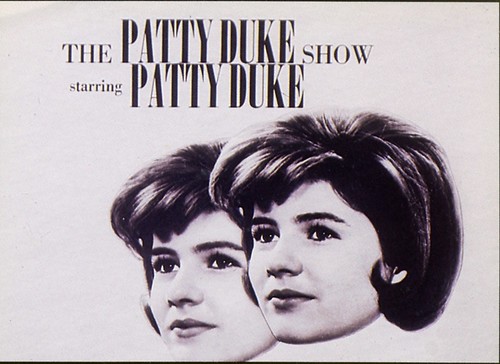
Among the upheavals and conflicts of the '60s, one thing gave hope to the world: the ability of look-alike teenage girls with nothing in common to work together toward a common goal. But now these pairs have decided to work together to commit deadly violence: It's identical long-lost sisters Sharon and Susan (Hayley Mills, The Parent Trap) vs. identical cousins Cathy and Patty (Patty Duke, The Patty Duke Show). Which twins will take the top tier in terrifying toughness?
Sharon and Susan have committed more acts of mayhem than Cathy and Patty, and they have the RAGE (tm) on their side because of the trauma they went through at the hands of their horrible abusive parents (what else would you call parents who split their twin girls apart and never tell them they have a sister?). On the other hand, Cathy and Patty have a wider variety of skills; Cathy has learned a thing or two from living most everywhere, and if Patty eats a hot dog before the fight, she will "lose control" and be an unstoppable killing machine.
Paramount's DVD release of Petticoat Junction: The Complete First Season has given me the opportunity to see a bunch of episodes I never saw before (the black-and-white episodes weren't syndicated, and the second half of the first season wasn't released on the Henning estate's previous DVD. This show is rightly regarded as the weakest of the Paul Henning Rural Trilogy, but as usual, the black-and-white episodes are better than the color ones, and this set contains some very good episodes -- mostly the few that Henning wrote himself. (Henning didn't run Petticoat, preferring to concentrate on running The Beverly Hillbillies.
The standout, which I'd never seen before, is "The Ladybugs," written by Henning and his Beverly Hillbillies writing partner Mark Tuttle and directed by none other than Donald O'Connor; inspired by Beatlemania, Uncle Joe organizes the girls (and guest star Sheila James from Dobie Gillis as the fourth member) into an all-girl group with Beatle wigs and ladybug sweaters. As Linda Kaye Henning (Betty Jo) and Pat Woodell (the black-and-white Bobbie Jo) explain in their introduction, this aired on March 24, 1964, little more than a month after the Beatles appeared on Ed Sullivan for the first time, and as a promotional tie-in, the girls appeared on the actual Ed Sullivan Show as the Ladybugs. The Sullivan footage is not on this DVD, unfortunately; since Paul Brownstein did the special features, I assume he either couldn't find it or couldn't clear it.
It's a funny script, as Henning's scripts usually were, but what surprised me the most was how good-natured it was about the Beatles phenomenon. Not just at the time but for years after, most pop-culture references to the Beatles were fairly derogatory -- remember Allan Sherman's "Pop Hates the Beatles." But this episode is different, even though it was made when the Beatles fad was almost completely new and unexpected. Of course it makes fun of the Beatles and the screaming reactions of their fans (Billie Jo rounds up some cute boys to scream and faint at their act the way girls do in Beatles audiences) and their hair and the rock n' roll business, with Jesse White as a bolo-tied concert promoter who calls himself "Colonel Partridge" -- get it? -- and wants to sign up the Ladybugs even though he hates rock music. But the girls, and young people in general, are not mocked for liking this kind of music, and they get to take a few digs at their parents for not understanding the fad. ("Mom's idea of a hip group," sighs Bobbie Jo, "is Guy Lombardo.") All the satire is genial and gentle with none of the nasty, what's-with-these-crazy-kids tone you usually got in TV episodes about Beatlemania. I just don't think it was in Paul Henning's nature to be nasty about anything; his writing is always so free from malice, and that's one of the things that makes his work hold up so well.
And when it's time for the Ladybugs' big performance in front of their invited audience of screaming boys and Colonel Partridge, Henning actually bothered to clear a real Beatles song for the girls to sing. So while the scene makes fun of this new musical fad, it also assumes that this is a song the audience might enjoy hearing for two and a half minutes.
The song is intact on Paramount's DVD, by the way. And I'm not really sure who's supposed to be who, except that (after an earlier argument about who gets to be Ringo) Betty Jo is their Ringo.
I hope this DVD sells well enough for us to get the second season (the last in black-and-white), when Henning installed his friend and fellow radio veteran Jay Sommers as head writer. Sommers co-wrote nearly all the episodes in the second season of Petticoat Junction, laying the foundation for the style of his own show, Green Acres.
Another thing that I like about Miracle On 34th Street, and didn't really think much about until I watched it again recently, is that it's one of the very few 1940s movies to take a dim view of pop psychoanalysis. As anyone who's seen Kings Row or Spellbound scores of other '40s and early '50s movies will agree, this was an era of filmmaking that was drenched in "Dollar-Book Freud" (Orson Welles's term for the Rosebud stuff in Citizen Kane).
But Miracle not only comes out against this kind of thing, it literally makes it the most evil force in the whole movie: the villain is Mr. Sawyer (Porter Hall), who uses fake Freudian jargon to convince a nice young man that his acts of kindness are really rooted in guilt, that he hates his father and that he has some kind of horrible buried secret in his past. All this phony psychiatry, used to make people feel that normal human emotions are rooted in something bad, is the one thing in the whole movie that can rouse Kris to anger and violence. And when telling off Mr. Sawyer, Kris mentions that he has respect for real psychiatrists but not for people who just want to use the language to make people question their own mental health. He, and George Seaton, might as well be telling off the whole '40s film industry.
I got a request for this episode, the 18th episode of the fourth and final season. Bailey is assigned to do a story on an underfunded children's hospital and, a la Janet Cooke, makes up a composite kid as the focal point of the story.
I'm not that fond of this episode, for two reasons. One, almost everybody seems out of character. (Even Mama Carlson seems out of character and she's not even in the episode -- but since when is she concerned with children's hospitals?) According to the book America's Favorite Radio Station, Hugh Wilson didn't always do a final rewrite on fourth season episodes the way he'd done for the first three seasons; this feels like one of the episodes that doesn't quite have the show's house style.
Second, it cops out every which way in order to keep Bailey or anyone else at the station from actually, intentionally airing a fake story. (And the issue her story is about is pretty innocuous, too.) There's not much point in doing a Janet Cooke episode when the issue is so watered down. The episode does have some good moments, mostly involving Les, but I think it's one of two episodes from the fourth season that feel like they wandered in from Embassy Television or someplace. (The other is "Pills.") This copy is taken from a tape of an original 1982 broadcast.
Cold Open and Act 1 (music: "Mustang Sally" by Wilson Pickett)
I was showing my 88-year-old mom today how to use google, and when we googled "frank doyle archie" your blog post from 2005 was the first on the page. I'm his daughter, Claire, and just wanted to say that I thoroughly enjoyed the post. You totally "got" my Dad's humor. You definitely pegged his style; I am sure from the first line that the bluebird of happiness story must have been his. He had a wonderful sense of humor and absurdity in real life, too, and that came through in his work. It's nice to know that he was appreciated.
As you know, I believe that Happy Days incorporates more shark-jump points than any other show. So when I watched the fourth season DVD (coming out tomorrow, and with all the music -- surprisingly -- intact and paid for), I was actively looking for other moments that could be seen as shark bait. And I found one: a scene that I remembered as being a possible JTS moment occurred midway through the fourth season. (The Pinky Tuscadero thing is also a definite JTS possibility, of course, but that's the season opener.)
What's JTS-y about this scene is that it takes all the gimmicks of the Fonzie character and incorporates them into less than two minutes of screen time: he inexplicably shows up to save Richie; turns an evil woman good with one snap of his fingers; performs some kind of impossible feat of strength; makes the jukebox play "Put Your Head On My Shoulder" by hitting it. By having all these clichés go off at once, the writers finally completed the transformation of Fonzie into a cartoon superhero, which is what he would be in the actual Jump the Shark episode. So this is, arguably, the moment when Fonzie became a complete parody of himself, and that's a possible definition of a JTS moment.
Are there any other moments you can think of that struck you like that -- where a show put in so many gimmicks and catchphrases at once that it seemed to have gone too far? I know there are lots of characters who turned into parodies of themselves over the years, but I can't think of many who had one specific moment of transition. The only other one I can think of for now is Xander on Buffy the Vampire Slayer, who instantly went from the best character on the show to a bad pod-person parody of himself when he had the slap-fight with Harmony.
I've been revisiting some recordings produced by John Culshaw, and once again I'm reminded that I love, absolutely love, "stereo staging" in recordings of theatre pieces (musicals, plays, operas).
When stereo came in, there was a lot of question about whether voices needed to move across the stereo arc -- did listeners need to hear a voice moving when a character moves, or would that just be distracting? Culshaw was one producer who was certain that, as he wrote, "if the baritone needs to flee from the tenor's wrath, he must obviously move away from him." So he and his other producers prepared for each opera recording by writing out all the movements that the characters would make, and then actually rehearsing the singers in where they were supposed to move, even putting numbers on the floor so they'd know where to stand at a given moment. (The singers had to move while singing, because the early stereo setups meant that you couldn't achieve a convincing movement by just panning the voice; it had to be the real sound of moving from one microphone to the next.) His recording of Georg Solti conducting Wagner's Rheingold, the first huge hit in stereo opera -- it stunned everyone by breaking onto the Billboard pop charts -- was full of this stuff.
As Culshaw explained in his liner notes, he not only staged operas from left to right but from front to back, so the voices would move backwards to indicate that they were at the back of the stage. In the first scene of Rheingold, when Alberich the dwarf is chasing the Rhine Maidens around the river, the voices move while the chase goes on, and when one of the maidens swims away to a higher point, she moves to the extreme right side and also moves back a bit (so her voice will be in a different acoustic for her next line). With the recording of Britten's Peter Grimes, even though Culshaw didn't have time to produce it himself, he and Benjamin Britten prepared for the recording by plotting out every movement and perspective: where the door would be in the pub scene, where Grimes' window would be. You can actually hear Peter Pears' footsteps as he walks from left to right, which is certainly something you don't usually hear in a studio recording.
Anyway, while some companies took up this idea for stereo demonstration purposes, not all of them really embraced it, and a few just flat-out rejected it. (When Herbert Von Karajan went to Deutsche Grammophon after recording operas with Culshaw for several years, he tried to talk his German producers into using Culshaw's techniques, but they talked him out of it, preferring to have the voices remain static.) And as time went on and stereo became commonplace rather than a gimmick, most opera recordings no longer had a lot of movement; they'd use such effects occasionally for entrances and exits, but they would not have a singer's voice actually move across the stage to correspond with some movement that would occur in a stage production. Culshaw's successors at Decca kept the technique going for a little while (the first recording of Britten's Death in Venice has the voices moving around more or less as they did in the first stage production), but mostly gave it up after a while. You'll almost never hear an opera recording with a true stereo staging plan.
I understand why this died out, because it's gimmicky and sometimes counter-productive. (Culshaw would sometimes have a whole aria sung in one speaker because the character was supposed to be sitting or standing at the left side of the stage. But as Culshaw's assistant and later senior Decca opera producer Christopher Raeburn pointed out, when someone sings an aria, you should have them dead center; it's just not effective to have the voice at one extreme or the other.) And there are a lot of late '50s recordings of operas, musicals and spoken-word performances that use stereo not just as a gimmick but a really pointless one: they'll have voices bouncing back and forth between right and left for no clear reason, just to show that they can do it. That's irritating and gets in the way of appreciating the performance.
But the basic principle behind the "stereo staging" approach -- that if you're recording a theatrical work, there should be some sense of where people are and why -- is one that I find makes for more exciting listening. Not only because you can follow the singers' movements but because it creates more variety not to have every singer in one position and one acoustic for an entire scene. If a movement is important to the scene, then it makes sense to put it in the stereo spread, the way producers put in important sound effects. (In The Marriage of Figaro, for example, every producer of an audio recording knows he's supposed to put in the sound of Susanna slapping Figaro. Yet they'll leave Susanna in one place for the whole scene, even though she's supposed to come in from offstage, approach Figaro, and then approach other characters.) It's not a big deal, obviously, but it does enhance the experience if done right; it helps make an audio opera recording into a "theatre of the mind" experience.
I think the last recording to really use this technique elaborately, and certainly one of the best, was the 1976 recording of Porgy and Bess by the Houston Grand Opera company (the best of the three recordings of Gershwin's complete score). The producer, Thomas Z. Shepard, who was RCA's head of classical and Broadway recordings, not only filled the recording with sound effects, but incorporated all kinds of audio movements to stand in for movements he'd seen on stage. It's one of the things that makes that recording feel much more theatrical and alive than other recordings of this piece. (Shepard also sometimes used this in his Broadway recordings -- in Sondheim's Pacific Overtures, you can hear the two characters in "Poems" walk from speaker to speaker as they walk across the stage.)
I watched a bit of The Pelican Brief on TCM the other day -- not much of a movie, but a good-looking one thanks to the late Alan Pakula. There was one scene that was shot in a way that I particularly liked, and I wanted to bring it up because you hardly ever see a scene like this any more, not just now but for many years before 1993 (when this film was made).
The scene features two guys in the back seat of a car, talking to each other about The Conspiracy. It's a two-shot, almost head-on, with each character occupying half of the Panavision frame. And instead of cutting to different angles the way I expected, the scene just plays out all the way through with no cuts; the characters turn toward each other, turn away, turn back, and it's all done in one take. Normally, when you have two characters sitting together and talking, the scene will start with that shot (the master) but quickly cut to closer angles for each character.
I like this kind of shot, for one thing, because it doesn't overstate the importance of a scene. For an exposition scene, or a light comedy relief scene, or any other kind of scene that isn't all that big, all the cutting just seems to make everything bigger than it is: look at that person's reaction, now look at that other person's reaction, now look at his face while he's talking. Cutting within a scene like this makes sense if the characters are seated or standing in such a way that you can't see them both clearly at the same time. But if they are both in full view of the camera at the same time, like in the back seat of a car, why not let the scene play out (and let us enjoy their reactions in real time) instead of pretending that this is the back-of-the-car scene from On the Waterfront?
This doesn't make The Pelican Brief a great film, but I just like that Pakula bothered to shoot a scene that way. I wish more big films -- and little films, too, which seem to me to have too much reflexive cutting -- would rediscover the principle, once well-known, that a short scene often fits better if you don't edit it so much.
Please read Ivan's great post on Miracle on 34th Street (the original, John-Payne-not-John-Hughes version). He rightly points out how "there is a thin coating of cynicism surrounding Miracle, and how the characters in the movie are motivated to do the right thing—for the wrong reasons."
That's one of the things that makes Miracle so much more than another sappy true-meaning-of-Christmas movie; while it pushes the message about the need to have faith and be irrational, it's also very clear-eyed about the fact that people act in rational, self-interested ways. Many of the remakes have forced the characters to become infected with the sentimentality of the premise, turning them into a bunch of mushy fools, like the John Hughes version and the Broadway flop Here's Love (a musical from Meredith Willson, creator of The Music Man, who was so totally out of ideas that he put in his old hit "It's Beginning to Look A Lot Like Christmas under a different name). But the original Miracle plays perfectly well as a romantic comedy about a crazy old coot who brings two people together; it's not trying to inflate itself and it's not trying to drop an emotional anvil on us. Even the ending is played as a goofy joke; it sends us out laughing.
And it also benefits from incorporating some of the neo-realist feel that Fox movies had in the late '40s, by going outside the studio and shooting in New York and inside Macy's. If it had been made a few years earlier it would have been shot entirely in the studio, and that would have made it feel more like a sappy fantasy.
George Seaton, though... he had a good career, but every time I look at his filmography I can't help thinking it should have been better. After a decade as a very successful screenwriter for comedy (A Day at the Races) and sentimental drama (The Song of Bernadette), he was allowed to direct his script for a Betty Grable musical, and it became perhaps her best film, Diamond Horseshoe. He formed a partnership with Fox producer William Perlberg, and they made some good comedies, dramas and musicals for Fox (The Shocking Miss Pilgrim, another Grable musical, has a Gershwin score entirely created from Gershwin's trunk material, with new lyrics by Ira Gershwin). But apart from Miracle, his movies fell into the category of pleasant things to watch on TV on a Sunday afternoon, as opposed to classics. And after he left Fox, the movies were still short of classic status but longer and less fun (The Country Girl, Teacher's Pet). In 1970, when most of his contemporaries were forced into semi-retirement, he had a huge hit by writing and directing Airport -- a movie that felt like it could have been made 20 years earlier -- and then got forced into semi-retirement anyway.
It's enough that he created one classic like Miracle; most directors don't even do that. But given his talent as a writer and his obvious skill at directing actors (many actors got Oscars or Oscar nominations for working with him), I wonder why a lot of his movies feel like they're missing something.