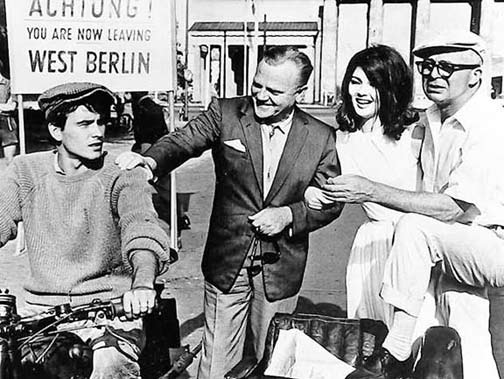
It's a good time to be a Frank Tashlin fan. Fox is finally releasing, in August, The Jayne Mansfield Collection, which will feature the DVD debuts of Tashlin's two best-known movies, The Girl Can't Help It and Will Success Spoil Rock Hunter? These movies were the ones where Tashlin had the greatest freedom to do what he wanted -- he said that Buddy Adler, the executive producer at Fox at the time, gave him total freedom on Rock Hunter, with the result that it was his only film where there was "no compromise" -- and they have everything that makes Tashlin great: cartoony gags (the famous wild takes from various men when Mansfield makes her entrance in Girl Can't Help It), censor-baiting humour (in Rock Hunter Joan Blondell recalls that she once had a crush on a milkman, but he found another girl who "liked his brand of cream"), fourth wall breaking. Most of all they show off his total irreverence toward every aspect of '50s culture: rock music, advertising, big corporations and breast fixations. At a time when out-and-out satire wasn't all that popular, Tashlin created, in Rock Hunter, one of the best satirical movies ever made.
The Tashlin DVD-ography was also improved last year with the release of several of his cartoons on the third Looney Tunes Golden Collection (including the cartoon that's arguably his masterpiece in the animation field, "Porky Pig's Feat"). But there's still a lot of Tashlin that needs to be dusted off and released to an unsuspecting public. Here are a couple of examples of Tashlin at his best, one animated, one live-action.
The animated cartoon is "Plane Daffy" (1944), one of the great cartoons from Tashlin's brief but memorable return to Warner Brothers in the early '40s. It shows off the angular, magazine-cartoon style of drawing he was using by this time, as well as the cynical edge of his humour: few "wartime" cartoons would dare to portray fighting men as a bunch of horndogs who would sell out their missions to party with a sexy Nazi spy ("Hata Mari"). Daffy's line after he emerges from the icebox is second only to the previously-quoted line from "Little Rural Riding Hood" as a guaranteed bring-down-the-house-er in a theatre. As to who animated what, I'll have to leave that to Thad; I'm never too sure of how to identify Tashlin's animators, perhaps because he cultivated a slightly different animation style than the other directors -- with the result that even distinctive animators like Art Davis seem to do things a little differently with Tashlin. Anyway, here's the cartoon:
(Clip removed due to copyright issues -- the cartoon will be available on the next Looney Tunes Golden Collection this year)
And the live-action excerpt is from Hollywood or Bust (1956), the second of Tashlin's two films with Dean Martin and Jerry Lewis. In this musical number, "A Day in the Country," the two drive down a country road (a real road; no rear-projection here) while waving to passers-by. It's Tashlin's tribute to Ernst Lubitsch and the "Beyond the Blue Horizon" number in Monte Carlo (where Jeanette MacDonald waves to passers-by from a train, and they wave back), except that every person Martin and Lewis wave to is a sexy woman in a skimpy outfit. Tashlin had something of an obsession with women's legs, and in this scene he gets to indulge it to his heart's content. But he also creates one of the few "outdoor" musical numbers that actually work; most musicals falter when they go out of the studio and into a natural setting, but because Tashlin's use of the outdoor setting is so insane (a countryside populated entirely by beautiful women in glamour poses), it doesn't feel incongruous to have people singing in this setting; it's just exhilarating and fun.
And just to further illustrate Tashlin's penchant for wholesome fetishism, here's a scene from his other Martin/Lewis movie, Artists and Models (1955). The scene has the two female leads, Dorothy Malone and Shirley MacLaine, and follows the Tashlin credo when dealing with female characters: no matter what the situation, always find an excuse to have them strike glamour-magazine poses. Among "mainstream" '50s directors, only Tashlin would have a character play a scene in a towel and high heels. Also, this movie cast Shirley MacLaine as a character obsessed with the Zodiac, long before she became associated with such things in real life.
Please forgive the video/audio quality of these clips, but I thought it was better to make them available in this form than not at all. Hopefully there'll be a DVD soon.
Thursday, May 04, 2006
WKRP, Round 2
(My first "WKRP in Cincinnati" post, about the episode "Real Families," can be found below this one.)
Now, of course I wouldn't be a true "WKRP in Cincinnati" fan if I didn't bring you the most famous scene in any of the show's 90 episodes: the turkey drop from "Turkeys Away" (season 1). Here's the whole scene, right up until Mr. Carlson's famous closing line.
And here are a few other brief excerpts from the first season:
A commercial for Red Wigglers (The Cadillac of Worms):
(Link not available)
Les tries on a new wig to the tune of "Hot Blooded" by Foreigner (Hugh Wilson got the idea for the scene after hearing "Hot Blooded" on the radio):
Johnny plays "That Old Time Rock n' Roll" but is interrupted by an invasion of elderly people who object to the station's new rock n' roll format:
Han Shoots First, Yada Yada
The original Star Wars Trilogy on DVD, by which USA Today means the original original trilogy, before George Lucas did whatever it is George Lucas does to his movies.
Every other post and comments thread I've seen about this makes two points:
a) This is a scam, since they'll just come out with yet another version in another format a year later;
b) Everyone will buy it anyway.
Sounds about right.
Every other post and comments thread I've seen about this makes two points:
a) This is a scam, since they'll just come out with yet another version in another format a year later;
b) Everyone will buy it anyway.
Sounds about right.
Wednesday, May 03, 2006
WKRP in Cincinnati - "Real Families"
Though "WKRP in Cincinnati" will probably never be on DVD (music rights, music rights, and music rights are the three reasons why), I have a lot of episodes on tape, so I thought I'd occasionally post some clips from the show, just to remind us all what we're missing.
In this post, I've Youtub'd some clips from probably the best episode of the series, "Real Families," which aired in November 1980. It was written (with the usual rewrites by creator/showrunner Hugh Wilson) by Peter Torokvei. Torokvei had come to WKRP from Toronto Second City, where he, Steve Kampmann (another future WKRP writer), Robin Duke and Martin Short were part of a cast that Second City producer Andrew Alexander called "One of the funniest stage casts I have had the pleasure of producing." Torokvei's material for WKRP has that Second City style to it sometimes: absurd in a deadpan sort of way, and at once fascinated and repelled by the effects of pop culture on the way we live our lives.
The idea of "Real Families" is that the sleazy sales manager Herb (Frank Bonner) is profiled on a reality show that picks one "average" person every week and finds out whether they're really as average as they claim to be. Herb is determined to make a great impression on the show, and the hosts of the show (Peter Marshall and Daphne Maxwell) are just as determined to embarrass him. The entire episode is shot as an episode of "Real Families," with no audience or laugh track, and a semi-improvised feel -- though most of the material was in fact scripted.
In this clip, the hosts show up when Herb isn't expecting them, and Herb, caught off guard, tries to prove he's a clean-living man by taking his family to church -- even though it soon becomes apparent that he has no idea where to find a church. This is followed by a clip of Herb trying to do all kinds of "average American" things for the camera and failing at each one of them: barbecuing, throwing the football around with his son, making small talk. The clip ends with a funny-grim scene of Herb's family spaced out in front of the television, and has Herb's wife Lucille (Edie McClurg) taking a little dig at the show "Little House on the Prairie," which was killing WKRP in the ratings at the time.
The next clip has the hosts going to all Herb's colleagues at WKRP, asking them to say what they think of Herb. Every one of them robotically recites the famous line "He's a hard worker, a loyal husband, and an all-around fine person." Though Bailey (Jan Smithers) has some trouble getting it right.
In the next clip, after a couple of fun bits for Jennifer (Loni Anderson) and Johnny (Howard Hesseman), the hosts go to work exposing Herb in front of the TV audience, discovering that he doesn't actually do his job, and when he does, it usually ends in disaster. The "dancing ducks" promotion is based on a disastrous promotion that actually happened at a radio station Hugh Wilson worked with in Atlanta.
And here are the last few minutes of the episode, where both Lucille and Herb turn on the hosts, especially Herb, who kicks the camera crew out with an impassioned Howard Beale-ish rant about television in general ("Nothing on the tube is real! Not even in the news!"). But it doesn't end there; there's a bitter little tag scene that reminds us that people will subject to any humiliation and like it, as long as they can get on television.
And then, after a brief "I Love Lucy" reference, the famous gibberish closing theme song, and the MTM Kitten, the episode is over.
Obviously this isn't a typical "WKRP" episode, but it does demonstrate how strong the characters were: they're so distinctive that even in their very brief bits reciting the same line ("hard worker, loyal husband..."), each one does it in a different way that is appropriate for his or her character: Les (Richard Sanders) tosses it off and goes right back to talking about the only thing that matters, his brilliant work as a newsman; Jennifer just tosses it off dismissively; Bailey stammers and gets nervous. And the episode is great both as a satire of television and its effect on everyday life, and as a character study of the slimy but pathetic and kind of likable-in-spite-of-everything Herb.
Most of all, I love the fact that Wilson usually kept "WKRP" relatively free of easy setup-punchline jokes, or extraneous jokes; the characters never sound like they're clever joke machines, but rather they sound like people and the humour comes from the characters and the way they react to particular situations. Hesseman recalled that if you suggested a joke to Wilson, he'd often say: "That's a good joke, but it's off-story," and reject it for that reason.
Steele-O-Vision
Well, finally, an '80s series will have every episode available on DVD: Fox has announced the last volume of "Remington Steele", which has the 22-episode fourth season and the disastrous fifth season. That season, most famous because it prevented Pierce Brosnan from becoming James Bond for another ten years (NBC wouldn't let him out of his contract) and prevented Stephanie Zimbalist from being the female lead in Robocop (same reason), consisted of three mediocre two-hour episodes, and on one of the season 2 commentaries, creator/showrunner Michael Gleason says he "didn't even come down to the set" during that season.
The special features are being produced by the same people who did the "Moonlighting" special features, and, like that show, the new set will have a special feature on the loyal fan base of "Steele." It's good to see the show getting the kind of recognition it's getting from these DVD releases, because it holds up very well and the character of Laura Holt still puts most TV heroines to shame when it comes to creating a female lead who is independent, strong and smart without a hint of Mary-Sue-ishness. I had much more about the show in this post from last year.
The special features are being produced by the same people who did the "Moonlighting" special features, and, like that show, the new set will have a special feature on the loyal fan base of "Steele." It's good to see the show getting the kind of recognition it's getting from these DVD releases, because it holds up very well and the character of Laura Holt still puts most TV heroines to shame when it comes to creating a female lead who is independent, strong and smart without a hint of Mary-Sue-ishness. I had much more about the show in this post from last year.
Tuesday, May 02, 2006
Those Weren't The Good Old Days
One of the things about being an old-movie buff is that you can fall into the trap of talking as though all movie genres were done better in the Good Old Days. (Abbreviation: the "GOD". Well, it makes more sense than that awful "MSM" abbreviation.) I definitely don't think that, but I do think that there were some genres that were, on the whole, better served in the early days of movies than they have been in the modern era. I date the "modern era" rather arbitrarily from the collapse of the studio system in the mid-'50s; some would put it later.
So I thought I would take a minute to ask myself, what kinds of movies do I think have been better off in the post-GOD (unlike the genres the GOD dominates, such as comedies and musicals)? I would answer as follows:
Gangster movies. By saying that I prefer more recent gangster movies, I'm by no means putting down the gangster films of the GOD; the definitive gangster movie star of that era, James Cagney, is somewhere near my favorite movie actor of the GOD. But I think that even the best gangster movies of the '30s and '40s were somewhat hobbled by the limitations on what could be done or said. Even in the "Pre-Code" era, a movie couldn't come close to portraying the full measure of real-life brutality or profanity. And that matters because a gangster movie is, by its nature, a realistic movie; it gets its special kick from the fact that it portrays a very real part of society that both repels and fascinates us. Something like a film noir, which is a crime movie but a stylized, almost dreamlike kind of crime movie, doesn't need realism to be effective; but something like The Roaring Twenties, which presents itself as a semi-documentary portrayal of a historical phenomenon, would be more effective if it could come closer to portraying the reality it purports to bring us.
Westerns. - The collapse of the studio system arguably began with a Western -- Jimmy Stewart's profit-sharing deal for Winchester '73, which signalled that stars and their agents would have much more deal-making power from now on -- so it's fitting that Westerns improved a great deal after that collapse. Among the very greatest Westerns, I can think of hardly any that were old-school studio-system contract-player products; My Darling Clementine, a Fox production, is just about the only one that comes to mind. In the late '40s and early '50s, when the studio system was crumbling, most of the best "A" Westerns were made by independent companies like John Ford and Merian C. Cooper's Argosy Productions. And the more the studio system crumbled away, the more interesting big-budget Westerns became.
Biopics. - I'm not saying the biopic has ever been a fertile source of great movie material, but to the extent that there is such a thing as a good biopic, there were fewer of them in the studio-system era. Censorship restrictions and studio timidity meant that every biopic had to drain all the "dark" stuff out of a historical or entertainment-industry figure and leave out anything even vaguely controversial, as for example the way The Life of Emile Zola had to leave out the issue of anti-Semitism. I can think of at least one great studio-system biopic -- John Ford's Young Mr. Lincoln -- but in general I think today's biopics, like Walk the Line, do a better job than those of the studio-system era.
Come Back, Ted
Cartoon Brew has had a number of posts on Cartoon Network's insane decision to show old live-action movies and TV shows (because, after all, where else can you go to see "Saved By the Bell?"). The collapse of Cartoon Network reminds me a lot of the slow implosion of the American Movie Classics channel, which started out showing uncut, commercial-free old movies -- then, gradually but inexorably, added commercials, newer movies, and other things that turned it into a channel with no real identity at all. That's what's happened to the Cartoon Network: by phasing out most of the cartoons they'd been showing -- classic cartoons, Hanna-Barbera cartoons that don't contain the word "Scooby" -- they sort of guaranteed that they'd eventually wind up catering to an audience that doesn't even like cartoons.
I should add that it seems to me that Cartoon Network and CNN both seemed to jump the shark around the time Ted Turner stopped being involved with them. (Though Turner Classic Movies seems to have retained its identity, at least for now.) Turner has his eccentricities, and he did give us that "Captain Planet" thing, but he does seem to like good cartoons -- he was the one who had the Cartoon Network buy the rights to broadcast Freakazoid!
In Canada, by the way, we've never had to suffer through a cartoon channel going down the tubes like this, because our cartoon channel, Teletoon, was mediocre right from the beginning. Teletoon would never show a cartoon made before the '80s, and when they finally gave in and purchased the rights to some Looney Tunes cartoons, they bought the "Bugs Bunny and Tweety Show" package that ABC used to show -- meaning that they were showing edited-for-Saturday-morning cartoons in prime time.
Monday, May 01, 2006
One More Avery Cartoon
"Little Rural Riding Hood" (1949) is sort of the end of an era for Avery: it was his last cartoon with "Red," the sexy red-haired dancing girl he'd introduced in 1943's "Red Hot Riding Hood." In fact, the animation of Red in this cartoon is all recycled from an earlier cartoon, "Swing Shift Cinderella" (not available online), as Red's animator, Preston Blair, had left the studio the year before and no one else could animate the character the way Blair did. You can see, in the cartoon, a bit of a clash between Blair's Disney-trained style and the more streamlined, minimalist animation style of some of Avery's younger animators -- we're seeing a transition here from the rich, fluid animation of the '40s to the less elaborate '50s style.
"Little Rural Riding Hood" contains the single funniest line in any Avery cartoon, which occurs after the country wolf accidentally kisses a cow. (I don't know why it's funny; no analysis will help; but I do know that it brings down the house every time the cartoon is shown.) It also has a gag, involving the country wolf and a blanket, where he demonstrates that he is not "master of his domain"; this was also sort of the end of an era for Avery, who would tone down the sexual humour a bit in the '50s.
"Little Rural Riding Hood" contains the single funniest line in any Avery cartoon, which occurs after the country wolf accidentally kisses a cow. (I don't know why it's funny; no analysis will help; but I do know that it brings down the house every time the cartoon is shown.) It also has a gag, involving the country wolf and a blanket, where he demonstrates that he is not "master of his domain"; this was also sort of the end of an era for Avery, who would tone down the sexual humour a bit in the '50s.
"That's My Purse! I Don't Know You!"
Season 6 of "King of the Hill" comes out on DVD tomorrow.
I have mixed feelings about this season. This is the season where "King of the Hill" got silly -- not "Simpsons" silly, let alone "Family Guy" silly, but definitely sillier than we'd expect from a show noted for its low-key realism. The showrunners for this season were Jonathan Aibel and Glenn Berger (Harvard Lampoon guys who'd been with the show from the beginning), and they seemed to favour stories that were wackier than usual for KotH:
- Bill, suspecting that the army performed experiments on him that caused him to become fat and bald, steals a tank from the army base and drives it through the neighborhood.
- Peggy pretends to be a nun in order to get a teaching job at a Catholic school.
- Connie, Kahn's child-prodigy daughter, discovers that she prefers playing bluegrass on her violin, so she joins up with Hank to form a bluegrass act and they go to perform in Branson, Missouri.
- The Hills go to Japan and discover that Hank has a long-lost Japanese half-brother.
To show you how much crazier the show got this season, one episode, "Fun With Jane and Jane," had a premise that was very similar to an earlier episode of "Family Guy." When KotH is similar to "Family Guy," it's kind of strayed from its roots.
However, while the show did throw realism out the window this season, it was also pretty dang funny, and in some ways Hank Hill's uptightness is even funnier when he's surrounded by total surreal insanity -- no matter what happens, his reaction is always to look awkward and rub the back of his neck with his hand.
After this season, which reportedly didn't please creator Mike Judge, the show regrouped and adopted a more realistic tone; now almost every episode is based on some real-life thing that the writers have observed (case in point: a recent episode was based on the Cold Stone Creamery ice cream shops that try to create an incessantly "fun" atmosphere). I respect that, and the job the new showrunners have done, but I sometimes miss the somewhat nuttier humour of the first six seasons, when the show was run by New Yorkers and Harvard Lampoon guys: it was a nice mix of inside-baseball Harvard humour and observational Texas humour.
One strike against season 6 is that it was the season when my favourite supporting character on the show, Luanne (Brittany Murphy) basically became a non-presence on the show, absent from most episodes. She's increased her presence on the show a little bit since then, but not enough for my taste -- to my mind that character has the same kind of loopy quality of Pamela Tiffin in Billy Wilder's One, Two, Three, the sense that she's not so much dumb as very strange.
Oh, and the subject quote comes from the most famous episode from this season (actually a holdover from season 5), "Bobby Goes Nuts," where Bobby (Pamela Adlon) takes a woman's self-defence course and learns to defend himself against bullies by kicking them in the testicles.
Other random lines from season 6 of "King of the Hill":
DALE: I should have known it was too good to be true. Fourteen years I've been running that ad, and not one call. Then, suddenly -- one call.
HANK: How about I buy you an ornament?
COTTON: "Peace?" You would like that, you draft-dodger! Sure you can't find one with a flag-burning on it?
HANK: It's Jesus peace, not hippie peace.
BILL: I want to hear "Puff the Magic Dragon." Play that song, I like it, play it. "Puff the magic dragon..."
HANK: Bill, do you have any idea what that song is about? It's about a dragon! We're grown men.
NANCY: Why is God punishing me? (to God) Why, sug?
LUANNE: She's not coming back, honey.
BOBBY: 'Course she is. She's Mr. Boomhauer's girlfriend.
LUANNE: Let's see, how can I explain this...? You know how you can be happy eating vanilla ice cream day after day after day? Well, Mr. Boomhauer isn't just like that. See, he likes to try different flavors.
BOBBY: But he can have a new flavor every day! He's dating the ice cream lady!
LUANNE: Mr. Boomhauer had grown-up sex with the ice cream lady, and now he's dumped her. You're never gonna have ice cream again, Bobby.
Watch Your Back, S.C.
US News and World Report: "Skewering comedy skit angers Bush and aides."
I can't add much to what is becoming a miniature web phenomenon -- Colbert's speech, which received almost no coverage in the news, has become the most viral of viral videos and has become the blog topic du jour -- but I do want to note one thing: there was an interesting contrast between President Bush's routine, which pleased the assembled reporters, and Colbert's routine, which most certainly didn't.
The President's funny routine basically portrayed the relationship of the press and the President as adversarial: he doesn't much like them, and they embarrass him by "not editing what I say." Everybody in the room can enjoy that, because that's what the relationship of the press and the government is supposed to be, at least in theory. The routine portrayed things as they should be.
Colbert's routine, while it's been described as a Bush-bashing routine, actually wasn't that hard on the President. It was, however, a stinging attack on the press, and it attacked them, over and over, for having a non-adversarial relationship to the government. Most of the jokes were built around the theme that the media is neutered and uncritical of the Bush administration: the joke about how the press hasn't been reporting critically on the issues that matter; the reference to the media's standard hackneyed descriptions of politicians ("John McCain, what a maverick"), the references to staged photo-ops. And the overlong videotaped segment with Helen Thomas was premised on the idea that most reporters don't ask questions that matter (so that Press Secretary Colbert reacts with shock and horror when Thomas asks him why they invaded Iraq). Colbert's routine essentially consisted of telling reporters, to their faces, that they've failed in their duty to be adversarial. That's a common belief among many people nowadays -- there's even a whole book about it -- but reporters, still worried about "liberal bias" complaints, haven't noticed the paradigm shift. Colbert forced them to notice, and they didn't like it at all.
Comedy Central star Stephen Colbert's biting routine at the White House Correspondents Association dinner won a rare silent protest from Bush aides and supporters Saturday when several independently left before he finished.
"Colbert crossed the line," said one top Bush aide, who rushed out of the hotel as soon as Colbert finished. Another said that the president was visibly angered by the sharp lines that kept coming.
"I've been there before, and I can see that he is [angry]," said a former top aide. "He's got that look that he's ready to blow."
I can't add much to what is becoming a miniature web phenomenon -- Colbert's speech, which received almost no coverage in the news, has become the most viral of viral videos and has become the blog topic du jour -- but I do want to note one thing: there was an interesting contrast between President Bush's routine, which pleased the assembled reporters, and Colbert's routine, which most certainly didn't.
The President's funny routine basically portrayed the relationship of the press and the President as adversarial: he doesn't much like them, and they embarrass him by "not editing what I say." Everybody in the room can enjoy that, because that's what the relationship of the press and the government is supposed to be, at least in theory. The routine portrayed things as they should be.
Colbert's routine, while it's been described as a Bush-bashing routine, actually wasn't that hard on the President. It was, however, a stinging attack on the press, and it attacked them, over and over, for having a non-adversarial relationship to the government. Most of the jokes were built around the theme that the media is neutered and uncritical of the Bush administration: the joke about how the press hasn't been reporting critically on the issues that matter; the reference to the media's standard hackneyed descriptions of politicians ("John McCain, what a maverick"), the references to staged photo-ops. And the overlong videotaped segment with Helen Thomas was premised on the idea that most reporters don't ask questions that matter (so that Press Secretary Colbert reacts with shock and horror when Thomas asks him why they invaded Iraq). Colbert's routine essentially consisted of telling reporters, to their faces, that they've failed in their duty to be adversarial. That's a common belief among many people nowadays -- there's even a whole book about it -- but reporters, still worried about "liberal bias" complaints, haven't noticed the paradigm shift. Colbert forced them to notice, and they didn't like it at all.
Sunday, April 30, 2006
"Little Archie On Mars"
Having done way too many posts about the greatness of cartoonist-writer Bob Bolling and his "Little Archie" comics, I thought I'd actually scan and post one of his stories so Bolling newcomers could get an idea of what makes his work so special.
This is "Little Archie on Mars," a 1961 story; it's included as the first story in the Little Archie Collection, which I highly recommend you get. This is Bolling in his high-adventure mode, a pure and perfect expression of a kid's wildest fantasies: everything in the story seems exactly the way a kid would imagine it. It's not a stuffy grown-up science-fiction story, it's a story for the imaginative child in all of us. Even the dialogue sounds like it comes from a child's vocabulary, without ever feeling in the least dumbed-down. And Bolling's artwork was always wonderful at finding the right angle or pose to suggest an important action. Check out the effect in the very last panel, with Little Archie bathed in the light of the TV that, as he says, has been watching him.
It's a 14 page story -- unlike the "regular" Archie artists, who tended to be limited to five or six pages for most stories, Bolling got a lot more leeway to make a story as long or short as he needed, and also unlike the other artists, he got to sign his name. Indeed, Bolling seems to have had a lot more freedom in terms of variety of subject matter, character development, and so on than many a "grown-up" comic book artist. And his work is still some of the best ever done for comic books, of the grown-up or kiddie type.


Lyrics By John LaTouche
Some more lyrics from that most fascinating of all flop musicals The Golden Apple, by the great John LaTouche. How many musical-theatre lyricists could write both "Windflowers," a ballad that's sort of half torch song and half poetry, and "Goona-Goona," an utterly ridiculous, goofy song for a Hawaiian-themed brothel? (This being an updated version of "The Odyssey," the sarong-clad hookers are supposed to stand in for the sirens, while "Windflowers" is given to Penelope, lamenting the passage of time since the departure of Ulysses.)
"Windflowers"
He brought me windflowers that grow among the rocks
And picked me wild berries bitter to the tongue.
He taught me to tell time by the dandelion clocks
When we were young,
When we were young.
He caught me a mockingbird and wove a willow cage,
A cage from the willow where we kissed and clung,
He fought me fierce dragons, we were princess and the page
When we were young,
When we were young.
Then we stood up in chuch and we whispered vows
And he took me to a mountain peak and built me a house.
The berries and the flowers and the dandelions fade,
The songbird is silent, shivering in the cold.
The dragons come creeping, and they tell me I'm afraid
That I'll grow old,
That I'll grow old.
And I lie in the house as the stars grow dim,
And I think of how his body was so warm and slim,
And I know there ain't no growing old for me and for him,
No, never, never, not for me and him.
"Goona-Goona"
By a goona, goona-goona,
By a goona, goona-goona lagoon,
We will croon a, croon a, croon a,
We will croon a, croon a real jungle tune.
Upon that golden shore, kids,
We'll lie on bedds of orchids,
And then later, by the crater
Of an old volcano,
We can promise we won't say "No
A-no-a," let's-a go-a,
Let's-a go-a, go-a go-away soon,
Where breezes blow-a, blow-a, blow-a,
Breezes blow-a like a big, big bassoon.
Snug as two baboons in a bamboo tree,
I'll bamboozle you and you'll bamboozle me,
By a goona, goona-goona,
By a goona, goona-goona lagoon.
By a goona, goona-goona,
By a goona, goona-goona lagoon,
We will swoon-a, swoon-a, swoon-a,
We will swoon-a, swoon-a beneath the moon.
Those hula-dancin' mamas
Are really yama-yamas,
They can shake and they can shimmy
Till they charm wild cobras,
Also, fellas, they wear no bras.
Aloha, lo-a, lo-a,
Let's-a go-a, go-a go-away soon,
We will throw a, throw a, throw a,
We will throw a, throw a big, big harpoon.
We'll hunt and fish-a the whole day long,
Whatever you wish-a, just sound the gong
By a goona, goona-goona,
By a goona, goona-goona lagoon.
Arise, Earl of Cloves!
Thad has an animation analysis of the Chuck Jones classic "Rabbit Hood."
It's based on another one of Greg Duffell's great animation analysis posts, which can be found here.
Also at Thad's site is your chance to see the 1941 Columbia cartoon "The Fox and the Grapes." Featuring WB animation talent -- director Frank Tashlin and voice artist Mel Blanc -- the cartoon's use of blackout gags (with the fox trying one unsuccessful gambit after another to get those grapes) heavily influenced all the try/fail blackout-gag cartoons that would pour out of other studios in subsequent years, especially Chuck Jones's Road Runner series.
Opera Recordings That Almost Never Were
I just placed an order at Amazon for a recording of Wagner's "Die Meistersinger Von Nurnberg", conducted by Rafael Kubelik, which is probably the all-time best studio recording of Wagner's only comic opera (Wagner being Wagner, it's a four-and-a-half hour comic opera with German nationalist overtones). What I find interesting about the recording, mostly because I'm the only one who cares about wheeling and dealing in the classical recording business, is that this recording -- an expensive studio production -- was financed by a major record company and then never released. It was recorded in 1967 and never got a commercial release until the '90s; the version at Amazon, from the original master tapes, came out in 2003.
What happened was that Deutsche Grammophon (Germany's biggest classical recording company) put up the money for Kubelik to record Meistersinger. But once the recording was completed and edited, the company then decided not to release it. There were two stories at the time as to why it wasn't released:
1. The most powerful musician recording for Deutsche Grammophon was the conductor Herbert Von Karajan, who at that time was recording Wagner's "Ring" for the company. There was a rumour at the time that Karajan was upset that the "Meistersinger" recording had been given to Kubelik -- who had sort of B-level status in terms of fame and status (though probably Karajan's superior as a conductor). There was speculation that the DG executives, wanting to keep Karajan happy, suppressed Kubelik's recording in case Karajan might want to record "Meistersinger" for them (he eventually recorded it for another company).
2. The golden boy at the classical recording companies at this time was the lieder singer Dietrich Fischer-Dieskau. He was everywhere in the '60s, recording hundreds of songs (one critic wrote "This record by Mr. Fischer-Dieskau is not among his hundred best") and branching out into opera, recording many roles he rarely if ever sang on stage. From the vantage point of today, it's hard to figure out exactly why the recording companies were so determined to cast him in Verdi and Puccini and Wagner and other composers that weren't really right for his lightish baritone voice (to be fair, his recording of Verdi's "Rigoletto" is actually quite terrific), but there we are; and the leading record producers felt that in order to record "Meistersinger," they would need to have Fischer-Dieskau in the lead role, Hans Sachs. Problem: Fischer-Dieskau had never sung the part and wasn't even interested in learning it, claiming that it was wrong for his voice. John Culshaw of Decca offered him a recording of "Meistersinger" and he said no; other producers offered him the same, and he still said no. But by the late '60s there was some talk that Fischer-Dieskau might give in and record the part of Sachs, and the rumour was that Deutsche Grammophon deep-sixed the Kubelik recording of "Meistersinger" so that they could record a Fischer-Dieskau version and cash in on what they apparently thought to be the baritone's superstar status. They did, in fact, finally record a "Meistersinger" with Fischer-Dieskau -- ten years later. As Sachs, he's quite a bit inferior to the baritone who takes the part for Kubelik, Thomas Stewart.
So that's that. Again, these kind of inside-baseball classical-music recording anecdotes aren't of much interest, I realize, but I still like digging them up, if only as a reminder that classical music used to be a bustling, profitable part of the recording industry -- with all the things that come with a bustling, profitable recording business, like behind-the-scenes machinations, bizarre decisions to suppress recordings, and kowtowing to powerful superstars.
The New Archie Bunker?
One thing that used to strike me about modern TV is that it hadn't really produced an Archie Bunker figure -- a TV character who was both a flawed-but-sympathetic character and a symbol of broader cultural conflicts. Archie was like that, and so in a different way was Alex Keaton on "Family Ties": they were a symbol of cultural trends that their creators didn't like, but at the same time they were three-dimensional characters, and basically sympathetic people. There aren't a lot of characters like that today; if a creator wants to use a character to make a statement about trends he doesn't like, he'll usually pick a villain or at least an antagonist -- he won't put that character front-and-center and he certainly won't confuse the issue by showing that that character is basically a good person underneath.
You could sort of make an argument that Stephen Colbert is the closest thing we have now to a successor to those characters. The character Colbert plays on his show -- the blowhard, self-absorbed talk-show host who believes in "truthiness" and is suspicious of actual facts -- is obviously a satire (though, as with Archie and Alex, there's a sort of sub-trend of viewers who don't get that the character is supposed to be a satire). But if you watch enough episodes, the Colbert character starts to become oddly sympathetic: he's a guy trying to seem like he knows everything when he knows nothing, and the strain of trying to look infallible seems to be wearing him down. As with Archie Bunker, he's really not a bad person, just a guy who doesn't really understand the changes in the world, and deliberately closes his mind to anything that might make him nervous.
Incidentally, here's what Colbert (sort of in-character) told a clearly hostile Washington Press Corps last night, a reminder that the primary satirical target of shows like "The Daily Show" and "The Colbert Report" is not politicians, but the media:
Over the last five years you people were so good. Over tax cuts, WMD intelligence, the effect of global warming. We Americans didn't want to know, and you had the courtesy not to try to find out. Those were good times... as far as we knew.
But listen, let's review the rules. Here's how it works: The President makes the decisions - he's the decider. The Press Secretary announces those decisions, and you people, the press, type those decisions down. Make, announce, check. Just put 'em through a spell check and go home. Get to know your family again. Make love to your wife. Write that novel you've got kicking around in your head. You know, the one about the intrepid Washington reporter with the courage to stand up to the administration? You know, fiction!
Saturday, April 29, 2006
A Lost Starlet at 65
Bill Crider reminds me that yesterday was the 65th birthday of Ann-Margret. (She shares a birthday with Saddam Hussein and Jay Leno.) A-M made my list of "Lost Starlets of the '60s," actresses who should have been superstars but had the misfortune to come along in the '60s, a time when American movies had basically run out of good parts for women. (To some extent they've never fully recovered, but the '60s hit a particularly bad patch in this respect.) In A-M's case, she had everything it took to be a big star in movie musicals, except that the movie musical was pretty much dead by the time she hit the screen.
The closest thing she ever had to a true star vehicle was 1966's The Swinger, a genuinely insane movie -- it has what is basically the plot of a pornographic film (A-M sets out to prove to Tony Franciosa that she can be a sexy swinger and spends most of the movie stripping and gyrating in front of him) except it's told in a family-friendly way; the key scene has A-M rolling around in paint, yet the scene is presented with a strange kind of innocence, and A-M plays it as though she's still in Pocketful of Miracles. It's the apotheosis of the '60s habit of presenting semi-obscene material as though it's sweet and wholesome.
The director of The Swinger was the crazy, semi-brilliant George Sidney, who had brought A-M to prominence in Bye Bye Birdie and Viva Las Vegas; he summed up her appeal by saying something like: "You don't know whether to offer her a lollipop or a diamond bracelet."
Thanks For Losing Your Mind
It's Always Fair Weather makes for a good DVD, with a good transfer and a making-of featurette that is more honest than these things usually are. The assembled talking heads actually talk about the problems with the production -- especially the friction between co-directors Gene Kelly and Stanley Donen, who ended their professional relationship after this film. (Kelly's career probably suffered more from the breakup; Donen did some great work on his own -- Charade, Two For the Road -- but Kelly never starred in or directed another first-rate movie again.) They also talk about the mistakes that keep the film from being one of the all-time great musicals, especially Kelly's bizarre decision to cut the only number where he and Cyd Charisse danced together, as well as the only solo number for the great Michael Kidd. (Both these cut numbers are included as outtakes on the DVD; their soundtracks aren't complete so they can't be re-integrated into the film.) The mistake they don't mention was the decision to let André Previn write the music. Previn is a wonderful musician, but as a melodist, he is a total dud; the big love song, "I Like Myself," is a poor man's version of Bernstein's "Lucky to Be Me" from the stage version of On the Town, and all the other songs basically sound like good ideas for tunes, as opposed to actual good tunes.
But still, overall It's Always Fair Weather is one of the better Arthur Freed musicals (certainly better than the movie it's following up, On the Town, which is also hobbled by weak songs by an MGM contract musician). The dark, mature tone of the movie, the suggestion that the carefree world of the traditional movie musical has been swallowed up by the anxieties and pressures of '50s life, is certainly memorable and unique. Donen and Kelly were also unmatched when it came to filming a musical number; other directors, like Vincente Minnelli, had trouble figuring out how to stage musical numbers for the wide CinemaScope screen, but Donen came up with all kinds of ways to make CinemaScope work for, not against, a musical number (dividing the screen into three; blacking out parts of the screen and zooming in on a face), and the fluid camerawork, with the camera practically flying down a studio backlot street, is beautiful to behold.
The best numbers are fairly well-known: the trash-can dance for Kelly, Kidd and Dan Dailey; Charisse's "Baby, You Knock Me Out," and Kelly's roller-skating routine to "I Like Myself," which, while not a great song, may be even better than "Singin' in the Rain" as a piece of dancing and camerawork. And, finally, there's Dolores Gray's "Thanks A Lot But No Thanks," the campiest number in the history of the Freed Unit. Wom! Wam! has screencaps of the number as well as an analysis: "The '50s offers quite a few song & dance numbers dramatizing the sexual dynamic between men & Women with outrageously built Glamazons packed into outlandish costumes..."
Friday, April 28, 2006
In Defence of the World "Sucks"
Lee Siegel's "Culture" blog at The New Republic is kind of a train wreck. (That publication's pop-culture coverage has sunk a long way since the days of Manny Farber.) It seems like Siegel mostly spends his time writing incomprehensible rants about how terrible pop culture is these days and how nobody is producing the kind of challenging, wonderful culture he wants and how the only person who really knows how bad things are is Lee Siegel. I picture him as a guy who keeps a gun by his bed in case the marauding hordes arrive to steal his Dwight MacDonald books.
However, his new post, "Against 'Sucks,'" reaches a new height of unintentional hilarity; it's a jeremiad against those vulgar, vulgar Internet people that may even be dumber than that Wall Street Journal one I linked to the other day. (And when you're dumber than the Wall Street Journal editorial page, that's really saying something.) Siegel is angry, really really angry, that every time he reads a big bad blog he encounters some punk kid using the word "sucks." Now, who invented that word? Could it be... Satan?
And he wants you to know that the use of the word "sucks" is a deep manifestation of contempt for that person, because, when it comes to oral sex, the suck-er is (so Siegel seems to have heard) distinctly inferior to the suck-ee. Few have summed up the oral sex caste system as well as our Lee, and he will tell us What It All Means:
It takes a special talent to find a threat to democracy in the fact that my generation grew up watching too much "Beavis and Butt-head."
I think a post like that speaks to a failure to understand how the widespread use of a term can develop it beyond its original meaning. Yes, "sucks" means what Siegel says it means. But it's taken on a whole host of other connotations, to the point that when you say something "sucks," it means something different from just saying it's "bad." The advantage of "sucks" is precisely that it seems to have a slightly obscene edge to it -- so that when you apply the term to a work of popular culture, you're not merely criticizing it but insulting it and dismissing it as a waste of your time. "Boy, that movie was really bad!" is a critical judgement; "Boy, that movie sucked!" is a statement that it wasn't even worth the effort of finding specific terms to criticize it with. And of course, there's just the sonic quality of it; the "k" sound is just funny, as any comedian will tell you. Plus you can play around with the way you use the term; somebody -- I think it was Joe Queenan -- came up with the noun "suckitude" to describe the degree to which something does or does not suck.
I'll leave the final word to Louann Van Houten from "The Simpsons":
"Well, Marge, the other day Milhouse told me my Meatloaf 'sucks!' He must have gotten that from your little boy, because they certainly don't say that on TV."
However, his new post, "Against 'Sucks,'" reaches a new height of unintentional hilarity; it's a jeremiad against those vulgar, vulgar Internet people that may even be dumber than that Wall Street Journal one I linked to the other day. (And when you're dumber than the Wall Street Journal editorial page, that's really saying something.) Siegel is angry, really really angry, that every time he reads a big bad blog he encounters some punk kid using the word "sucks." Now, who invented that word? Could it be... Satan?
I see it used in online magazines with rising frequency. It's all over the Internet. It's the pejorative verb of the age. Let's be blunt about the word's origins: It's short for "sucks cock." (Forgive me. The situation requires it, and the context allows it.) So when some case of stunted development writes in to his favorite blog in order to register a thoughtful dissent from another visitor--e.g. "Thucydides862 sucks!"--what he's really saying is that Thucydides862 "sucks cock." Considering how many times "sucks" is used in print, in conversation, and online now, the entire country is evoking the act of fellatio on a continuous basis.
And he wants you to know that the use of the word "sucks" is a deep manifestation of contempt for that person, because, when it comes to oral sex, the suck-er is (so Siegel seems to have heard) distinctly inferior to the suck-ee. Few have summed up the oral sex caste system as well as our Lee, and he will tell us What It All Means:
So saying someone or something "sucks" is not just an expression of contempt. It's a verdict on that person or thing as being, literally, beneath contempt. It's a wish not so much to rise above others as to subordinate them, an angry anti-democratic retort to the nettleseome tides of democratization. After all, when someone "sucks," they can't talk back. Isn't that the bully's and the tyrant's timeless dream, to move among people who can't talk back? It's certainly the dream of a child's fragile ego. It could be that we are surrounded by adults who have the fragile egos of children. And I know exactly what those unwitting people would say about that situation.
It takes a special talent to find a threat to democracy in the fact that my generation grew up watching too much "Beavis and Butt-head."
I think a post like that speaks to a failure to understand how the widespread use of a term can develop it beyond its original meaning. Yes, "sucks" means what Siegel says it means. But it's taken on a whole host of other connotations, to the point that when you say something "sucks," it means something different from just saying it's "bad." The advantage of "sucks" is precisely that it seems to have a slightly obscene edge to it -- so that when you apply the term to a work of popular culture, you're not merely criticizing it but insulting it and dismissing it as a waste of your time. "Boy, that movie was really bad!" is a critical judgement; "Boy, that movie sucked!" is a statement that it wasn't even worth the effort of finding specific terms to criticize it with. And of course, there's just the sonic quality of it; the "k" sound is just funny, as any comedian will tell you. Plus you can play around with the way you use the term; somebody -- I think it was Joe Queenan -- came up with the noun "suckitude" to describe the degree to which something does or does not suck.
I'll leave the final word to Louann Van Houten from "The Simpsons":
"Well, Marge, the other day Milhouse told me my Meatloaf 'sucks!' He must have gotten that from your little boy, because they certainly don't say that on TV."
Et Tu, Harley?
"The Batman," aka "The Show That Is Not 'Batman the Animated Series,'" aka "Batmanime," will be adding Harley Quinn to its roster of re-designed villains. The good news is that the episode is written by Harley's co-creator, Paul Dini; the bad news is that he doesn't know if Arleen Sorkin will be doing her voice.
The thing about "The Batman" or, really, any animated Batman show is that because the '90s series was so good, and because it became so much a part of the way my generation thought about Batman, it's almost made the character less adaptable for television. There was no problem doing a Batman series with a different style and approach than the old Filmation version, but after "Batman: the Animated Series" it just seems like Kevin Conroy is the voice of Batman/Bruce Wayne as much as Daws Butler is the voice of Huckleberry Hound. It's not surprising that Warner Brothers would want to make a new Batman series in the style that kids expect now (fake anime; lots of jumping and kicking); but it somehow seems almost sacrilegious. Some comic-book characters can be adapted and re-adapted for television every so often; Batman may be a prisoner of WB's mid-'90s success.
On the other hand, "The Batman" seems to be a relatively successful series, and it won an Emmy, so what do I know?
Thursday, April 27, 2006
Averyana
Here are some rare Tex Avery MGM cartoons that are currently YouTubeified:
Avery's first cartoon at MGM, "Blitz Wolf" (1942) re-tells the story of the Three Little Pigs with the wolf as Hitler. (The wolf, by the way, is voiced by the great Bill Thompson -- voice of Droopy, Wallace Wimple on "Fibber McGee and Molly" and Jock in Lady and the Tramp.) No one had ever done a mainstream theatrical cartoon this grown-up before, not even Avery; it combines Disney-bashing (always a favourite Avery theme) with current events, fourth-wall breaking, a relentless pace and even an eerie anticipation of the events of three years later (a scene shows Japan being literally blown up). My favourite gag is the one where Avery freeze-frames over what would otherwise be a naughty line in the song "You're in the army now," but the bit that got the biggest laugh when I screened it for a an audience was the gag where a drooping gun is revived with a bunch of pills -- sort of a Viagra gag before there was Viagra.
"Uncle Tom's Cabana" (1947) is a cartoon you won't be seeing on television any time soon, though the racial stereotyping isn't on a "Coal Black and de Sebben Dwarfs" level. Contains the funniest erection joke in cartoon history (involving the villain, Simon Legree, and a cash register).
And, finally, no controversy involved, that all-time Avery favourite "Bad Luck Blackie":
Subscribe to:
Posts (Atom)