The great video on the special effects of Bringing Up Baby was deleted along with the user's account, but fortunately he uploaded it again at a different account. Which is an excuse for me to bring up a question I've been wanting to pose for a while: what are some types of special effects that tend to hold up well over time, and others that don't?
The essence of a good special effect is that it's not recognizable as a special effect. Some effects are always going to be noticed because they portray things that can't happen in real life, like teleporting or boat travel. But most special effects are used to fake stuff that, theoretically, could be done for real. Like in Bringing Up Baby: it would be possible for people to be in the same shot as a leopard, and in fact Hawks originally intended to do a lot more shots that way, but in the end, special effects were used to make it look like Cary Grant was standing next to a leopard. And in Citizen Kane, special effects are used in virtually every scene to fake sets that Welles didn't have the money to build, or crowds of extras that Welles didn't have the money to pay.
It's fun to have these things pointed out to us after the fact, but these effects are successful because most people aren't aware of them. When I saw Bringing Up Baby for the first time, I knew Grant and Hepburn were in front of a rear-projection screen in the car, but I didn't realize that Baby was part of the screen rather than the car. (Presumably because Baby was filmed in the car, in front of the rear-projection screen, and then combined into one plate; I'm assuming they didn't actually take him into a car and do the road filming with him in the car.) I didn't notice that Kane was making his big political speech in front of a fake crowd. And so on. Most of these effects hold up over time; audiences don't watch the movies and point out how fake the effects look. At least not when they watch the movies for the first time.
But do some special effects have a special ability to hold up over time? Probably not, at least not exactly; it depends on how they're used and what they're used for. Rear projection can be fairly convincing for some things, though it's almost always totally unconvincing when it's used to make it look like the characters are somewhere other than in the studio (a car, a park -- though it works fairly well for trains). I think that CGI has a way of dating really fast, to the point that characters look like horribly fake cartoons almost as soon as the movie comes out, but of course there are plenty of uses of CGI that are more convincing than that damn CGI rodent at the beginning of Indiana Jones IV.
I do have a feeling, and it's only a feeling, that models often date very badly. There are good model shots, obviously, but a lot of the special effects that date the worst are models, like the awful model village at the beginning of The Lady Vanishes or the model train in The Smiling Lieutenant, which got the only unintentional laugh in the screenings I've seen over the years. Models are kind of like CGI (they're both three-dimensional constructions, after all); if they're not perfectly executed, they look like silly toys.
On the other hand, I think matte paintings have a habit of holding up well. Again, there are lots of bad matte shots, but when I'm surprised to find out that a shot in an old movie was faked, it's usually done with a matte. There's something about the way mattes blend in with their 2-D filmed surroundings, or maybe it's just that the painter has more of a chance to match his work to the style/look of the film than the model designer does. Whatever the cause, I (as a young viewer) was more easily fooled by the likes of Peter Ellenshaw than I was by almost anyone else.
Finally, I think the worst special effects shot in a great movie may be that stupid fake bird at the beginning of The Seventh Seal. It doesn't hurt the movie, though. If anything it helps by announcing that this is not a big lavish historical epic, but a low-budget, small-scale movie that happens to have a historical setting.
Which leads me to the final point: of course, the key to making any special effect work is for the movie to be good to begin with. We're much more likely to notice fakery when we're not caught up in the story.
Wednesday, October 14, 2009
The Elusive Period (Punctuation-Wise)
This is sort of a combination of a "request" post and a "my random thoughts" post. First, the random thought: ever since I was a kid, I've wondered what made some cartoon letterers unwilling to end a sentence with a period.
I know why the "all exclamation points, all the time" rule got started. When cartoons were reproduced in newspapers or comic books, periods would sometimes disappear due to the limitations of reproduction technology. So it was better to use either exclamation points (which had a better chance of being reproduced clearly) or dashes, or no punctuation at all. But years after these limitations had been more or less corrected, and when many letterers were able to use periods all the time without any problem, some people just refused to write "." unless they absolutely couldn't avoid it.
Charles Schulz is the ultimate example. Punctuation in Peanuts consists of the following:
- Exclamation points (for emphatic statements)
- Two or three dots, .. or ... (for statements that continue into the next panel)
- No punctuation (for statements that are complete but not particularly emphatic)
It seems like he'd eliminate punctuation where another cartoonist -- Walt Kelly, say -- would have used a period. (Some of Kelly's early stuff uses the no-punctuation device, like an early strip where Pogo says "It hard to figure out the angles on a worm tad" - no period, no exclamation, no nothing. But he very soon started using periods, and when he turned over the lettering to others, they continued to use periods.)

But to the end of his life, Schulz would use periods in Charlie Brown's letters or Snoopy's novels, but never in the dialogue balloons. Maybe it worked for him, or maybe he'd just been trained not to use periods and never got out of that habit.
Many letterers proved that periods could work beautifully, even in comedy cartoon balloons; Al Wiseman's outstanding lettering for the great Dennis the Menace comic books abounded in periods, and it made the dialogue feel more subtle than if they seemed to be SHOUTING! EVERY! STATEMENT!

And at the same time it was more satisfying than if the sentences just trailed off with no clear ending. Punctuation can have a surprising amount of psychological impact in a cartoon, and a willingness to use a period once in a while can make the characters seem more like they're holding real conversations.
Next, the request, which is connected to the random thought. In comments on a previous post, a commenter asked for an example of Bob Bolling's drawing of the regular versions of the Archie characters. One of the earliest examples is a story from 1963 where the teenage characters flash back to themselves as children. (Both Bolling and Dexter Taylor did "combination" stories like this around this time.) The most striking thing about the story is how much more comfortable Bolling was with writing for these characters as children (as teenagers, they have no clear personalities; as soon as they become little kids, he's on his home turf). But it also serves as a reminder that you could always tell when Bolling did his own lettering on a story: he was literally the only non-superhero person at the whole company who would end a sentence with a period. And the use of periods is one of the many things that gives many of his stories a "softer," sweeter feel than the rest of the company's output.


I know why the "all exclamation points, all the time" rule got started. When cartoons were reproduced in newspapers or comic books, periods would sometimes disappear due to the limitations of reproduction technology. So it was better to use either exclamation points (which had a better chance of being reproduced clearly) or dashes, or no punctuation at all. But years after these limitations had been more or less corrected, and when many letterers were able to use periods all the time without any problem, some people just refused to write "." unless they absolutely couldn't avoid it.
Charles Schulz is the ultimate example. Punctuation in Peanuts consists of the following:
- Exclamation points (for emphatic statements)
- Two or three dots, .. or ... (for statements that continue into the next panel)
- No punctuation (for statements that are complete but not particularly emphatic)
It seems like he'd eliminate punctuation where another cartoonist -- Walt Kelly, say -- would have used a period. (Some of Kelly's early stuff uses the no-punctuation device, like an early strip where Pogo says "It hard to figure out the angles on a worm tad" - no period, no exclamation, no nothing. But he very soon started using periods, and when he turned over the lettering to others, they continued to use periods.)

But to the end of his life, Schulz would use periods in Charlie Brown's letters or Snoopy's novels, but never in the dialogue balloons. Maybe it worked for him, or maybe he'd just been trained not to use periods and never got out of that habit.
Many letterers proved that periods could work beautifully, even in comedy cartoon balloons; Al Wiseman's outstanding lettering for the great Dennis the Menace comic books abounded in periods, and it made the dialogue feel more subtle than if they seemed to be SHOUTING! EVERY! STATEMENT!

And at the same time it was more satisfying than if the sentences just trailed off with no clear ending. Punctuation can have a surprising amount of psychological impact in a cartoon, and a willingness to use a period once in a while can make the characters seem more like they're holding real conversations.
Next, the request, which is connected to the random thought. In comments on a previous post, a commenter asked for an example of Bob Bolling's drawing of the regular versions of the Archie characters. One of the earliest examples is a story from 1963 where the teenage characters flash back to themselves as children. (Both Bolling and Dexter Taylor did "combination" stories like this around this time.) The most striking thing about the story is how much more comfortable Bolling was with writing for these characters as children (as teenagers, they have no clear personalities; as soon as they become little kids, he's on his home turf). But it also serves as a reminder that you could always tell when Bolling did his own lettering on a story: he was literally the only non-superhero person at the whole company who would end a sentence with a period. And the use of periods is one of the many things that gives many of his stories a "softer," sweeter feel than the rest of the company's output.


Monday, October 12, 2009
The Depressing Comedy of the '50s
I didn't mean to do another post in my unofficial "the obscure live-action films of Frank Tashlin" series so soon, but I finally managed to get a letterboxed copy of The Lieutenant Wore Skirts, Tashlin's first film for Fox and (therefore) his first in CinemaScope. Watching the movie, instead of half of it -- this is early 'Scope, so it's almost literally cut in half in the pan-n-scan version -- I like it better than I used to, although it's still not nearly as good as The Girl Can't Help It or Will Success Spoil Rock Hunter?, and though it's from his '50s prime, you can see the elements that would become out of control in his work, leading to his '60s artistic burnout.
I've posted the Rita Moreno scene before, with Moreno parodying Marilyn Monroe from Seven Year Itch (the fact that she's the wrong physical type probably makes her impression funnier: it's a parody of the fact that in the '50s, everyone is under pressure to act like Monroe). It's obviously much more effective in 'Scope:
A lot of '50s comedy movies have a cruel, even depressing edge to them, as if the slower pacing of the era (and 'Scope had a very bad effect on comedy pacing, creating a whole generation of clunky, lumbering comedies) revealed all the nastiness that was hidden by the speed and style of '40s comedies. Skirts is a direct response to, and in some scenes a parody of, The Seven Year Itch, one of the most depressing light comedies ever made. And it's not so much a movie as a series of escalatingly cruel moments, culminating in a sequence where Tom Ewell tries to Gaslight his wife into thinking she's insane, so that she'll be kicked out of the Air Force on a Section 8.
What makes it a better movie than Seven Year Itch, and certainly a more interesting movie, is first of all that it sometimes acknowledges its own cruelty and is willing to make us feel really uncomfortable; there are moments that are intentionally not a lot of fun to sit through, where we feel how painful it would be to go through these situations in real life. There's a surprising amount of real pain in this goofy comedy.
The best moment in the movie, though it's not at all funny, comes early in the film when Ewell is telling his stories of World War II heroism. He's interrupted by a young flier who recently became a hero and is about to have a book written about his exploits: the young man treats Ewell, and by extension all WWII veterans, with complete contempt, as a relic of an old war and old fighting techniques. The scene takes the big joke of this movie and Seven Year Itch -- a middle-aged man like Ewell as a leading man -- and actually makes us feel rotten for him when someone calls attention to his age.
The scene is also a commentary on the U.S.'s attitude to war in the '50s, the treatment of it as just another celebrity industry: people flock to the newest star with the newest killing technology, and WWII vets like Ewell's character are treated as washed-up celebrities.
The whole movie is most interesting for the points it makes about the place of the military in peacetime: both lead characters see their military service as the most fulfiling moments in their lives, and see the peacetime military as a sort of easy way to recapture the sense of being needed. And of course it has plenty of jokes about postwar male anxiety, with Ewell spending most of the movie desperately trying to force his wife back into a role he's comfortable with. This being a comedy, the characters get the fulfilment they're looking for and re-enforce the traditional gender roles in the traditional way: with a baby. But it's pretty mean and nasty about these issues in the course of the movie, and unlike most '50s and '60s comedies, it doesn't try very hard to disguise the nastiness.
That's why it's hard not to be a Tashlin buff if you're at all interested in the issues that people were preoccupied with in the '50s: in most '50s comedies, these issues are just encoded, presented almost unconsciously. Tashlin is always aware of them and insists we be aware of them, even at the expense of some laughs. Again, it's no wonder he was such a big influence on Godard, another filmmaker who is always trying to make us look at things from the outside instead of just letting us sit back and get involved in the story.
I've posted the Rita Moreno scene before, with Moreno parodying Marilyn Monroe from Seven Year Itch (the fact that she's the wrong physical type probably makes her impression funnier: it's a parody of the fact that in the '50s, everyone is under pressure to act like Monroe). It's obviously much more effective in 'Scope:
A lot of '50s comedy movies have a cruel, even depressing edge to them, as if the slower pacing of the era (and 'Scope had a very bad effect on comedy pacing, creating a whole generation of clunky, lumbering comedies) revealed all the nastiness that was hidden by the speed and style of '40s comedies. Skirts is a direct response to, and in some scenes a parody of, The Seven Year Itch, one of the most depressing light comedies ever made. And it's not so much a movie as a series of escalatingly cruel moments, culminating in a sequence where Tom Ewell tries to Gaslight his wife into thinking she's insane, so that she'll be kicked out of the Air Force on a Section 8.
What makes it a better movie than Seven Year Itch, and certainly a more interesting movie, is first of all that it sometimes acknowledges its own cruelty and is willing to make us feel really uncomfortable; there are moments that are intentionally not a lot of fun to sit through, where we feel how painful it would be to go through these situations in real life. There's a surprising amount of real pain in this goofy comedy.
The best moment in the movie, though it's not at all funny, comes early in the film when Ewell is telling his stories of World War II heroism. He's interrupted by a young flier who recently became a hero and is about to have a book written about his exploits: the young man treats Ewell, and by extension all WWII veterans, with complete contempt, as a relic of an old war and old fighting techniques. The scene takes the big joke of this movie and Seven Year Itch -- a middle-aged man like Ewell as a leading man -- and actually makes us feel rotten for him when someone calls attention to his age.
The scene is also a commentary on the U.S.'s attitude to war in the '50s, the treatment of it as just another celebrity industry: people flock to the newest star with the newest killing technology, and WWII vets like Ewell's character are treated as washed-up celebrities.
The whole movie is most interesting for the points it makes about the place of the military in peacetime: both lead characters see their military service as the most fulfiling moments in their lives, and see the peacetime military as a sort of easy way to recapture the sense of being needed. And of course it has plenty of jokes about postwar male anxiety, with Ewell spending most of the movie desperately trying to force his wife back into a role he's comfortable with. This being a comedy, the characters get the fulfilment they're looking for and re-enforce the traditional gender roles in the traditional way: with a baby. But it's pretty mean and nasty about these issues in the course of the movie, and unlike most '50s and '60s comedies, it doesn't try very hard to disguise the nastiness.
That's why it's hard not to be a Tashlin buff if you're at all interested in the issues that people were preoccupied with in the '50s: in most '50s comedies, these issues are just encoded, presented almost unconsciously. Tashlin is always aware of them and insists we be aware of them, even at the expense of some laughs. Again, it's no wonder he was such a big influence on Godard, another filmmaker who is always trying to make us look at things from the outside instead of just letting us sit back and get involved in the story.
Thursday, October 08, 2009
A Great Director For One Thing Only
I was talking to someone about a subject I've brought up earlier, how unfortunate it is that Richard Lester is now widely considered a hack solely on the basis of the Superman movies. (Though it may not matter much: anyone who would consider Lester a hack must be someone who knows him only from Superman, and the opinion of someone who hasn't seen anything except the Superman movies isn't hugely valuable.) The thing is, though, that while it's absurd to talk as if Richard Donner is a better director than Richard Lester, Donner was a better director for this particular franchise.
Donner is not a great director, and from the '90s on he wasn't even an effective one, but with Superman and his sections of Superman II, he figured out a style and approach that would make this character work on the big screen. No one else who made a Superman movie seems to have been able to do that as well, including people like Lester who are usually better directors than Richard Donner.

I think it sometimes happens that a director who isn't usually all that interesting will just prove to have the right touch when it comes to one particular franchise. The James Bond franchise provides two memorable examples. Terence Young directed three of the first four Bond films, taught Sean Connery how to be James Bond, and created the movies' combination of brutality and comedy. He was the greatest James Bond director. But outside of that franchise, he wasn't even a very good director, He made a couple of other hit films, but he was a hack, and not even a particularly successful hack.
Martin Campbell has a better non-Bond track record, but still, from his other films, you'd hardly guess that this is the guy who seems to have a special talent for Bond movies: he's re-booted the series with new Bonds not once but twice, and both times, the directors who followed him weren't able to do as well with the templates he helped create.
As movies become more and more franchise-dependent, I think we may see (or maybe we're already seeing) still more examples of this: directors who do extremely good jobs launching a franchise, and then prove to be uninteresting directors in their non-franchise work. And that's because adapting a franchise character to the screen takes a somewhat different set of skills than making a completely self-contained movie. Dick Lester had the skill to make a good self-contained movie (even The Three Musketeers, which the Salkinds probably thought might be a franchise, was really just one interesting movie split into two). But the very things that made him good at bringing a personal touch to movies made him less than good at working on the Superman franchise. Franchise moviemaking is a strange thing; there's some artistry involved -- because obviously good franchise movies are better artistically than bad ones -- but a lot of it is different from what we normally think of as art. Maybe "art" is even the wrong word for it.
Donner is not a great director, and from the '90s on he wasn't even an effective one, but with Superman and his sections of Superman II, he figured out a style and approach that would make this character work on the big screen. No one else who made a Superman movie seems to have been able to do that as well, including people like Lester who are usually better directors than Richard Donner.

I think it sometimes happens that a director who isn't usually all that interesting will just prove to have the right touch when it comes to one particular franchise. The James Bond franchise provides two memorable examples. Terence Young directed three of the first four Bond films, taught Sean Connery how to be James Bond, and created the movies' combination of brutality and comedy. He was the greatest James Bond director. But outside of that franchise, he wasn't even a very good director, He made a couple of other hit films, but he was a hack, and not even a particularly successful hack.
Martin Campbell has a better non-Bond track record, but still, from his other films, you'd hardly guess that this is the guy who seems to have a special talent for Bond movies: he's re-booted the series with new Bonds not once but twice, and both times, the directors who followed him weren't able to do as well with the templates he helped create.
As movies become more and more franchise-dependent, I think we may see (or maybe we're already seeing) still more examples of this: directors who do extremely good jobs launching a franchise, and then prove to be uninteresting directors in their non-franchise work. And that's because adapting a franchise character to the screen takes a somewhat different set of skills than making a completely self-contained movie. Dick Lester had the skill to make a good self-contained movie (even The Three Musketeers, which the Salkinds probably thought might be a franchise, was really just one interesting movie split into two). But the very things that made him good at bringing a personal touch to movies made him less than good at working on the Superman franchise. Franchise moviemaking is a strange thing; there's some artistry involved -- because obviously good franchise movies are better artistically than bad ones -- but a lot of it is different from what we normally think of as art. Maybe "art" is even the wrong word for it.
Wednesday, October 07, 2009
Stereo Separation Addendum
One thing I wanted to add to my post on the different attitudes to stereo mixing in different types of music in the '60s: one thing that's interesting is that the more power producers had to actually make the music, the less interested they seemed to be in stereo.
That's a big generalization, of course, but the biggest advances in stereo, and the most wholehearted embrace of stereo by producers, were in classical, where the producer cannot change the music at all. He can influence the interpretation of the music, and the way the music is recorded, but all the notes are written out already. So one of the ways for a classical producer to put his own stamp on the sound of the record was to exploit the possibilities of stereo and try and create the illusion of width and depth on the recording. (In a recording-session conversation with Benjamin Britten, his producer, John Culshaw, can be heard asking him to arrange the instruments for a good stereo layout; Britten doesn't accept that particular suggestion, but it was something that was on both of their minds.) And in an opera, the producer could literally "produce" the recording by having the voices move across the stereo stage.
In pop, and especially the album-centric pop music that developed in the '60s, the producer can and often does have a big influence not just on how the music sounds, but what the music is. A lot of, say, George Martin's job was composing or arranging, not just "producing." And as producers make music, layer in new sounds and instruments, and try to literally create a new composition in the studio, stereo could be seen as a nuisance, or at least a secondary thing. (The most famous example of a pop producer who didn't like stereo was, of course, Phil Spector, who felt that stereo separation ruined the multi-layered effects he was trying to create.)
The documentary The Golden Ring, about the recording of Wagner's Ring cycle, gives a fairly good illustration of what a classical producer (Culshaw) does. When the Funeral March has been recorded, at the end of this clip, the producer sits down with the conductor to look at the score, discuss tempo/balance, and figure out how the music will work best on the record. The documentary caused a minor scandal in the classical music world by showing that the conductor, Georg Solti, actually took advice from his producer on what tempo to use. As the documentary explains, Solti wants to take it slower; Culshaw wants it faster, and it's the fast version that goes on the record.
In fact, most studio classical recordings appear to be like that in some ways -- because the artist doesn't necessarily know how a sound that works in the concert hall will translate on a record, they often do take the producer's advice about which version will work the best. But still, the producer is only influencing the way the music sounds; he's not actually creating the music the way pop producers were doing at this time (1964). That's even more the case now that most classical recordings are made using live concerts for some of the takes (because it's too expensive to take a whole recording into the studio, and recording techniques have developed enough that engineers can make live recordings that don't sound too distant). The producer can record the concerts and rehearsals, and call a special session to fix things that went wrong during the concert, but he has fewer opportunities to influence the performance; he's basically there to record a bunch of takes and then figure out how to make a coherent recording out of them.
The documentary is in mono, which makes it inappropriate for a post about stereo recording, but I'll post a clip from it anyway, as the most famous example of a classical producer in action.
That's a big generalization, of course, but the biggest advances in stereo, and the most wholehearted embrace of stereo by producers, were in classical, where the producer cannot change the music at all. He can influence the interpretation of the music, and the way the music is recorded, but all the notes are written out already. So one of the ways for a classical producer to put his own stamp on the sound of the record was to exploit the possibilities of stereo and try and create the illusion of width and depth on the recording. (In a recording-session conversation with Benjamin Britten, his producer, John Culshaw, can be heard asking him to arrange the instruments for a good stereo layout; Britten doesn't accept that particular suggestion, but it was something that was on both of their minds.) And in an opera, the producer could literally "produce" the recording by having the voices move across the stereo stage.
In pop, and especially the album-centric pop music that developed in the '60s, the producer can and often does have a big influence not just on how the music sounds, but what the music is. A lot of, say, George Martin's job was composing or arranging, not just "producing." And as producers make music, layer in new sounds and instruments, and try to literally create a new composition in the studio, stereo could be seen as a nuisance, or at least a secondary thing. (The most famous example of a pop producer who didn't like stereo was, of course, Phil Spector, who felt that stereo separation ruined the multi-layered effects he was trying to create.)
The documentary The Golden Ring, about the recording of Wagner's Ring cycle, gives a fairly good illustration of what a classical producer (Culshaw) does. When the Funeral March has been recorded, at the end of this clip, the producer sits down with the conductor to look at the score, discuss tempo/balance, and figure out how the music will work best on the record. The documentary caused a minor scandal in the classical music world by showing that the conductor, Georg Solti, actually took advice from his producer on what tempo to use. As the documentary explains, Solti wants to take it slower; Culshaw wants it faster, and it's the fast version that goes on the record.
In fact, most studio classical recordings appear to be like that in some ways -- because the artist doesn't necessarily know how a sound that works in the concert hall will translate on a record, they often do take the producer's advice about which version will work the best. But still, the producer is only influencing the way the music sounds; he's not actually creating the music the way pop producers were doing at this time (1964). That's even more the case now that most classical recordings are made using live concerts for some of the takes (because it's too expensive to take a whole recording into the studio, and recording techniques have developed enough that engineers can make live recordings that don't sound too distant). The producer can record the concerts and rehearsals, and call a special session to fix things that went wrong during the concert, but he has fewer opportunities to influence the performance; he's basically there to record a bunch of takes and then figure out how to make a coherent recording out of them.
The documentary is in mono, which makes it inappropriate for a post about stereo recording, but I'll post a clip from it anyway, as the most famous example of a classical producer in action.
Monday, October 05, 2009
Okay, Anita, Take Five
I could get a better-quality version of this picture if I bought it off Ebay, but I'm not a very good memorabilia-buyer. Still, this promotional still from Artists and Models appears to be the only one from the film that features the director, Frank Tashlin. He's talking to Anita Ekberg, in one of only three scenes she has in the movie. And the other two times she appears, I originally wasn't aware it was her. But there's no mistaking her in this scene.

Ekberg was apparently thrown into the movie at the last minute when Hal Wallis, feeling that she was going to be the next big sex symbol, decided he wanted her in the film even though there wasn't really a role for her. Luckily, Artists and Models is a movie that doesn't really have to make sense (as I've said before, it starts out semi-normal and gets more surreal as it goes on, and that progression was a big influence on the French directors who loved it, like Rivette and Godard). So the fact that Ekberg is billed fairly prominently, but doesn't actually have a character to play (she literally plays "Anita"), is not a problem.
It becomes a bit more of a problem for me in Hollywood Or Bust the year after, where the whole plot is built around Ekberg (though she still doesn't have much screen time). Unlike Jayne Mansfield, she didn't really lend herself to Tashlin's mockery -- he didn't seem to find the foreign-goddess stereotype as funny as the Marilyn Monroe stereotype -- and despite the constant promotion, she was not a truly major cinema sex symbol, not by Monroe/Loren standards. (She achieved international sex-symbol status for about a year, thanks to Fellini. But as I've said before, most of her film career consists of being somehow less sexy than some other woman in the picture.) Which is one of the reasons I prefer Artists and Models to Hollywood Or Bust; because of the subject matter and the slowly-increasing surrealism, it takes all the things that sometimes drag down Hal Wallis's Paramount movies -- in this case, Wallis's tendency to try and find a part for any starlet who caught his eye -- and turns them into advantages.

Ekberg was apparently thrown into the movie at the last minute when Hal Wallis, feeling that she was going to be the next big sex symbol, decided he wanted her in the film even though there wasn't really a role for her. Luckily, Artists and Models is a movie that doesn't really have to make sense (as I've said before, it starts out semi-normal and gets more surreal as it goes on, and that progression was a big influence on the French directors who loved it, like Rivette and Godard). So the fact that Ekberg is billed fairly prominently, but doesn't actually have a character to play (she literally plays "Anita"), is not a problem.
It becomes a bit more of a problem for me in Hollywood Or Bust the year after, where the whole plot is built around Ekberg (though she still doesn't have much screen time). Unlike Jayne Mansfield, she didn't really lend herself to Tashlin's mockery -- he didn't seem to find the foreign-goddess stereotype as funny as the Marilyn Monroe stereotype -- and despite the constant promotion, she was not a truly major cinema sex symbol, not by Monroe/Loren standards. (She achieved international sex-symbol status for about a year, thanks to Fellini. But as I've said before, most of her film career consists of being somehow less sexy than some other woman in the picture.) Which is one of the reasons I prefer Artists and Models to Hollywood Or Bust; because of the subject matter and the slowly-increasing surrealism, it takes all the things that sometimes drag down Hal Wallis's Paramount movies -- in this case, Wallis's tendency to try and find a part for any starlet who caught his eye -- and turns them into advantages.
Saturday, October 03, 2009
Chuck, The Duck, and Luck
I've become really interested in the ongoing series of Chuck Jones' letters to his daughter Linda, being posted one at a time at his official site. As I said earlier, it's a chance to see that Jones in private was pretty much the same as his public persona, but less reserved, and with a better sense of his opinions and feelings on other things besides animation.
The last two letters, from January 28, 1953 and from February 16 of the same year, also give us a look at his satisfaction and disappointment over "Duck Amuck." On January 28, he writes proudly that the film is "still wowing them with Hans Christian Andersen" (so WB cartoons were shown with non-WB pictures) and that he's "had more comments on this cartoon than any since “For Scent-imental Reasons” and maybe more than even that." But then he writes about the cartoon's chances of getting an Academy Award ("hell, I can't believe that it will go any place"), and in the next letter, he's gotten his answer:
"Duck Amuck" was submitted for the 1952 Oscars, though it is listed as having been released in 1953; since Jones says it played with "Hans Christian Andersen" (a 1952 release) it must have been eligible. The nominees for that award were:
Not a great batch of nominees, and one of the weaker T&J winners (and it's still puzzling that no Avery cartoon had been nominated in years, yet the good-but-not-great "Little Johnny Jet" somehow made it into the finals). Jones hopefully came to realize that he was right and that the Academy was wrong. Meanwhile, here's the NFB film he felt should have won -- but didn't -- "The Romance of Transportation."
Back to Jones' letters, the Feb. 16 letter also has some tidbits on the development of the Pepe Le Pew cartoon that would eventually be released as "Past Perfumance." And Jones brings up something that I think is hard to argue with: the best parts of most Pepe Le Pew cartoons after "For Scent-imental Reasons" are the parts that focus on the fractured French and the local color, not the Pepe formula itself.
The closest the series ever came to that was Mike Maltese's formula-breaking script for "Really Scent," which Jones did not direct (Abe Levitow did it while Jones was away). But even that is primarily a Pepe story.
"Past Perfumance" is an interesting case because it takes so long for Pepe to arrive, and so much of it is devoted to gags involving the French movie studio, that, yes, I kind of do feel like it might have been better if they had just cut Pepe and done a cartoon about a French movie studio. Though I don't actually know how they could have sustained that for six minutes.
The last two letters, from January 28, 1953 and from February 16 of the same year, also give us a look at his satisfaction and disappointment over "Duck Amuck." On January 28, he writes proudly that the film is "still wowing them with Hans Christian Andersen" (so WB cartoons were shown with non-WB pictures) and that he's "had more comments on this cartoon than any since “For Scent-imental Reasons” and maybe more than even that." But then he writes about the cartoon's chances of getting an Academy Award ("hell, I can't believe that it will go any place"), and in the next letter, he's gotten his answer:
We didn’t get into the finals for the Academy. Very, very disappointing. I had high hopes for that picture. Like Stevenson, I can only say that I’m too old to cry, but it hurts too much to laugh. I know it is a fine audience picture; perhaps it just isn’t as unusual as I thought it was. Two UPAs and two MGMs and, of all things, a Canadian cartoon got in the finals. The Canadian picture is a beautiful job and should win. It’s called The Romance of Transportation in Canada and is a lively and beautifully designed parody on the documentary short subject. It is very funny, too. It should win and I hope it does. If I sound disgruntled it is only because I am. I did love Duck Amuck and I think you will, too. Oh, well, better luck, or better picture, next time.
"Duck Amuck" was submitted for the 1952 Oscars, though it is listed as having been released in 1953; since Jones says it played with "Hans Christian Andersen" (a 1952 release) it must have been eligible. The nominees for that award were:
Johann Mouse (MGM, Tom and Jerry, winner)
Little Johnny Jet (MGM, Avery)
Madeline (UPA)
Pink and Blue Blues (UPA)
The Romance of Transportation in Canada (National Film Board of Canada)
Not a great batch of nominees, and one of the weaker T&J winners (and it's still puzzling that no Avery cartoon had been nominated in years, yet the good-but-not-great "Little Johnny Jet" somehow made it into the finals). Jones hopefully came to realize that he was right and that the Academy was wrong. Meanwhile, here's the NFB film he felt should have won -- but didn't -- "The Romance of Transportation."
Back to Jones' letters, the Feb. 16 letter also has some tidbits on the development of the Pepe Le Pew cartoon that would eventually be released as "Past Perfumance." And Jones brings up something that I think is hard to argue with: the best parts of most Pepe Le Pew cartoons after "For Scent-imental Reasons" are the parts that focus on the fractured French and the local color, not the Pepe formula itself.
I sometimes feel that I could make an excellent Pepé picture if I didn’t have to have Pepé in it, just the French customs, language and literature. I may do it sometime.
The closest the series ever came to that was Mike Maltese's formula-breaking script for "Really Scent," which Jones did not direct (Abe Levitow did it while Jones was away). But even that is primarily a Pepe story.
"Past Perfumance" is an interesting case because it takes so long for Pepe to arrive, and so much of it is devoted to gags involving the French movie studio, that, yes, I kind of do feel like it might have been better if they had just cut Pepe and done a cartoon about a French movie studio. Though I don't actually know how they could have sustained that for six minutes.
Thursday, October 01, 2009
The '20s in the '50s
File this in the "Posts about a not-so-great movie from a not-so-great era" category: I've written before about Sheree North, who in some ways was the most interesting of the Marilyn Monroe substitutes developed (no pun intended) by Fox and other studios in the '50s. Not only because she wound up as an excellent, respected character actress, but because she was primarily a dancer, something that isn't normally associated with Monroe types. (In many ways she was more of a logical successor to Betty Grable than to Monroe -- she co-starred with Grable in How To Be Very, Very Popular after Monroe pulled out of the film.) But the market for musicals collapsed at almost the precise moment of her arrival at Fox, so she was out of luck. Her singing was dubbed -- even though she could sing a little bit, and did on stage -- but she certainly was good at dancing energetically.
I bring this up because I found a clip of one of the few musicals North made at Fox in her brief Monroe-substitute period; this was The Best Things In Life Are Free, a biopic of the songwriting team of DeSylva, Brown and Henderson. (I'd say that studios were running out of composers to make movies about, except that this team wrote some of the biggest hits of the '20s, and were a more plausible choice for a movie than many of the songwriters who had already gotten the biopic treatment.) This isn't the best number from the film -- that would be "Birth of the Blues" with North and Jacques D'Amboise -- but it gives North a chance to do the kind of wild limbs-flailing dance that brought her to Fox's attention in the first place (her jitterbug in Hazel Flagg, which she repeated on the screen with Jerry Lewis in Living It Up). Pan and scan, unfortunately.
While the movie is pleasant enough, it's probably more interesting to speculate on why it was made, since Fox was doing almost no musicals at the time except big-budget Rodgers and Hammerstein adaptations. (The producer of the movie was Henry Ephron, who had just produced and written -- with his partner and wife, Phoebe Ephron -- Carousel. The director was Michael Curtiz, already incurably bland only a few years after leaving Warners.) It looks like a "contract burn-off" picture of the type that MGM was making in droves at the same time: Dan Dailey was probably owed another film on his contract, and Gordon MacRae might have been owed another film after stepping in to replace Frank Sinatra in Carousel. So the cast basically consists of three musical performers with almost no musicals to star in -- Dailey, North and MacRae -- plus Ernest Borgnine. A strange lineup, but fun as long as you don't expect a great movie. In a way it's like a big clunky mid-'50s version of the little period-piece musicals that Fox used to crank out in the '40s almost without a second thought.
I bring this up because I found a clip of one of the few musicals North made at Fox in her brief Monroe-substitute period; this was The Best Things In Life Are Free, a biopic of the songwriting team of DeSylva, Brown and Henderson. (I'd say that studios were running out of composers to make movies about, except that this team wrote some of the biggest hits of the '20s, and were a more plausible choice for a movie than many of the songwriters who had already gotten the biopic treatment.) This isn't the best number from the film -- that would be "Birth of the Blues" with North and Jacques D'Amboise -- but it gives North a chance to do the kind of wild limbs-flailing dance that brought her to Fox's attention in the first place (her jitterbug in Hazel Flagg, which she repeated on the screen with Jerry Lewis in Living It Up). Pan and scan, unfortunately.
While the movie is pleasant enough, it's probably more interesting to speculate on why it was made, since Fox was doing almost no musicals at the time except big-budget Rodgers and Hammerstein adaptations. (The producer of the movie was Henry Ephron, who had just produced and written -- with his partner and wife, Phoebe Ephron -- Carousel. The director was Michael Curtiz, already incurably bland only a few years after leaving Warners.) It looks like a "contract burn-off" picture of the type that MGM was making in droves at the same time: Dan Dailey was probably owed another film on his contract, and Gordon MacRae might have been owed another film after stepping in to replace Frank Sinatra in Carousel. So the cast basically consists of three musical performers with almost no musicals to star in -- Dailey, North and MacRae -- plus Ernest Borgnine. A strange lineup, but fun as long as you don't expect a great movie. In a way it's like a big clunky mid-'50s version of the little period-piece musicals that Fox used to crank out in the '40s almost without a second thought.
Monday, September 28, 2009
The CHINATOWN Conundrum
So Roman Polanski is in the news again. I don't feel like writing a post about that, because, yuck, but here's something I notice about Chinatown: not only is it somewhat atypical of Polanski's career, it's also somewhat atypical of Robert Towne's career.
Towne's script is often taught in screenwriting classes and books as a model of the well-made screenplay. Most of Towne's own scripts (apart from the many he doctored, like Bonnie and Clyde) are messier and less heavily plotted than Chinatown; his excellent script from the year before, The Last Detail, is more the kind of film he usually wrote.
As for Polanski, his style is all over the movie, not just in the nihilistic ending he insisted on, but the sense of creepy dread he brings to every scene. The movie would not have worked if it had been given to another director, because any other director would have treated it as an old-fashioned crime movie, and it would have become an exercise in nostalgia. (The Robert Altman Long Goodbye option, to contrast old movie ethics with modern living, wasn't available here, because of the period setting.) Polanski insisted on shooting it in color and in Panavision, to make sure that it would not be mistaken for a pastiche of old movies, and as usual he made the movie look beautiful and feel terribly unsettling, so the audience couldn't sit back and keep their distance from the story.
And yet it's not exactly a Polanski project: he didn't write it (Rosemary's Baby was another project handed to him by Robert Evans, but he wrote it himself), and it's not a type of movie he usually made; the underlying theme of the movie almost seems to be Polanski trying to figure out how to make himself interested in a genre he doesn't usually go for. The story that seems closest to Polanski's '60s films is Evelyn Mulwray's story, but the nature of the script means that that story has to be peripheral, something we only learn about in dialogue (and, in the "my sister/my daughter" scene, pretty campy dialogue at that).
In many ways it seems like the person of whom this movie is most "typical" is Robert Evans. Not only because it was his first movie as a producer (as opposed to studio executive) and so he had a lot riding on it, but because it's the kind of thing he loved to work on in his Paramount years: he showed a great fondness for period pieces (The Godfather, The Great Gatsby) and modern takes on old-school movies (Love Story). Evans was successful as head of Paramount because he knew how to steer a middle ground between Old and New Hollywood, making Old Hollywood genre movies informed by the New Hollywood style. Chinatown was his attempt to do for film noir what he'd done for tearjerkers and gangster movies. Though as with The Godfather, the director took it to places Evans might not have expected, and he was smart enough to go along with that.
I've never been able to embrace Chinatown completely because I feel like, because Polanski brings that creeped-out style to everything he does, there's a too-limited emotional range to this movie. Polanski's little cameo is my favorite scene in the movie because it's funny as well as scary, one of the few funny moments in a mostly humorless movie (and much funnier than most of The Fearless Vampire Killers, which is supposed to be funny-creepy and mostly isn't). For one minute, Polanski is venturing out of his comfort zone and doing something a little different. But the movie is so brilliantly made and haunting that I can't really fault it too much for not being something it isn't.
Towne's script is often taught in screenwriting classes and books as a model of the well-made screenplay. Most of Towne's own scripts (apart from the many he doctored, like Bonnie and Clyde) are messier and less heavily plotted than Chinatown; his excellent script from the year before, The Last Detail, is more the kind of film he usually wrote.
As for Polanski, his style is all over the movie, not just in the nihilistic ending he insisted on, but the sense of creepy dread he brings to every scene. The movie would not have worked if it had been given to another director, because any other director would have treated it as an old-fashioned crime movie, and it would have become an exercise in nostalgia. (The Robert Altman Long Goodbye option, to contrast old movie ethics with modern living, wasn't available here, because of the period setting.) Polanski insisted on shooting it in color and in Panavision, to make sure that it would not be mistaken for a pastiche of old movies, and as usual he made the movie look beautiful and feel terribly unsettling, so the audience couldn't sit back and keep their distance from the story.
And yet it's not exactly a Polanski project: he didn't write it (Rosemary's Baby was another project handed to him by Robert Evans, but he wrote it himself), and it's not a type of movie he usually made; the underlying theme of the movie almost seems to be Polanski trying to figure out how to make himself interested in a genre he doesn't usually go for. The story that seems closest to Polanski's '60s films is Evelyn Mulwray's story, but the nature of the script means that that story has to be peripheral, something we only learn about in dialogue (and, in the "my sister/my daughter" scene, pretty campy dialogue at that).
In many ways it seems like the person of whom this movie is most "typical" is Robert Evans. Not only because it was his first movie as a producer (as opposed to studio executive) and so he had a lot riding on it, but because it's the kind of thing he loved to work on in his Paramount years: he showed a great fondness for period pieces (The Godfather, The Great Gatsby) and modern takes on old-school movies (Love Story). Evans was successful as head of Paramount because he knew how to steer a middle ground between Old and New Hollywood, making Old Hollywood genre movies informed by the New Hollywood style. Chinatown was his attempt to do for film noir what he'd done for tearjerkers and gangster movies. Though as with The Godfather, the director took it to places Evans might not have expected, and he was smart enough to go along with that.
I've never been able to embrace Chinatown completely because I feel like, because Polanski brings that creeped-out style to everything he does, there's a too-limited emotional range to this movie. Polanski's little cameo is my favorite scene in the movie because it's funny as well as scary, one of the few funny moments in a mostly humorless movie (and much funnier than most of The Fearless Vampire Killers, which is supposed to be funny-creepy and mostly isn't). For one minute, Polanski is venturing out of his comfort zone and doing something a little different. But the movie is so brilliantly made and haunting that I can't really fault it too much for not being something it isn't.
WKRP Episode: "Preacher"
I got a request for this one, though apart from the beginning it doesn't have much you won't see on Hulu (but if you're in Canada, you can't see it on Hulu anyway). This episode has an odd airing history because it was only the third episode produced, and it was shown in its proper place when the show went into syndication, but it was not aired on CBS until the very end of the first season. (Technically it aired after the regular season was over, as a burn-off.)
I don't know why it was held over, since it's a funny show, the first written by Wilson's friend Bill Dial (whose most famous credit on the show is the Thanksgiving episode), maybe broader and more focused on guest-star parts than what came afterward. My favorite line is a throwaway for Venus: "Andy, I think I'll... I don't know, I'll probably go buy a car or something." It's hard to write a line for a character who's about to leave the room for no particular reason; that's a really good one, and like most of the best lines on this show, not really a punchline per se.
In casting notes, John Chappell, who plays the Minister, was cast by Bill Dial as the engineer on The New WKRP, and Suzanne Kent, one of the "Merciful Sisters of Melody," had a busy time on TV that season; she also played Angela in the famous "Blind Date" episode of Taxi (returning for a follow-up episode the year after).
This is the only episode where Herb and Les don't appear. The original idea was that there would be maybe three characters who appeared in every episode, and other characters would rotate in and out like Sue Ann and Georgette on Mary Tyler Moore (characters who were not in every episode but were sort of regulars). However, by the end of the first season, Hugh Wilson decided that all eight characters should appear in every episode.
The song Johnny plays in the opening scene is, as I've noted before, "I'm Down" by The Beatles. Hugh Wilson was a big Beatles fan and would have liked to include more of their songs on the show, but even with the discounted rates the show got, they were too expensive, and their songs were only used in two other episodes. (Second most expensive, probably -- and not surprisingly -- were the Rolling Stones, whose tracks were the first to get removed from the show in syndication.) I don't know about the music at the very beginning; it might be a piece of soundtrack music, but since it was removed in the '90s, it might be a real song of some kind.
Also, there are two versions of this episode, one as originally produced with the main title before the first act, and one that uses the first scene as a cold opening before the main title. This is the original version (unfortunately without the title sequence, but you've seen it).
Act 1
Act 2 and Tag
I don't know why it was held over, since it's a funny show, the first written by Wilson's friend Bill Dial (whose most famous credit on the show is the Thanksgiving episode), maybe broader and more focused on guest-star parts than what came afterward. My favorite line is a throwaway for Venus: "Andy, I think I'll... I don't know, I'll probably go buy a car or something." It's hard to write a line for a character who's about to leave the room for no particular reason; that's a really good one, and like most of the best lines on this show, not really a punchline per se.
In casting notes, John Chappell, who plays the Minister, was cast by Bill Dial as the engineer on The New WKRP, and Suzanne Kent, one of the "Merciful Sisters of Melody," had a busy time on TV that season; she also played Angela in the famous "Blind Date" episode of Taxi (returning for a follow-up episode the year after).
This is the only episode where Herb and Les don't appear. The original idea was that there would be maybe three characters who appeared in every episode, and other characters would rotate in and out like Sue Ann and Georgette on Mary Tyler Moore (characters who were not in every episode but were sort of regulars). However, by the end of the first season, Hugh Wilson decided that all eight characters should appear in every episode.
The song Johnny plays in the opening scene is, as I've noted before, "I'm Down" by The Beatles. Hugh Wilson was a big Beatles fan and would have liked to include more of their songs on the show, but even with the discounted rates the show got, they were too expensive, and their songs were only used in two other episodes. (Second most expensive, probably -- and not surprisingly -- were the Rolling Stones, whose tracks were the first to get removed from the show in syndication.) I don't know about the music at the very beginning; it might be a piece of soundtrack music, but since it was removed in the '90s, it might be a real song of some kind.
Also, there are two versions of this episode, one as originally produced with the main title before the first act, and one that uses the first scene as a cold opening before the main title. This is the original version (unfortunately without the title sequence, but you've seen it).
Act 1
Act 2 and Tag
The Many Faces of Mrs. Cooper
In my recent Bob Bolling profile, I noted that he tended to change the designs of the characters depending on what kind of story he was doing. There's another reason why cartoonists change a character's design, of course: because the character hasn't appeared often enough to have a fixed design. One character who fit into both categories for Mr. Bolling was the never-named (at least in his stories) Mrs. Cooper. The look of Bolling's Mr. Cooper, while not entirely consistent, at least portrayed him as more or less the same guy every time: a middle-aged guy with glasses. (If you try to put these stories into some kind of strict continuity you would conclude that he actually got younger by the time his youngest daughter was a teenager.) But Mrs. Cooper? I don't have an example of her early appearances in this title, but all the women in the first few years looked the same: generic suburban housewives. (Except Mrs. Andrews who was "generic hot suburban housewife.")
But then Bolling introduced an older brother, Chic Cooper, and he realized that if Mrs. Cooper had a college-age son, she couldn't be as young as the other mothers in town. So in issue # 12 she became a pudgy middle-aged woman (like what poor Mary Andrews is destined to become).

Then, three issues later, Bolling decided to do some solo stories for Little Betty, and suddenly her mom looks not only younger than Mrs. Andrews, but younger than most teenagers in this universe. The implications of her being married to Mr. Cooper are frankly disturbing.

But in the very next issue, Mrs. Cooper puts in an appearance in one of the adventure stories. Bolling's technique for the adventure/mystery stories was to draw the kids in the normal, cartoony fashion but draw everyone else, including the parents, realistically. And so Mrs. Cooper goes from what we saw above, to what we see below:

Addendum: Here's another panel from the same story that shows the cartoony kids/realistic adults style Bolling used for these adventure tales.

But don't worry, in the very next issue she's back to being a cute cartoony blonde married to a man apparently half again as old as she is (still an improvement over twice as old, which is how he looked two issues ago).

A couple of years went by and Bolling introduced Polly, featuring her in four or five stories. Because the design for Polly was basically the same as the design he'd used for Mrs. Cooper in some of the earlier stories, Mrs. Cooper once again has to look like somebody who could have an older kid... but Bolling may have overdone it:

One issue later, Mrs. Cooper is back in a more plausible and moderately age-appropriate version.

But that wasn't the end of it, because when Bolling returned to the series in the '80s, Mrs. Cooper was once again looking like someone who should not be married to a schlumpy-looking guy (one who appears to spend most of his time chasing his daughter's cat across rooftops).

The lesson of all this? I'm not sure. Unless it's that Mr. Cooper keeps divorcing and/or disposing of wives in much the way that Mrs. Andrews keeps getting new and different-looking husbands. And even if he is a sort of modern Bluebeard, it wouldn't explain why his wives vary so greatly in age. One of those eternal comics mysteries, I guess.
But then Bolling introduced an older brother, Chic Cooper, and he realized that if Mrs. Cooper had a college-age son, she couldn't be as young as the other mothers in town. So in issue # 12 she became a pudgy middle-aged woman (like what poor Mary Andrews is destined to become).

Then, three issues later, Bolling decided to do some solo stories for Little Betty, and suddenly her mom looks not only younger than Mrs. Andrews, but younger than most teenagers in this universe. The implications of her being married to Mr. Cooper are frankly disturbing.

But in the very next issue, Mrs. Cooper puts in an appearance in one of the adventure stories. Bolling's technique for the adventure/mystery stories was to draw the kids in the normal, cartoony fashion but draw everyone else, including the parents, realistically. And so Mrs. Cooper goes from what we saw above, to what we see below:

Addendum: Here's another panel from the same story that shows the cartoony kids/realistic adults style Bolling used for these adventure tales.

But don't worry, in the very next issue she's back to being a cute cartoony blonde married to a man apparently half again as old as she is (still an improvement over twice as old, which is how he looked two issues ago).

A couple of years went by and Bolling introduced Polly, featuring her in four or five stories. Because the design for Polly was basically the same as the design he'd used for Mrs. Cooper in some of the earlier stories, Mrs. Cooper once again has to look like somebody who could have an older kid... but Bolling may have overdone it:

One issue later, Mrs. Cooper is back in a more plausible and moderately age-appropriate version.

But that wasn't the end of it, because when Bolling returned to the series in the '80s, Mrs. Cooper was once again looking like someone who should not be married to a schlumpy-looking guy (one who appears to spend most of his time chasing his daughter's cat across rooftops).

The lesson of all this? I'm not sure. Unless it's that Mr. Cooper keeps divorcing and/or disposing of wives in much the way that Mrs. Andrews keeps getting new and different-looking husbands. And even if he is a sort of modern Bluebeard, it wouldn't explain why his wives vary so greatly in age. One of those eternal comics mysteries, I guess.
Thursday, September 24, 2009
Reciprocal Wodehouse Linkage

He linked to my old post about P.G. Wodehouse, but even if he hadn't, I'd recommend that you look at Ray Givran's post about the source of a P.G. Wodehouse short story.
What I argued a few years ago was that many of Wodehouse's works, and in particular the short stories, are basically parodies of popular fiction from the early 20th century; the subjects and stock characters that other writers might be dealing with in a serious way -- dissolute young clubmen, bluff, hearty ex-explorers -- are played for laughs. The Mr. Mulliner stories, my favorite Wodehouse series, are a send-up of a once-popular type of fiction which is "framed" by a bunch of people sitting around and listening to one person tell them the story. (It was a deliberate send-up of a type of story that Wodehouse particularly disliked.)
One of the few Mulliner stories about a woman, Mr. Mulliner's niece Charlotte, is "Unpleasantness at Bludleigh Court": Charlotte, a pretentious animal-rights supporter who writes "Vignettes in Verse," and her boyfriend, an equally pretentious writer of "Pastels in Prose," go to a country house populated by stereotypical hunting addicts. The house exercises some kind of power that turns anyone into a lover of hunting; by the end of the story she and her gentleman friend are trying to shoot an old man with an air-gun, and her poems are all about the joys of shooting gnus. It also contains one of the very greatest Wodehouse lines:
The sky was blue. The sun was shining. All Nature seemed to call to her to come out and kill things.
According to Givran, a discussion on a message board has suggested that this might be a parody of a John Buchan story that had appeared the year before, called "Fullcircle: Martin Peckwether's Story." It's about a young literarily-inclined, couple that moves into a house that exerts a similar fascination on them, until they drop their freethinking ways and become just like the person who originally owned the house.
Now, Wodehouse might not have had that specific story in mind, because he'd already written a somewhat similar (and truly insane) story called "Honeysuckle Cottage," in which a writer of hard-boiled mysteries moves into a house owned by his aunt, a writer of soppy romance novels. He finds himself not only being possessed by the spirit of his aunt's writing (coy, beautiful maidens keep finding their way into his stories along with lines like "a veritable child of faerie") but also finds himself living out the plot of one of her sentimental books: a beautiful girl gets hit by a car and winds up staying in his house, he saves her dog's life, the girl's aged fiance nobly steps aside so she can be with the man of her heart, etc. (The story is a great guide to the cliches of a type of novel -- the completely sexless romance -- that no longer exists.) But the Buchan story does show that this kind of plot was used frequently in serious, or at least semi-serious fiction. Wodehouse's stories are crazier versions of plots that were actually played straight in the rest of the magazine.
As time went on and those stories started to die out, of course, Wodehouse's treatment of these ideas and characters became more stylized, because his audience was no longer aware that they were supposed to be parodies of anything.
Tuesday, September 22, 2009
Most Unflattering Makeup Job?

North By Northwest is on now (I wonder if the upcoming Blu-Ray release will finally correct the mis-framing that cuts off the full name on the secret spy agency's plaque? It's been cut off in every version of the film I've seen). It reminds me that one of the Pauline Kael observations I really agreed with was her denunciation of Eva Marie Saint's makeup in this film. Kael wrote that "a perverse make-up artist has turned her into an albino African mask."
When I saw the movie for the first time, it was the second thing I'd ever seen Saint in, the first being Exodus, and I thought she didn't look as good as she had in Exodus. Then I saw her in On the Waterfront and other movies where she wasn't too ostentatiously made up, and she looked great. But in North By Northwest her face looks lumpy and artificial. There's no such thing as a truly "natural" look in movies -- everybody's changed by the camera, even if they don't wear any makeup at all -- but sometimes a person looks better when the makeup and hair people are trying to make him or her look natural, and that's definitely the case here. The more they try to make her look like a beautiful blonde, the less she looks like one, even though she actually is a beautiful blonde.
This is probably due to a combination of a) Hitchcock's desire to make her look like the generic Hitchcock Blonde and b) An unfamiliar makeup department -- this was Hitchcock's only movie at MGM, and while he took most of his Paramount crew along with him, he used MGM's hair and makeup crew.
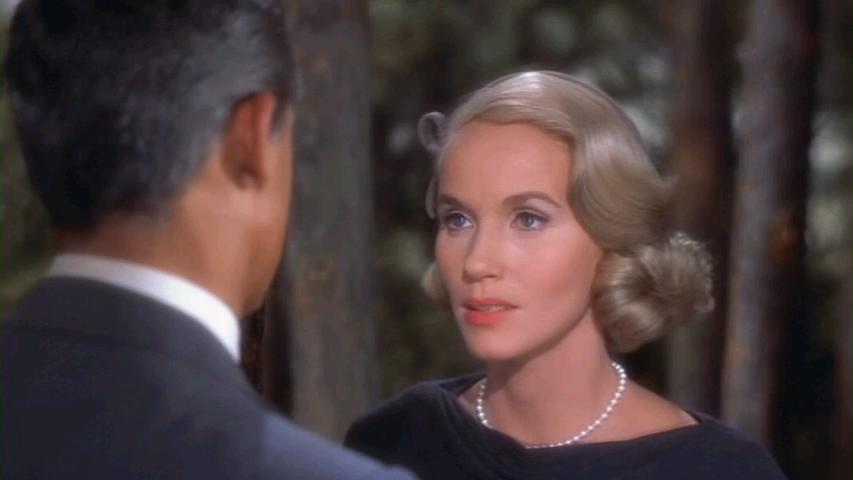
This is always the case that comes to mind when I try to think of the most unintentionally unflattering makeup job in movies. What are some other movies where someone is intended to look good, but is given makeup that makes him or her look less good than usual?
Thursday, September 17, 2009
In Honor Of Road Runner Anniversary Day
This is the 60th anniversary of "Fast and Furry-ous," and while the Chuck Jones site has the early Road Runner/Coyote model sheet posted today, I'm more interested in this November 1952 Chuck Jones letter they posted a few days ago, where he talks about working on a Road Runner cartoon -- which given the chronology is probably either "Stop, Look and Hasten!" or "Ready, Set, Zoom!" -- and the process of making these story-less, rigidly-formatted gag cartoons:
Even if the cartoon he was working on isn't "Stop, Look and Hasten," this is a good one to post, because I've noticed that a lot of people increasingly are picking that one as a favorite. Because it has a few things that give it kind of a story-like structure, if not an actual story -- the first of a few opening sequences where Jones and Maltese show the Coyote alone and hungry (Jones decided this wasn't necessary and soon gave up on it, but it worked well when he used it, and he brought back a variant of it in "To Beep Or Not To Beep"), and the gag that doesn't pay off the first time but pays off at the very end -- it feels like it holds together as a cartoon. Whereas some of the other cartoons, which may have better individual gags, could easily fit any of those gags into any other picture. The one big reservation I have about it is that ever since I was a child, I've been disappointed in any Road Runner cartoon that doesn't have the overhead shot of the Coyote falling into the canyon. That just is the Road Runner series to me.
One thing about the early Road Runner cartoons that slightly differentiates them from the later (post-shutdown) cartoons is that the early ones tended to have at least one genuine "chase" sequence: instead of just the Coyote trying to trap the Road Runner, there would be one scene where they were actually running, like the "clover" sequence in "Fast and Furry-Ous" or the tunnel bit in "Beep Beep." And here we get the scene on the train tracks, plus a sort of abbreviated chase scene at the end.
Heigh-ho or rather ho-hum. I’m a little sleepy. Been slamming through another Coyote and Roadrunner, as I may have mentioned. These are sort of money-in-the-bank type pictures. We don’t have to worry about establishing a premise or continuity or character development much or trick backgrounds. Everything’s pretty open. Just sit down and start drawing and when all the gags are roughed out, arrange them according to pace, so’s the picture will build in tempo, find myself a strong gag to end on and I’m in business. Timing is a snap because no dialogue and there’s no worry about making it too long, because I can time the gags as I go along and use just as many as I need. All in all, life could be very simple and maybe a little bit dull if all I had to do was direct coyote and r.r.s.
Even if the cartoon he was working on isn't "Stop, Look and Hasten," this is a good one to post, because I've noticed that a lot of people increasingly are picking that one as a favorite. Because it has a few things that give it kind of a story-like structure, if not an actual story -- the first of a few opening sequences where Jones and Maltese show the Coyote alone and hungry (Jones decided this wasn't necessary and soon gave up on it, but it worked well when he used it, and he brought back a variant of it in "To Beep Or Not To Beep"), and the gag that doesn't pay off the first time but pays off at the very end -- it feels like it holds together as a cartoon. Whereas some of the other cartoons, which may have better individual gags, could easily fit any of those gags into any other picture. The one big reservation I have about it is that ever since I was a child, I've been disappointed in any Road Runner cartoon that doesn't have the overhead shot of the Coyote falling into the canyon. That just is the Road Runner series to me.
One thing about the early Road Runner cartoons that slightly differentiates them from the later (post-shutdown) cartoons is that the early ones tended to have at least one genuine "chase" sequence: instead of just the Coyote trying to trap the Road Runner, there would be one scene where they were actually running, like the "clover" sequence in "Fast and Furry-Ous" or the tunnel bit in "Beep Beep." And here we get the scene on the train tracks, plus a sort of abbreviated chase scene at the end.
Tuesday, September 15, 2009
Mono, Stereo and All Those Things In Between
I didn't buy the mono super-limited edition Beatles recordings, even though I fully agree with those who say the mono mixes are superior (or at least, more authentic). I just couldn't justify the expense, and instead bought a few of the stereo recordings cheap. Of course with some of those 35-minute albums, EMI could easily have put both the mono and stereo mixes on one CD, but that would have been generous to the consumer and therefore forbidden by the code of record-company morality.
Anyway, I'm one who grew up listening to a lot of recordings from the late '50s and '60s -- more classical and Broadway than pop, but because my father bought most of his LPs in the late '50s, '60s and early '70s, that's where my listening habits were formed. Dad bought most of his LPs in stereo, because he was mostly a classical collector, and classical had converted to stereo almost completely by the '60s: there were still mono versions being released, but most of the producers had stopped paying attention to anything but the stereo mix, and buyers of classical LPs knew that the stereo was the "real" version. So those LPs had stereo mixes that were designed to appeal to the audiophile who wanted the concert-hall illusion: the idea was to provide the feeling that you were listening to an orchestra spread across your living room, and could pick out the position of every instrumental section or singer. Here's the start of the 1959 recording, Wagner's Rheingold, that helped define the way classical collectors liked their stereo to be mixed:
Then the show-music recordings were in a mix of real stereo and fake stereo: the mix was clearly genuine stereo, in that you could hear the orchestra spread across the stereo stage, but much of the mix -- and especially the voices -- was sort of mono-style. Either the voices would be bunched together in the middle or they'd be split between the extremes of the two speakers. If you listen to a Columbia cast album, you'll notice that when there are two singers, they're always singing to each other from opposite ends of the room; on the original cast album of The Sound of Music, in "My Favorite Things," Maria is on the extreme left and the Mother Superior is on the extreme right. (No political commentary intended.) I think this was sort of a combination of the mixing in the classical and jazz departments; at Columbia, classically-oriented Goddard Lieberson produced all the recordings, but his chief assistant, in charge of the mixing and post-production, was jazz producer Teo Macero, who liked extreme right-left contrasts. So here again is the mix for "Thinking" from Do I Hear a Waltz (by Richard Rodgers and Stephen Sondheim), sung by two characters who are supposed to be at a table together.
And then finally you have the recordings that were mixed in stereo that was really "triple mono." This is where pop acts like the Beatles come in. The stereo mixes of most of their recordings, as you probably know, are really just mono split in three, with one set of sounds on the left, another in the middle and another on the left. But even after they started mixing in real stereo, they did exactly the same thing. You can tell "Here Comes the Sun" is a true stereo recording because the sounds aren't as bisected as they were on the earlier recordings (there's more of a sense of space) and there are some "panning" effects. But it's still got the guitar on the extreme left, and the voices on the extreme right, an arrangement that makes no physical sense if you think of a recording as a representation of a performance. (Since George is playing the guitar on the left side of your living room but singing on the right.) Of course it's not supposed to be representative of a performance, so the issue doesn't come up, but that's the '60s way of stereo mixing in pop, whether for real or after the fact: put one thing on the right, and another on the left, and maybe the drums in the middle, and call it a day. It's not supposed to give the illusion of people in a place playing instruments and singing -- and it shouldn't.
Saturday, September 12, 2009
Grudge Match: Nerd Batman vs. Jock Batman

This is a Grudge Match™ idea I came up with a few years ago and kind of like: as we all know, Batman's success is based on the fact that he trained himself to become both the world's greatest jock and the world's greatest nerd, building his physical prowess and becoming, as Homer Simpson pointed out, a scientist.
So let's say some kind of evil science ray hits Batman (again) and splits him into his two halves, the jock side (with all his wacky martial-arts training and muscles) and the nerd side (with all his scientific knowledge and smarts). If these two Batmen fought against each other, who would win?
Nerd Batman (sometimes referred to as "BatNerd") has only average strength and speed, but is able to make all those elaborate contingency plans and anticipations of his opponent's moves. BatJock has only average intelligence, but has the ability to beat the crap out of nerds in silly costumes.

Who wins this archetypal brains vs. brawn battle?
Wednesday, September 09, 2009
Non-Offensive Subtext In a Busby Berkeley Number
I don't know why I hadn't seen Roman Scandals, even though I like Eddie Cantor and Busby Berkeley, and Berkeley was at his peak when Warners loaned him back to Goldwyn to do this film (he'd been the choreographer on the stage and film version of Cantor's Whoopee!). The "Keep Young and Beautiful" number is on YouTube, and it may now be the most famous part of the movie because it's the most appalling: not only is it Cantor's obligatory blackface number, but the whole song is about how women (including a young Lucille Ball) should spend all their time trying to be impossibly thin, wrinkle-free and perfect if they "want to be loved."
It's a great Harry Warren tune, though, and Al Dubin's contributions to these musicals are underrated: in numbers like this and "Shanghai Lil," he wrote a huge number of additional lyrics covering any idea Berkeley had. Because of Dubin, these were musical numbers that really used the songs to advance their own little self-contained stories, instead of just having Berkeley illustrate a short pop song.
The strange thing about the number is that as it progresses and gets more and more surreal and bizarre -- the usual pattern of a Berkeley number -- it almost seems to be rebelling against itself. First it betrays one of the rules of a blackface number by having the dancers actually notice that Cantor is a white guy in blackface, and get quite angry at him for it. Then the two groups of dancers, black and white, who were originally separated from each other, join together and team up against their common enemy: Cantor, the white guy pretending to be black, the man telling them all how they should look. They use one of the beauty treatments they had to go through to "keep young and beautiful" as an instrument of torture against Cantor, pumping their fists in revolutionary style.
I doubt Berkeley actually intended this to be some kind of act of revolution against the traditional blackface number or girlie number. But he would follow his crazy ideas wherever they took him, and that's where this particular idea seems to take him: the chorus girls take over the number, stage a coup, and kill the star.
It's a great Harry Warren tune, though, and Al Dubin's contributions to these musicals are underrated: in numbers like this and "Shanghai Lil," he wrote a huge number of additional lyrics covering any idea Berkeley had. Because of Dubin, these were musical numbers that really used the songs to advance their own little self-contained stories, instead of just having Berkeley illustrate a short pop song.
The strange thing about the number is that as it progresses and gets more and more surreal and bizarre -- the usual pattern of a Berkeley number -- it almost seems to be rebelling against itself. First it betrays one of the rules of a blackface number by having the dancers actually notice that Cantor is a white guy in blackface, and get quite angry at him for it. Then the two groups of dancers, black and white, who were originally separated from each other, join together and team up against their common enemy: Cantor, the white guy pretending to be black, the man telling them all how they should look. They use one of the beauty treatments they had to go through to "keep young and beautiful" as an instrument of torture against Cantor, pumping their fists in revolutionary style.
I doubt Berkeley actually intended this to be some kind of act of revolution against the traditional blackface number or girlie number. But he would follow his crazy ideas wherever they took him, and that's where this particular idea seems to take him: the chorus girls take over the number, stage a coup, and kill the star.
Speaking Of Music...
I haven't done a classical-music post here in a long time, even though (thanks to YouTube) I've been listening to more of it recently than I have in a while. One thing I've noticed about classical music on YouTube is that most of the comments show a disturbing obsession with speed. That is, every YouTube comment thread on a performance of a classical piece will consist mostly of a discussion of the tempo, usually with most commenters claiming it's too fast. (Sometimes they might say it's too slow, but this is not quite as common.)
Not that YouTube comments are a place where you expect to find deep intellectual commentary, but you're more likely to find relatively sophisticated discussion of musical performance in threads about pop music. For the classical videos, it mostly becomes an argument about tempo, divorced from other considerations like phrasing, balances (what instruments are allowed to dominate and which are muffled) and dynamics. Even the tempo discussions are weirdly divorced from reality, since you get people claiming that a slower tempo is what Beethoven or Mozart would have expected -- which, given that "Andante" and "Adagio" were faster in their day than they later became, just isn't true. Then you get the opposite, people pointing to metronome markings and historical evidence for what the "right" tempo is, and that in some ways is just as bad (what matters is whether the speed makes sense in this particular performance, not what the metronome marking says). Finally it becomes a discussion of the tempo the performer starts with, when most performances go through at least some change in speed. Some performers, the "romantic," demonstrative ones, make it clear when they're speeding up or slowing down, others try to disguise it, but they all do it to some extent. In short, the basic speed of a performance certainly is worth talking about, but not at the expense of everything else.
With that out of the way, here's a Beethoven symphony performance I found on the YouTube (aka "le YouTube," "der YouTube," and "il YouTuba"). It's by Frans Brüggen, a recorder player who also became Holland's leading period-instrument conductor, putting together a band called "The Orchestra of the 18th Century" with which he recorded a lot of (strangely enough) 19th century music by Beethoven and Schubert. His Beethoven is hard to find on disc, but it's actually probably the best of the period-instrument Beethoven. He turned in performances that were leaner and rougher than big-orchestra Beethoven, but also more flexible and personal in interpretation than the "authentic" Beethoven performances coming out of England.
This video is from a 2002 performance of Beethoven's 8th symphony, which is kind of perfect for YouTube because every movement is under 10 minutes, so each movement fits neatly into one video. In some ways it's Beethoven's weirdest symphony. He wrote it at a time when he was known for making symphonies bigger, longer and more ambitious than ever before; he wrote it at the same time as his 7th symphony. And yet it's the shortest symphony he ever wrote, deliberately re-introduces devices that were out of date (like calling the dance movement a "minuet"), and makes its impact by introducing weird, unsettling or surprising little moments into movements that are otherwise very light and conventional-sounding.
It's not at all the kind of thing you would have expected to find between his 7th and 9th symphonies, and people have spent almost 200 years trying to figure out what exactly he meant by writing it: was it a look back at the "classical" style of Haydn and Mozart? Was it a parody of old-fashioned compositional methods? Or maybe a parody of current musical fads? (There used to be a legend that the second movement was a parody of the metronome, a device that had only just been invented.) It's a fun piece, but there's something a little unsettling about the fun. That's one reason why the harsher sound of period instruments works well in this piece.
Not that YouTube comments are a place where you expect to find deep intellectual commentary, but you're more likely to find relatively sophisticated discussion of musical performance in threads about pop music. For the classical videos, it mostly becomes an argument about tempo, divorced from other considerations like phrasing, balances (what instruments are allowed to dominate and which are muffled) and dynamics. Even the tempo discussions are weirdly divorced from reality, since you get people claiming that a slower tempo is what Beethoven or Mozart would have expected -- which, given that "Andante" and "Adagio" were faster in their day than they later became, just isn't true. Then you get the opposite, people pointing to metronome markings and historical evidence for what the "right" tempo is, and that in some ways is just as bad (what matters is whether the speed makes sense in this particular performance, not what the metronome marking says). Finally it becomes a discussion of the tempo the performer starts with, when most performances go through at least some change in speed. Some performers, the "romantic," demonstrative ones, make it clear when they're speeding up or slowing down, others try to disguise it, but they all do it to some extent. In short, the basic speed of a performance certainly is worth talking about, but not at the expense of everything else.
With that out of the way, here's a Beethoven symphony performance I found on the YouTube (aka "le YouTube," "der YouTube," and "il YouTuba"). It's by Frans Brüggen, a recorder player who also became Holland's leading period-instrument conductor, putting together a band called "The Orchestra of the 18th Century" with which he recorded a lot of (strangely enough) 19th century music by Beethoven and Schubert. His Beethoven is hard to find on disc, but it's actually probably the best of the period-instrument Beethoven. He turned in performances that were leaner and rougher than big-orchestra Beethoven, but also more flexible and personal in interpretation than the "authentic" Beethoven performances coming out of England.
This video is from a 2002 performance of Beethoven's 8th symphony, which is kind of perfect for YouTube because every movement is under 10 minutes, so each movement fits neatly into one video. In some ways it's Beethoven's weirdest symphony. He wrote it at a time when he was known for making symphonies bigger, longer and more ambitious than ever before; he wrote it at the same time as his 7th symphony. And yet it's the shortest symphony he ever wrote, deliberately re-introduces devices that were out of date (like calling the dance movement a "minuet"), and makes its impact by introducing weird, unsettling or surprising little moments into movements that are otherwise very light and conventional-sounding.
It's not at all the kind of thing you would have expected to find between his 7th and 9th symphonies, and people have spent almost 200 years trying to figure out what exactly he meant by writing it: was it a look back at the "classical" style of Haydn and Mozart? Was it a parody of old-fashioned compositional methods? Or maybe a parody of current musical fads? (There used to be a legend that the second movement was a parody of the metronome, a device that had only just been invented.) It's a fun piece, but there's something a little unsettling about the fun. That's one reason why the harsher sound of period instruments works well in this piece.
Monday, September 07, 2009
So That's What an Orchestra Sounds Like
There was never a final episode for Animaniacs, so so put together the 99th and last episode, the producers took one leftover cartoon and asked Richard Stone, the supervising composer, to fill out the episode by composing an "Animaniacs Suite" based on the various themes he had written for the characters. (All the characters had original themes except Slappy Squirrel, whose theme was Dvořák's 7th "Humoresque.") The music was illustrated with clips from the previous 98 episodes. I don't think the cartoon has been run very often -- YTV used to have a package that consisted of the first 98 episodes, but not this elusive 99th. It's too bad, because the Suite, written for an expanded orchestra, stands as a nice tribute to Stone, who died only a few years later. I don't think it would really work as a separate orchestral piece (though I doubt Warners ever even bothered trying to market it that way), but I wouldn't mind being able to get it as a separate track or download, without the sound effects. I would also like the Goodfeathers section to be longer, since I thought the combination of cartoony music with jazzy New York movie music made for some of the show's best scores.
The question of how much you do or don't like Stone's style -- and the style of his other staff composers, but they all learned to write exactly like him -- is inseparable from the question of what you think of the shows, since he was an exact match for the style of the shows he composed for: brash, loud, and with a tendency toward obvious effects; if there was ever an opportunity for a wah-wah trombone moan, he'd take it. (Some of this, though, may not have been his personal choice; in his interview with Daniel Goldmark, he mentioned that he would have preferred to hold the music back for explosions and let the sound effects do the work, the way Stalling did, but that he was asked to put big musical stings under the explosion effects.) Also, no matter who was orchestrating for him, the obsessive use of the xylophone is a feature of nearly all Stone scores.
But I don't think any of that matters much compared to his ability to find the exact right musical style for these shows. Tiny Toons, which didn't have as much of a uniform style, had some good scores, some weak scores, and just like the show itself, we didn't always quite know what kind of style it was aiming for. Stone came up with a type of music that sounded like what Tiny Toons, Animaniacs and the rest were trying to be: like the old cartoons, but not too much like them (because any time they tried to compete head-to-head with the classic stuff, they inevitably fell short). It was like Carl Stalling music in terms of the effects and the musical jokes, but if you compared a Stone score with a Stalling score you would find that the overall sound wasn't unpleasantly similar (in part because it had just enough of a '90s sound to it to avoid sounding like a complete retro throwback). It's music that nods to the past but sidesteps unflattering direct comparisons, just like the shows were trying to do.
The upload above is in mono; there's also a YouTube clip that has only the audio of this segment, without the video, but it's in stereo, and in some ways the music comes off better without the clips.
The question of how much you do or don't like Stone's style -- and the style of his other staff composers, but they all learned to write exactly like him -- is inseparable from the question of what you think of the shows, since he was an exact match for the style of the shows he composed for: brash, loud, and with a tendency toward obvious effects; if there was ever an opportunity for a wah-wah trombone moan, he'd take it. (Some of this, though, may not have been his personal choice; in his interview with Daniel Goldmark, he mentioned that he would have preferred to hold the music back for explosions and let the sound effects do the work, the way Stalling did, but that he was asked to put big musical stings under the explosion effects.) Also, no matter who was orchestrating for him, the obsessive use of the xylophone is a feature of nearly all Stone scores.
But I don't think any of that matters much compared to his ability to find the exact right musical style for these shows. Tiny Toons, which didn't have as much of a uniform style, had some good scores, some weak scores, and just like the show itself, we didn't always quite know what kind of style it was aiming for. Stone came up with a type of music that sounded like what Tiny Toons, Animaniacs and the rest were trying to be: like the old cartoons, but not too much like them (because any time they tried to compete head-to-head with the classic stuff, they inevitably fell short). It was like Carl Stalling music in terms of the effects and the musical jokes, but if you compared a Stone score with a Stalling score you would find that the overall sound wasn't unpleasantly similar (in part because it had just enough of a '90s sound to it to avoid sounding like a complete retro throwback). It's music that nods to the past but sidesteps unflattering direct comparisons, just like the shows were trying to do.
The upload above is in mono; there's also a YouTube clip that has only the audio of this segment, without the video, but it's in stereo, and in some ways the music comes off better without the clips.
Thursday, September 03, 2009
A Reminder That DVD Classics Still Exist
Well, they still do. John Ford's Wagon Master is coming out on DVD next week. (Or possibly the week after; it seems like some stores might have it next week.) It's one of Ford's own favorites among his films, and there's no doubt that Wagon Master is one of his best Westerns.
Watch Wagon Master (1950, John Ford) in Drama | View More Free Videos Online at Veoh.com
It was passed over for DVD release a few times because it doesn't have any stars in it; the closest thing to a star is Ben Johnson, but really the "star" is Ford's whole stock company, including Johnson, Harry Carey Jr. (who participates in the commentary track with the ubiquitous Peter Bogdanovich), Ward Bond, Jane Darwell, and Alan Mowbray, who get to do their thing without being overshadowed by a star like Wayne or Fonda. If Fort Apache, my own favorite Ford Western, is a movie with almost nothing but stars -- as others have noted, nearly everybody in the film either was a big star (Wayne, Fonda), used to be a star (Shirley Temple, George O'Brien), or was a star in Mexico (Pedro Armendáriz, Miguel Inclán) -- then Wagon Master is the movie that does without stars altogether. I think that may be something Ford especially valued about it, since his other '50s favorite, The Sun Shines Bright, is similarly star-less.
The odd person out in Wagon Master is the female lead, Joanne Dru, since she wasn't precisely a Ford stock player, though she had been in his previous Western, She Wore a Yellow Ribbon. One thing that's a bit unusual about her is that she was a Howard Hawks discovery who was then taken up by Ford. They usually had very different tastes in leading women. Hawks used Dru in Red River as part of his usual pattern of finding an unknown actress and making her play the typical Hawks woman (Lauren Bacall, Angie Dickinson). And, also part of his usual pattern, he never did another film with her. Then Ford used her, first as the sort of spunky-but-not-too-independent girl he liked to feature in his Westerns (Vera Miles, Maureen O'Hara), then in Wagon Master as someone a little closer to her Red River character.
None of these are great parts -- her Red River character, unlike the similar characters played by Bacall and Dickinson, is too peripheral to the story to make any impact -- but I've always liked her in all three movies. But they didn't help her career much, because they caused her to be typecast as a Western heroine. In the mid-'50s she tried to change her image with some decidedly non-Western photoshoots, but it didn't get her any better parts, and she didn't look any more comfortable in those photos than she did in gingham gowns

She just seemed a little angry all the time, even when playing the good girl; in She Wore a Yellow Ribbon the first shot of her has her looking like she's going to kill somebody, and she acts that way through the whole movie.
Watch Wagon Master (1950, John Ford) in Drama | View More Free Videos Online at Veoh.com
It was passed over for DVD release a few times because it doesn't have any stars in it; the closest thing to a star is Ben Johnson, but really the "star" is Ford's whole stock company, including Johnson, Harry Carey Jr. (who participates in the commentary track with the ubiquitous Peter Bogdanovich), Ward Bond, Jane Darwell, and Alan Mowbray, who get to do their thing without being overshadowed by a star like Wayne or Fonda. If Fort Apache, my own favorite Ford Western, is a movie with almost nothing but stars -- as others have noted, nearly everybody in the film either was a big star (Wayne, Fonda), used to be a star (Shirley Temple, George O'Brien), or was a star in Mexico (Pedro Armendáriz, Miguel Inclán) -- then Wagon Master is the movie that does without stars altogether. I think that may be something Ford especially valued about it, since his other '50s favorite, The Sun Shines Bright, is similarly star-less.
The odd person out in Wagon Master is the female lead, Joanne Dru, since she wasn't precisely a Ford stock player, though she had been in his previous Western, She Wore a Yellow Ribbon. One thing that's a bit unusual about her is that she was a Howard Hawks discovery who was then taken up by Ford. They usually had very different tastes in leading women. Hawks used Dru in Red River as part of his usual pattern of finding an unknown actress and making her play the typical Hawks woman (Lauren Bacall, Angie Dickinson). And, also part of his usual pattern, he never did another film with her. Then Ford used her, first as the sort of spunky-but-not-too-independent girl he liked to feature in his Westerns (Vera Miles, Maureen O'Hara), then in Wagon Master as someone a little closer to her Red River character.
None of these are great parts -- her Red River character, unlike the similar characters played by Bacall and Dickinson, is too peripheral to the story to make any impact -- but I've always liked her in all three movies. But they didn't help her career much, because they caused her to be typecast as a Western heroine. In the mid-'50s she tried to change her image with some decidedly non-Western photoshoots, but it didn't get her any better parts, and she didn't look any more comfortable in those photos than she did in gingham gowns

She just seemed a little angry all the time, even when playing the good girl; in She Wore a Yellow Ribbon the first shot of her has her looking like she's going to kill somebody, and she acts that way through the whole movie.
It's Friendship, But Not Bob
Just a note on Art Spiegelman and Françoise Mouly's "Classic Children's Comics": the one story credited to Bob Bolling in the volume, "It's Friendship," is probably not Bolling. It's not signed by him, and the art and writing style isn't really his; he was drawing the characters shorter and plumper at the time. Others have identified it as probably being Dexter Taylor, who had just started on the title.
The mistaken credit is a shame for Bolling, who deserved to have several stories in such a book and instead has none, but it's a far bigger shame for Taylor, who -- while his work suffers by comparison to Bolling's -- has been working on this title virtually uninterrupted since 1957, much of it without credit.
Still, I suppose it's a good thing that Taylor got a story into the anthology, in recognition -- albeit accidental -- of his long career as one of the most widely-read children's comics' creators, even though the story isn't one of his better ones. (My suspicion is that Spiegelman and Mouly chose this story because it's somewhat similar to the formula of the "big" titles; it's not really a particularly interesting story.) And perhaps the credit will be fixed in future printings.
That still leaves us waiting for "The Long Walk" ,which was considered for this anthology, and somehow lost out to many lesser stories, to make it into a book.
(I've never really figured out why Bolling was allowed to sign his stories and nobody else was, but I suspect that it's a combination of two things: one, the need to have kids associate the title with a particular name the way they associated Dennis the Menace with Hank Ketcham, and two, letting the creator of a franchise sign his name was a cheap way of stopping him from asking for more money. It's the Mel Blanc principle: give somebody credit instead of a raise.)
The mistaken credit is a shame for Bolling, who deserved to have several stories in such a book and instead has none, but it's a far bigger shame for Taylor, who -- while his work suffers by comparison to Bolling's -- has been working on this title virtually uninterrupted since 1957, much of it without credit.
Still, I suppose it's a good thing that Taylor got a story into the anthology, in recognition -- albeit accidental -- of his long career as one of the most widely-read children's comics' creators, even though the story isn't one of his better ones. (My suspicion is that Spiegelman and Mouly chose this story because it's somewhat similar to the formula of the "big" titles; it's not really a particularly interesting story.) And perhaps the credit will be fixed in future printings.
That still leaves us waiting for "The Long Walk" ,which was considered for this anthology, and somehow lost out to many lesser stories, to make it into a book.
(I've never really figured out why Bolling was allowed to sign his stories and nobody else was, but I suspect that it's a combination of two things: one, the need to have kids associate the title with a particular name the way they associated Dennis the Menace with Hank Ketcham, and two, letting the creator of a franchise sign his name was a cheap way of stopping him from asking for more money. It's the Mel Blanc principle: give somebody credit instead of a raise.)
Tuesday, September 01, 2009
Hugh Martin Claims Credit For Lots of Suff, Probably Accurately
Hugh Martin (Meet Me In St. Louis, Best Foot Forward, "An Occasional Man") is one of my favorite people in the history of American show music, a terrific songwriter and perhaps the greatest vocal arranger in Broadway history. (His arrangements for songs like "Sing For Your Supper" in The Boys From Syracuse sometimes outshine the songs themselves.) He's still alive, in his 90s; he was interviewed for Steven Suskin's book on Broadway orchestration, and recently, Martin's friend Michael Feinstein asked him for some thoughts on a new book about his songwriting/singing partner, Ralph Blane.
Martin responded -- at least I'm assuming this is legit -- with this partial list of corrections, mostly pointing out that many Martin-Blane songs were in fact Martin's alone, and that all the vocal arrangements were by Martin since Blane "couldn't do a vocal arrangement if his life depended on it."
The succession of "I wrote this" and "I wrote that" lines may become a bit wearying, but I find it interesting, because I love these songs and there has been very little documentation of who wrote what. Martin and Blane's partnership was, as I've said many times, essentially the same as Lennon and McCartney's in the last few years of the Beatles, where they would each write songs on their own (both music and lyrics), then take joint credit for all the songs, as well as making small changes to each other's work. Some books -- including, apparently, this book on Blane -- mistakenly say that Martin wrote the music and Blane the lyrics, when in fact they almost never worked this way. (Martin says that the only song they wrote like that was "Three Men On a Date," a song from Best Foot Forward.) It's hard to identify who wrote what, but Martin is often responsible for the songs that have big jazzy choral sections and a hard-driving, peppy style also typical of his friend Kay Thompson.
In Best Foot Forward, their first Broadway and movie success, Suskin's Show Tunes identifies some of the songs by author; Blane wrote the big hit "Buckle Down Winsocki" and my favorite song from the show, "Shady Lady Bird," which unfortunately was not used in the film. Benny Goodman recorded the song with Peggy Lee singing; here it is, just as a reminder that Blane was a fine songwriter himself (something that can get lost in Martin's comments, because he's responding to a book that apparently tried to give Blane credit for everything).
Incidentally, why has Encores! not done this show? Great score, the original jazz-influenced Don Walker orchestrations and Martin vocal arrangements would sound great, and the only place anybody has heard the full score is the 1963 Off-Broadway revival with the young Christopher Walken and Liza Minnelli, which used only two pianos and jettisoned Martin's choral arrangements.
Anyway, Martin's contributions to Best Foot Forward the wonderful ironic torch song "Ev'ry Time." I recall seeing somewhere that "Three B's" was mostly Martin, though since it's really a suite of songs, there might be contributions from both of them in there. And according to "Show Tunes," one song from the show, "The Guy Who Brought Me," was mostly written uncredited by Richard Rodgers, who was a producer of the show.
As the Martin/Blane collaboration continued, Martin seems to have done more of the memorable work; his solo work, compared to Blane's (they both did musicals and movies on their own or with other collaborators) suggests that he had become the superior songwriter, which would explain why their big hits after 1943 or so tend to be Martin's work.
That's maybe too much credit-assigning for one post, but I say all this just to emphasize that songwriting credits for Broadway and Hollywood musicals can be every bit as deceptive as their counterparts in modern pop music.
AAs for Martin's comments, I'm assuming that they are real if only because the information given in the post checks out with the little bits of information that have been confirmed before: I knew that Blane wrote "Buckle Down Winsocki" himself and that "Have Yourself a Merry Little Christmas" is all Martin. And he says that my favorite song from the team, "An Occasional Man" (see above) was one of his, which is what I guessed in an earlier post, so I'm naturally inclined to accept it at face value...
Martin also explains why one of the most famous Martin-Blane novelty songs is credited jointly to them and Roger Edens, Arthur Freed's brilliant right-hand man:
Roger Edens went to the library and made a list of Indian tribes that started with "Ch." He also wrote 8 bars of music that he thought might be appropriate. I went home that night and wrote "Pass That Peace Pipe," using Roger's 8 bars of melody and all of the Indian tribes that he listed. The song got an Oscar nomination in 1947.
Annoyingly, the original version of "Pass That Peace Pipe" has been pulled from YouTube. Of the versions that are on there, the version from Duckman is (somewhat surprisingly) much better than the one by the Muppets.
Subscribe to:
Posts (Atom)
