In my recent Bob Bolling profile, I noted that he tended to change the designs of the characters depending on what kind of story he was doing. There's another reason why cartoonists change a character's design, of course: because the character hasn't appeared often enough to have a fixed design. One character who fit into both categories for Mr. Bolling was the never-named (at least in his stories) Mrs. Cooper. The look of Bolling's Mr. Cooper, while not entirely consistent, at least portrayed him as more or less the same guy every time: a middle-aged guy with glasses. (If you try to put these stories into some kind of strict continuity you would conclude that he actually got younger by the time his youngest daughter was a teenager.) But Mrs. Cooper? I don't have an example of her early appearances in this title, but all the women in the first few years looked the same: generic suburban housewives. (Except Mrs. Andrews who was "generic hot suburban housewife.")
But then Bolling introduced an older brother, Chic Cooper, and he realized that if Mrs. Cooper had a college-age son, she couldn't be as young as the other mothers in town. So in issue # 12 she became a pudgy middle-aged woman (like what poor Mary Andrews is destined to become).
Then, three issues later, Bolling decided to do some solo stories for Little Betty, and suddenly her mom looks not only younger than Mrs. Andrews, but younger than most teenagers in this universe. The implications of her being married to Mr. Cooper are frankly disturbing.
But in the very next issue, Mrs. Cooper puts in an appearance in one of the adventure stories. Bolling's technique for the adventure/mystery stories was to draw the kids in the normal, cartoony fashion but draw everyone else, including the parents, realistically. And so Mrs. Cooper goes from what we saw above, to what we see below:
Addendum: Here's another panel from the same story that shows the cartoony kids/realistic adults style Bolling used for these adventure tales.
But don't worry, in the very next issue she's back to being a cute cartoony blonde married to a man apparently half again as old as she is (still an improvement over twice as old, which is how he looked two issues ago).
A couple of years went by and Bolling introduced Polly, featuring her in four or five stories. Because the design for Polly was basically the same as the design he'd used for Mrs. Cooper in some of the earlier stories, Mrs. Cooper once again has to look like somebody who could have an older kid... but Bolling may have overdone it:
One issue later, Mrs. Cooper is back in a more plausible and moderately age-appropriate version.
But that wasn't the end of it, because when Bolling returned to the series in the '80s, Mrs. Cooper was once again looking like someone who should not be married to a schlumpy-looking guy (one who appears to spend most of his time chasing his daughter's cat across rooftops).
The lesson of all this? I'm not sure. Unless it's that Mr. Cooper keeps divorcing and/or disposing of wives in much the way that Mrs. Andrews keeps getting new and different-looking husbands. And even if he is a sort of modern Bluebeard, it wouldn't explain why his wives vary so greatly in age. One of those eternal comics mysteries, I guess.
What I argued a few years ago was that many of Wodehouse's works, and in particular the short stories, are basically parodies of popular fiction from the early 20th century; the subjects and stock characters that other writers might be dealing with in a serious way -- dissolute young clubmen, bluff, hearty ex-explorers -- are played for laughs. The Mr. Mulliner stories, my favorite Wodehouse series, are a send-up of a once-popular type of fiction which is "framed" by a bunch of people sitting around and listening to one person tell them the story. (It was a deliberate send-up of a type of story that Wodehouse particularly disliked.)
One of the few Mulliner stories about a woman, Mr. Mulliner's niece Charlotte, is "Unpleasantness at Bludleigh Court": Charlotte, a pretentious animal-rights supporter who writes "Vignettes in Verse," and her boyfriend, an equally pretentious writer of "Pastels in Prose," go to a country house populated by stereotypical hunting addicts. The house exercises some kind of power that turns anyone into a lover of hunting; by the end of the story she and her gentleman friend are trying to shoot an old man with an air-gun, and her poems are all about the joys of shooting gnus. It also contains one of the very greatest Wodehouse lines:
The sky was blue. The sun was shining. All Nature seemed to call to her to come out and kill things.
According to Givran, a discussion on a message board has suggested that this might be a parody of a John Buchan story that had appeared the year before, called "Fullcircle: Martin Peckwether's Story." It's about a young literarily-inclined, couple that moves into a house that exerts a similar fascination on them, until they drop their freethinking ways and become just like the person who originally owned the house.
Now, Wodehouse might not have had that specific story in mind, because he'd already written a somewhat similar (and truly insane) story called "Honeysuckle Cottage," in which a writer of hard-boiled mysteries moves into a house owned by his aunt, a writer of soppy romance novels. He finds himself not only being possessed by the spirit of his aunt's writing (coy, beautiful maidens keep finding their way into his stories along with lines like "a veritable child of faerie") but also finds himself living out the plot of one of her sentimental books: a beautiful girl gets hit by a car and winds up staying in his house, he saves her dog's life, the girl's aged fiance nobly steps aside so she can be with the man of her heart, etc. (The story is a great guide to the cliches of a type of novel -- the completely sexless romance -- that no longer exists.) But the Buchan story does show that this kind of plot was used frequently in serious, or at least semi-serious fiction. Wodehouse's stories are crazier versions of plots that were actually played straight in the rest of the magazine.
As time went on and those stories started to die out, of course, Wodehouse's treatment of these ideas and characters became more stylized, because his audience was no longer aware that they were supposed to be parodies of anything.
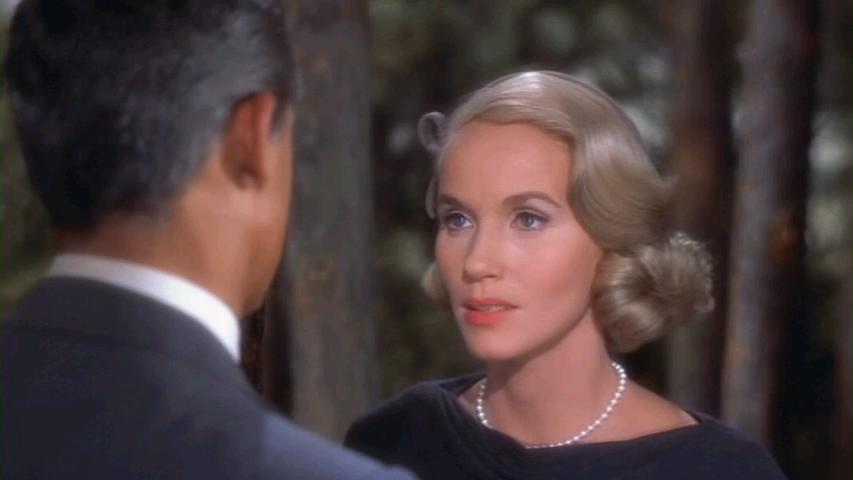
North By Northwest is on now (I wonder if the upcoming Blu-Ray release will finally correct the mis-framing that cuts off the full name on the secret spy agency's plaque? It's been cut off in every version of the film I've seen). It reminds me that one of the Pauline Kael observations I really agreed with was her denunciation of Eva Marie Saint's makeup in this film. Kael wrote that "a perverse make-up artist has turned her into an albino African mask."
When I saw the movie for the first time, it was the second thing I'd ever seen Saint in, the first being Exodus, and I thought she didn't look as good as she had in Exodus. Then I saw her in On the Waterfront and other movies where she wasn't too ostentatiously made up, and she looked great. But in North By Northwest her face looks lumpy and artificial. There's no such thing as a truly "natural" look in movies -- everybody's changed by the camera, even if they don't wear any makeup at all -- but sometimes a person looks better when the makeup and hair people are trying to make him or her look natural, and that's definitely the case here. The more they try to make her look like a beautiful blonde, the less she looks like one, even though she actually is a beautiful blonde.
This is probably due to a combination of a) Hitchcock's desire to make her look like the generic Hitchcock Blonde and b) An unfamiliar makeup department -- this was Hitchcock's only movie at MGM, and while he took most of his Paramount crew along with him, he used MGM's hair and makeup crew.
This is always the case that comes to mind when I try to think of the most unintentionally unflattering makeup job in movies. What are some other movies where someone is intended to look good, but is given makeup that makes him or her look less good than usual?
This is the 60th anniversary of "Fast and Furry-ous," and while the Chuck Jones site has the early Road Runner/Coyote model sheet posted today, I'm more interested in this November 1952 Chuck Jones letter they posted a few days ago, where he talks about working on a Road Runner cartoon -- which given the chronology is probably either "Stop, Look and Hasten!" or "Ready, Set, Zoom!" -- and the process of making these story-less, rigidly-formatted gag cartoons:
Heigh-ho or rather ho-hum. I’m a little sleepy. Been slamming through another Coyote and Roadrunner, as I may have mentioned. These are sort of money-in-the-bank type pictures. We don’t have to worry about establishing a premise or continuity or character development much or trick backgrounds. Everything’s pretty open. Just sit down and start drawing and when all the gags are roughed out, arrange them according to pace, so’s the picture will build in tempo, find myself a strong gag to end on and I’m in business. Timing is a snap because no dialogue and there’s no worry about making it too long, because I can time the gags as I go along and use just as many as I need. All in all, life could be very simple and maybe a little bit dull if all I had to do was direct coyote and r.r.s.
Even if the cartoon he was working on isn't "Stop, Look and Hasten," this is a good one to post, because I've noticed that a lot of people increasingly are picking that one as a favorite. Because it has a few things that give it kind of a story-like structure, if not an actual story -- the first of a few opening sequences where Jones and Maltese show the Coyote alone and hungry (Jones decided this wasn't necessary and soon gave up on it, but it worked well when he used it, and he brought back a variant of it in "To Beep Or Not To Beep"), and the gag that doesn't pay off the first time but pays off at the very end -- it feels like it holds together as a cartoon. Whereas some of the other cartoons, which may have better individual gags, could easily fit any of those gags into any other picture. The one big reservation I have about it is that ever since I was a child, I've been disappointed in any Road Runner cartoon that doesn't have the overhead shot of the Coyote falling into the canyon. That just is the Road Runner series to me.
One thing about the early Road Runner cartoons that slightly differentiates them from the later (post-shutdown) cartoons is that the early ones tended to have at least one genuine "chase" sequence: instead of just the Coyote trying to trap the Road Runner, there would be one scene where they were actually running, like the "clover" sequence in "Fast and Furry-Ous" or the tunnel bit in "Beep Beep." And here we get the scene on the train tracks, plus a sort of abbreviated chase scene at the end.
I didn't buy the mono super-limited edition Beatles recordings, even though I fully agree with those who say the mono mixes are superior (or at least, more authentic). I just couldn't justify the expense, and instead bought a few of the stereo recordings cheap. Of course with some of those 35-minute albums, EMI could easily have put both the mono and stereo mixes on one CD, but that would have been generous to the consumer and therefore forbidden by the code of record-company morality.
Anyway, I'm one who grew up listening to a lot of recordings from the late '50s and '60s -- more classical and Broadway than pop, but because my father bought most of his LPs in the late '50s, '60s and early '70s, that's where my listening habits were formed. Dad bought most of his LPs in stereo, because he was mostly a classical collector, and classical had converted to stereo almost completely by the '60s: there were still mono versions being released, but most of the producers had stopped paying attention to anything but the stereo mix, and buyers of classical LPs knew that the stereo was the "real" version. So those LPs had stereo mixes that were designed to appeal to the audiophile who wanted the concert-hall illusion: the idea was to provide the feeling that you were listening to an orchestra spread across your living room, and could pick out the position of every instrumental section or singer. Here's the start of the 1959 recording, Wagner's Rheingold, that helped define the way classical collectors liked their stereo to be mixed:
Then the show-music recordings were in a mix of real stereo and fake stereo: the mix was clearly genuine stereo, in that you could hear the orchestra spread across the stereo stage, but much of the mix -- and especially the voices -- was sort of mono-style. Either the voices would be bunched together in the middle or they'd be split between the extremes of the two speakers. If you listen to a Columbia cast album, you'll notice that when there are two singers, they're always singing to each other from opposite ends of the room; on the original cast album of The Sound of Music, in "My Favorite Things," Maria is on the extreme left and the Mother Superior is on the extreme right. (No political commentary intended.) I think this was sort of a combination of the mixing in the classical and jazz departments; at Columbia, classically-oriented Goddard Lieberson produced all the recordings, but his chief assistant, in charge of the mixing and post-production, was jazz producer Teo Macero, who liked extreme right-left contrasts. So here again is the mix for "Thinking" from Do I Hear a Waltz (by Richard Rodgers and Stephen Sondheim), sung by two characters who are supposed to be at a table together.
And then finally you have the recordings that were mixed in stereo that was really "triple mono." This is where pop acts like the Beatles come in. The stereo mixes of most of their recordings, as you probably know, are really just mono split in three, with one set of sounds on the left, another in the middle and another on the left. But even after they started mixing in real stereo, they did exactly the same thing. You can tell "Here Comes the Sun" is a true stereo recording because the sounds aren't as bisected as they were on the earlier recordings (there's more of a sense of space) and there are some "panning" effects. But it's still got the guitar on the extreme left, and the voices on the extreme right, an arrangement that makes no physical sense if you think of a recording as a representation of a performance. (Since George is playing the guitar on the left side of your living room but singing on the right.) Of course it's not supposed to be representative of a performance, so the issue doesn't come up, but that's the '60s way of stereo mixing in pop, whether for real or after the fact: put one thing on the right, and another on the left, and maybe the drums in the middle, and call it a day. It's not supposed to give the illusion of people in a place playing instruments and singing -- and it shouldn't.
This is a Grudge Match™ idea I came up with a few years ago and kind of like: as we all know, Batman's success is based on the fact that he trained himself to become both the world's greatest jock and the world's greatest nerd, building his physical prowess and becoming, as Homer Simpson pointed out, a scientist.
So let's say some kind of evil science ray hits Batman (again) and splits him into his two halves, the jock side (with all his wacky martial-arts training and muscles) and the nerd side (with all his scientific knowledge and smarts). If these two Batmen fought against each other, who would win?
Nerd Batman (sometimes referred to as "BatNerd") has only average strength and speed, but is able to make all those elaborate contingency plans and anticipations of his opponent's moves. BatJock has only average intelligence, but has the ability to beat the crap out of nerds in silly costumes.
I don't know why I hadn't seen Roman Scandals, even though I like Eddie Cantor and Busby Berkeley, and Berkeley was at his peak when Warners loaned him back to Goldwyn to do this film (he'd been the choreographer on the stage and film version of Cantor's Whoopee!). The "Keep Young and Beautiful" number is on YouTube, and it may now be the most famous part of the movie because it's the most appalling: not only is it Cantor's obligatory blackface number, but the whole song is about how women (including a young Lucille Ball) should spend all their time trying to be impossibly thin, wrinkle-free and perfect if they "want to be loved."
It's a great Harry Warren tune, though, and Al Dubin's contributions to these musicals are underrated: in numbers like this and "Shanghai Lil," he wrote a huge number of additional lyrics covering any idea Berkeley had. Because of Dubin, these were musical numbers that really used the songs to advance their own little self-contained stories, instead of just having Berkeley illustrate a short pop song.
The strange thing about the number is that as it progresses and gets more and more surreal and bizarre -- the usual pattern of a Berkeley number -- it almost seems to be rebelling against itself. First it betrays one of the rules of a blackface number by having the dancers actually notice that Cantor is a white guy in blackface, and get quite angry at him for it. Then the two groups of dancers, black and white, who were originally separated from each other, join together and team up against their common enemy: Cantor, the white guy pretending to be black, the man telling them all how they should look. They use one of the beauty treatments they had to go through to "keep young and beautiful" as an instrument of torture against Cantor, pumping their fists in revolutionary style.
I doubt Berkeley actually intended this to be some kind of act of revolution against the traditional blackface number or girlie number. But he would follow his crazy ideas wherever they took him, and that's where this particular idea seems to take him: the chorus girls take over the number, stage a coup, and kill the star.
I haven't done a classical-music post here in a long time, even though (thanks to YouTube) I've been listening to more of it recently than I have in a while. One thing I've noticed about classical music on YouTube is that most of the comments show a disturbing obsession with speed. That is, every YouTube comment thread on a performance of a classical piece will consist mostly of a discussion of the tempo, usually with most commenters claiming it's too fast. (Sometimes they might say it's too slow, but this is not quite as common.)
Not that YouTube comments are a place where you expect to find deep intellectual commentary, but you're more likely to find relatively sophisticated discussion of musical performance in threads about pop music. For the classical videos, it mostly becomes an argument about tempo, divorced from other considerations like phrasing, balances (what instruments are allowed to dominate and which are muffled) and dynamics. Even the tempo discussions are weirdly divorced from reality, since you get people claiming that a slower tempo is what Beethoven or Mozart would have expected -- which, given that "Andante" and "Adagio" were faster in their day than they later became, just isn't true. Then you get the opposite, people pointing to metronome markings and historical evidence for what the "right" tempo is, and that in some ways is just as bad (what matters is whether the speed makes sense in this particular performance, not what the metronome marking says). Finally it becomes a discussion of the tempo the performer starts with, when most performances go through at least some change in speed. Some performers, the "romantic," demonstrative ones, make it clear when they're speeding up or slowing down, others try to disguise it, but they all do it to some extent. In short, the basic speed of a performance certainly is worth talking about, but not at the expense of everything else.
With that out of the way, here's a Beethoven symphony performance I found on the YouTube (aka "le YouTube," "der YouTube," and "il YouTuba"). It's by Frans Brüggen, a recorder player who also became Holland's leading period-instrument conductor, putting together a band called "The Orchestra of the 18th Century" with which he recorded a lot of (strangely enough) 19th century music by Beethoven and Schubert. His Beethoven is hard to find on disc, but it's actually probably the best of the period-instrument Beethoven. He turned in performances that were leaner and rougher than big-orchestra Beethoven, but also more flexible and personal in interpretation than the "authentic" Beethoven performances coming out of England.
This video is from a 2002 performance of Beethoven's 8th symphony, which is kind of perfect for YouTube because every movement is under 10 minutes, so each movement fits neatly into one video. In some ways it's Beethoven's weirdest symphony. He wrote it at a time when he was known for making symphonies bigger, longer and more ambitious than ever before; he wrote it at the same time as his 7th symphony. And yet it's the shortest symphony he ever wrote, deliberately re-introduces devices that were out of date (like calling the dance movement a "minuet"), and makes its impact by introducing weird, unsettling or surprising little moments into movements that are otherwise very light and conventional-sounding.
It's not at all the kind of thing you would have expected to find between his 7th and 9th symphonies, and people have spent almost 200 years trying to figure out what exactly he meant by writing it: was it a look back at the "classical" style of Haydn and Mozart? Was it a parody of old-fashioned compositional methods? Or maybe a parody of current musical fads? (There used to be a legend that the second movement was a parody of the metronome, a device that had only just been invented.) It's a fun piece, but there's something a little unsettling about the fun. That's one reason why the harsher sound of period instruments works well in this piece.
There was never a final episode for Animaniacs, so so put together the 99th and last episode, the producers took one leftover cartoon and asked Richard Stone, the supervising composer, to fill out the episode by composing an "Animaniacs Suite" based on the various themes he had written for the characters. (All the characters had original themes except Slappy Squirrel, whose theme was Dvořák's 7th "Humoresque.") The music was illustrated with clips from the previous 98 episodes. I don't think the cartoon has been run very often -- YTV used to have a package that consisted of the first 98 episodes, but not this elusive 99th. It's too bad, because the Suite, written for an expanded orchestra, stands as a nice tribute to Stone, who died only a few years later. I don't think it would really work as a separate orchestral piece (though I doubt Warners ever even bothered trying to market it that way), but I wouldn't mind being able to get it as a separate track or download, without the sound effects. I would also like the Goodfeathers section to be longer, since I thought the combination of cartoony music with jazzy New York movie music made for some of the show's best scores.
The question of how much you do or don't like Stone's style -- and the style of his other staff composers, but they all learned to write exactly like him -- is inseparable from the question of what you think of the shows, since he was an exact match for the style of the shows he composed for: brash, loud, and with a tendency toward obvious effects; if there was ever an opportunity for a wah-wah trombone moan, he'd take it. (Some of this, though, may not have been his personal choice; in his interview with Daniel Goldmark, he mentioned that he would have preferred to hold the music back for explosions and let the sound effects do the work, the way Stalling did, but that he was asked to put big musical stings under the explosion effects.) Also, no matter who was orchestrating for him, the obsessive use of the xylophone is a feature of nearly all Stone scores.
But I don't think any of that matters much compared to his ability to find the exact right musical style for these shows. Tiny Toons, which didn't have as much of a uniform style, had some good scores, some weak scores, and just like the show itself, we didn't always quite know what kind of style it was aiming for. Stone came up with a type of music that sounded like what Tiny Toons, Animaniacs and the rest were trying to be: like the old cartoons, but not too much like them (because any time they tried to compete head-to-head with the classic stuff, they inevitably fell short). It was like Carl Stalling music in terms of the effects and the musical jokes, but if you compared a Stone score with a Stalling score you would find that the overall sound wasn't unpleasantly similar (in part because it had just enough of a '90s sound to it to avoid sounding like a complete retro throwback). It's music that nods to the past but sidesteps unflattering direct comparisons, just like the shows were trying to do.
The upload above is in mono; there's also a YouTube clip that has only the audio of this segment, without the video, but it's in stereo, and in some ways the music comes off better without the clips.
Well, they still do. John Ford's Wagon Master is coming out on DVD next week. (Or possibly the week after; it seems like some stores might have it next week.) It's one of Ford's own favorites among his films, and there's no doubt that Wagon Master is one of his best Westerns.
It was passed over for DVD release a few times because it doesn't have any stars in it; the closest thing to a star is Ben Johnson, but really the "star" is Ford's whole stock company, including Johnson, Harry Carey Jr. (who participates in the commentary track with the ubiquitous Peter Bogdanovich), Ward Bond, Jane Darwell, and Alan Mowbray, who get to do their thing without being overshadowed by a star like Wayne or Fonda. If Fort Apache, my own favorite Ford Western, is a movie with almost nothing but stars -- as others have noted, nearly everybody in the film either was a big star (Wayne, Fonda), used to be a star (Shirley Temple, George O'Brien), or was a star in Mexico (Pedro Armendáriz, Miguel Inclán) -- then Wagon Master is the movie that does without stars altogether. I think that may be something Ford especially valued about it, since his other '50s favorite, The Sun Shines Bright, is similarly star-less.
The odd person out in Wagon Master is the female lead, Joanne Dru, since she wasn't precisely a Ford stock player, though she had been in his previous Western, She Wore a Yellow Ribbon. One thing that's a bit unusual about her is that she was a Howard Hawks discovery who was then taken up by Ford. They usually had very different tastes in leading women. Hawks used Dru in Red River as part of his usual pattern of finding an unknown actress and making her play the typical Hawks woman (Lauren Bacall, Angie Dickinson). And, also part of his usual pattern, he never did another film with her. Then Ford used her, first as the sort of spunky-but-not-too-independent girl he liked to feature in his Westerns (Vera Miles, Maureen O'Hara), then in Wagon Master as someone a little closer to her Red River character.
None of these are great parts -- her Red River character, unlike the similar characters played by Bacall and Dickinson, is too peripheral to the story to make any impact -- but I've always liked her in all three movies. But they didn't help her career much, because they caused her to be typecast as a Western heroine. In the mid-'50s she tried to change her image with some decidedly non-Western photoshoots, but it didn't get her any better parts, and she didn't look any more comfortable in those photos than she did in gingham gowns
She just seemed a little angry all the time, even when playing the good girl; in She Wore a Yellow Ribbon the first shot of her has her looking like she's going to kill somebody, and she acts that way through the whole movie.
Just a note on Art Spiegelman and Françoise Mouly's "Classic Children's Comics": the one story credited to Bob Bolling in the volume, "It's Friendship," is probably not Bolling. It's not signed by him, and the art and writing style isn't really his; he was drawing the characters shorter and plumper at the time. Others have identified it as probably being Dexter Taylor, who had just started on the title.
The mistaken credit is a shame for Bolling, who deserved to have several stories in such a book and instead has none, but it's a far bigger shame for Taylor, who -- while his work suffers by comparison to Bolling's -- has been working on this title virtually uninterrupted since 1957, much of it without credit.
Still, I suppose it's a good thing that Taylor got a story into the anthology, in recognition -- albeit accidental -- of his long career as one of the most widely-read children's comics' creators, even though the story isn't one of his better ones. (My suspicion is that Spiegelman and Mouly chose this story because it's somewhat similar to the formula of the "big" titles; it's not really a particularly interesting story.) And perhaps the credit will be fixed in future printings.
That still leaves us waiting for "The Long Walk" ,which was considered for this anthology, and somehow lost out to many lesser stories, to make it into a book.
(I've never really figured out why Bolling was allowed to sign his stories and nobody else was, but I suspect that it's a combination of two things: one, the need to have kids associate the title with a particular name the way they associated Dennis the Menace with Hank Ketcham, and two, letting the creator of a franchise sign his name was a cheap way of stopping him from asking for more money. It's the Mel Blanc principle: give somebody credit instead of a raise.)
Hugh Martin (Meet Me In St. Louis, Best Foot Forward, "An Occasional Man") is one of my favorite people in the history of American show music, a terrific songwriter and perhaps the greatest vocal arranger in Broadway history. (His arrangements for songs like "Sing For Your Supper" in The Boys From Syracuse sometimes outshine the songs themselves.) He's still alive, in his 90s; he was interviewed for Steven Suskin's book on Broadway orchestration, and recently, Martin's friend Michael Feinstein asked him for some thoughts on a new book about his songwriting/singing partner, Ralph Blane.
Martin responded -- at least I'm assuming this is legit -- with this partial list of corrections, mostly pointing out that many Martin-Blane songs were in fact Martin's alone, and that all the vocal arrangements were by Martin since Blane "couldn't do a vocal arrangement if his life depended on it."
The succession of "I wrote this" and "I wrote that" lines may become a bit wearying, but I find it interesting, because I love these songs and there has been very little documentation of who wrote what. Martin and Blane's partnership was, as I've said many times, essentially the same as Lennon and McCartney's in the last few years of the Beatles, where they would each write songs on their own (both music and lyrics), then take joint credit for all the songs, as well as making small changes to each other's work. Some books -- including, apparently, this book on Blane -- mistakenly say that Martin wrote the music and Blane the lyrics, when in fact they almost never worked this way. (Martin says that the only song they wrote like that was "Three Men On a Date," a song from Best Foot Forward.) It's hard to identify who wrote what, but Martin is often responsible for the songs that have big jazzy choral sections and a hard-driving, peppy style also typical of his friend Kay Thompson.
In Best Foot Forward, their first Broadway and movie success, Suskin's Show Tunes identifies some of the songs by author; Blane wrote the big hit "Buckle Down Winsocki" and my favorite song from the show, "Shady Lady Bird," which unfortunately was not used in the film. Benny Goodman recorded the song with Peggy Lee singing; here it is, just as a reminder that Blane was a fine songwriter himself (something that can get lost in Martin's comments, because he's responding to a book that apparently tried to give Blane credit for everything).
Incidentally, why has Encores! not done this show? Great score, the original jazz-influenced Don Walker orchestrations and Martin vocal arrangements would sound great, and the only place anybody has heard the full score is the 1963 Off-Broadway revival with the young Christopher Walken and Liza Minnelli, which used only two pianos and jettisoned Martin's choral arrangements.
Anyway, Martin's contributions to Best Foot Forward the wonderful ironic torch song "Ev'ry Time." I recall seeing somewhere that "Three B's" was mostly Martin, though since it's really a suite of songs, there might be contributions from both of them in there. And according to "Show Tunes," one song from the show, "The Guy Who Brought Me," was mostly written uncredited by Richard Rodgers, who was a producer of the show.
As the Martin/Blane collaboration continued, Martin seems to have done more of the memorable work; his solo work, compared to Blane's (they both did musicals and movies on their own or with other collaborators) suggests that he had become the superior songwriter, which would explain why their big hits after 1943 or so tend to be Martin's work.
That's maybe too much credit-assigning for one post, but I say all this just to emphasize that songwriting credits for Broadway and Hollywood musicals can be every bit as deceptive as their counterparts in modern pop music.
AAs for Martin's comments, I'm assuming that they are real if only because the information given in the post checks out with the little bits of information that have been confirmed before: I knew that Blane wrote "Buckle Down Winsocki" himself and that "Have Yourself a Merry Little Christmas" is all Martin. And he says that my favorite song from the team, "An Occasional Man" (see above) was one of his, which is what I guessed in an earlier post, so I'm naturally inclined to accept it at face value...
Martin also explains why one of the most famous Martin-Blane novelty songs is credited jointly to them and Roger Edens, Arthur Freed's brilliant right-hand man:
Roger Edens went to the library and made a list of Indian tribes that started with "Ch." He also wrote 8 bars of music that he thought might be appropriate. I went home that night and wrote "Pass That Peace Pipe," using Roger's 8 bars of melody and all of the Indian tribes that he listed. The song got an Oscar nomination in 1947.
Annoyingly, the original version of "Pass That Peace Pipe" has been pulled from YouTube. Of the versions that are on there, the version from Duckman is (somewhat surprisingly) much better than the one by the Muppets.
One of my favorite Bugs Bunny cartoons as a kid was "Hare-Less Wolf," featuring the return of the absent-minded, borderline brain-damaged wolf Friz Freleng had introduced in "Red Riding Hoodwinked." I still like it, and wish it was available in some format (I've never been able to see a version with the opening credits); the wolf is a funny character, and his design makes the best possible case for Hawley Pratt's bizarre, ultra-angular post-1955 design style. It's kind of like one of those early '40s Bugs cartoons where he goes up against a complete, overmatched idiot like Red Hot Ryder; even the frequent quotations of "He's a horses ass" on the soundtrack give it kind of an early '40s feel, though Bugs is obviously a much tamer character here than he was in those early cartoons.
What I didn't know as a kid was that the version I watched on ABC had already been cut by two minutes. Or at least, this version -- from an earlier incarnation of ABC's Bugs Bunny Saturday morning show -- contains two minutes of stuff that wasn't in the print I remember seeing.
And here's the version I grew up with. They cut three entire scenes for sinful violence: the one with Virgil Ross animating the old reliable "shooting at a tin can and 'accidentally' shooting the other guy" gag, the scene with the grenade gag, and the dynamite scene. And they also eliminated the wolf saying that he hates his wife. Because this would teach kids that it's all right to say bad things about an abusive spouse, and we can't have that.
As you can see from the logo, this is the version of this cartoon that was sent to the Teletoon Retro channel, so this is still the mutilated version that is being shown after all these years.
This is an extension of something I wrote elsewhere, but: I've always thought that one of the reasons the mirror routine in Duck Soup is such a great version of that routine (which had been done many times before, and would be done many times after, but -- at least on film -- never as well) is that both Groucho and Harpo know exactly what is going on.
The usual way to do that routine is to have the person in disguise try, with some success, to fool the other person. That makes it a clear straight man/comic routine: one character is in on the joke, and the other isn't. But in Duck Soup, Groucho never acts like he's fooled by Harpo. He knows he's not looking in a mirror. He knows this is a guy made up to look like him. He could just reach out and grab Harpo (the way he finally grabs Chico at the end of the routine). But he's intrigued by how successful Harpo is in imitating his movements, and he's determined to make Harpo slip up.
So the routine as it plays out is partly an exercise in timing and simultaneous movement, but only partly. A lot of it is just a battle of wits between two characters who each know what is going on. Sometimes Groucho seems to have the upper hand, but Harpo turns the tables on him. Sometimes Harpo pulls off a feat that is physically impossible (producing the right object out of nowhere when he clearly had a different object behind his back), and sometimes he wins in a very realistic way (standing still while Groucho spins around).
And as the routine goes on, Groucho becomes so obsessed with the game that he loses sight of the objective: Harpo drops his hat and Groucho hands it back to him, then Harpo goes totally out of synch with Groucho, but Groucho then starts to think of some other way to make Harpo drop the act, not realizing (or not caring) that it's already happened. Groucho has forgotten why he's doing all this; he started the scene with a goal, and now he just has a ritual that he's going to keep repeating obsessively. If Chico didn't wander into the scene, making it impossible for Groucho and Harpo to keep up the pretense, they'd conceivably keep on doing it forever.
I have no doubt that this is the way this routine was sometimes done in the better Vaudeville and stage versions. It may even have been done this way on film before. But this is not the way it's usually done; it's usually just done to show us that two performers can move in exact synchronization. And that's just one joke, really. It may be a well-executed joke if the performers are good enough, but it's not as funny as Duck Soup, because it doesn't go through all those different stages and have as much back-and-forth between the characters.
That's why the version of this routine from I Love Lucy never did it for me. It's well-done in the technical sense, but the way it's written, Harpo is basically acting like a moron for a large portion of the scene. He acts like maybe that is his reflection, and he's just testing to see whether this is so. Groucho doesn't have to play dumb, because in their version of the scene, he's not taken in. (And this even though Harpo-as-Groucho looks a lot more like his brother than Lucille Ball looks like Harpo.) In Duck Soup it's a scene about two smart people trying to score points off each other, instead of a scene about an idiot being fooled by what is obviously someone in a costume.
Abbott and Costello's "Who's On First?," as I also said in that other post, has an element of this as well. It's pretty clear as the routine goes on that Costello has figured it out. That's the point of him saying "third base!" along with Abbott: Costello knows that I Don't Know is the third baseman. But he can't just cut it short and phrase his question in a different way. You can interpret it as Costello being trapped by the rules of this comedy routine, or Costello being stubborn (like Groucho in the mirror routine) and refusing to give up until he gets Abbott to give him the answer he wants in the exact way he wants. But there is no sense, the way they do it, that Costello is an idiot who can't figure out that "Who" is the name of the first baseman. The dynamic is that of two guys who will not give up phrasing things in exactly the way they want: the other one will have to change his wording first.
I don't believe that Harpo is fooled for a minute, though he may mime some amazement to the audience; he's determined to play this through so long as Lucy is. It's a sketch compared to the full-blown sequence of the McCarey picture, but both Harpo and Lucy do play it seriously. No small amount of the scene's comedy comes from Lucy's desperate hopes to fool Harpo, and his obliging, energetic, even generous following along with her.
That well may be the case. The way I always interpreted the scene, based on Harpo's amazement and confusion, is that he is fooled or at least that he doesn't fully know what's going on. But when I looked at the scene again, I realized I'd forgotten an important detail (not having seen the episode in a long while): he does see her duck out of sight at the beginning of the scene. And that's presumably meant to establish that he knows at least part of what's going on (someone is impersonating him). So it may be more accurate to say that he is humoring this mysterious Harpo imitator for as long as she can keep it up. I still think the way the scene plays out, and many of Harpo's gestures, indicate that he doesn't really know what's going on -- like his shrug and the way he feels his face as if to check whether he really looks like that younger person in the mirror. But it's not as simple as him just being clueless all the way through.
I've said in the past on this blog that, much as I love Gilbert and Sullivan, I usually can't bring myself to go to see their works performed any more. Part of this is just something that can't be helped by anyone who puts on a G&S operetta: there aren't that many of these works, and by design (Gilbert's design) the characters have no depth, so there really is very little you can do to make them fresh. If you know the music and lyrics and script, almost nothing a G&S production does can surprise you. But most productions try to solve this problem with gimmicks, rewritten lyrics and dialogue, non-singers in singing roles. None of this gives the plot or characters any more depth than they had before, and they make the production harder to sit through.
So maybe it's just my reaction against modern G&S performance, or just pure nostalgia, but I find that I'm more favorably disposed to the old G&S performance tradition -- that of the D'Oyly Carte company, which held the copyright on G&S in England until 1961 and was notorious for trying to do productions that aped the originals in sets, design, and stage business. (Lots of unwritten bits of business became absolute D'Oyly Carte requirements that no performer would change, including some bits that were introduced after Gilbert's death, like the Mikado laughing and screaming in the middle of his song. What was important to the D'Oyly Carte wasn't Gilbert's intentions, it was "tradition," no matter how those traditions got started.) But when I found two online excerpts from the 1966 D'Oyly Carte film of The Mikado, I watched them and thought: this isn't perfect, but I'd be happy to see The Mikado done this way today.
This film is just a regular performance done in front of a movie camera (and without an audience). And I might just order a copy. No, the performance isn't very lively, probably because of the absence of the audience and the apparent decision to use pre-recorded tracks. And the flaws of "tradition" are very clear in the delivery of the dialogue: that stylized, slowly-delivered parody of a type of acting that no longer was in favor by that time. (In Gilbert's time, of course, most plays were like that, and he probably did order his actors to to play the dialogue this way: emphatic, melodramatic, not obviously aware of the absurdity of the words they're saying.) But still, the stylized Victorian-melodrama delivery works better, and is certainly more appropriate to the material, than attempts to pep it up and make the actors obviously, consciously, play the dialogue for laughs. And while the D'Oyly Carte wasn't known for high musical standards, they did have some people with legitimate operatic voices that could do at least partial justice to Sullivan's music.
The old-fashioned approach works best in the song, because there's no attempt to camp it up or make it "lively": it's a moment that depends entirely on the song and the performer. A lot of G&S productions seem to forget that. It doesn't work so great in the dialogue, but it's no worse than today's usual methods.
(The song itself is one of the most famous examples of the weirdness of the relationship between Sullivan's music and Gilbert's lyrics. The lyric, which Gilbert wrote first, is a hymn to conceit and vanity, a song about someone who sees all of nature as just barely matching up to her wonderfulness. Sullivan set it with a gorgeous, passionate melody. The music and lyrics are working at cross-purposes, yet they somehow seem to go together just right.)
And here's D'Oyly Carte's comic lead at the time (the guy who played the parts that George Grossmith originated), John Reed, singing the "Tit-Willow" song. Not of the highest standard either in singing or conducting (by the D'Oyly Carte's reliable but unexciting veteran conductor, Isidore Godfrey), but it trusts the material much more than a modern production would, and that now seems kind of charming. And even the work of Gilbert, the angriest Victorian of them all, needs to be played some charm.
This is another lyric I wrote to see what a musical version of Mann's Dr. Faustus might be like. This song was for Rudi Schwerdtfeger, the violinist whose role in the novel would take too much time to explain here (almost everything in the novel is a little hard to explain in words). But what I tried to focus on in the song was something that's implied in the novel but not really dealt with at length, which is the artistic relationship between Schwerdtfeger, the handsome, popular performer, and Adrian Leverkuhn, the experimental composer.
Schwerdfeger talks Leverkuhn into writing a concerto for him to perform, a concerto which (as described by the narrator) is recognizably Leverkuhn's own but more accessible than some of his other work, and Schwerdtfeger is just the kind of performer who can sell this new music to the public. So I tried to write a lyric that was influenced by the plot of Schoenberg's Moses and Aaron (since Leverkuhn is partly based on Schoenberg), where Moses is the bold innovator who can't make his work loved by the public, and Aaron is the smooth-talking populist who delivers the innovations to the public in a form they can understand. Since Schoenberg saw that as a Faustian bargain of a sort -- sacrificing truth for accessibility -- I thought that idea would fit in with the Dr. Faustus subject.
This lyric has its problems, including: a) It's too long, and b) Trying to deal with a subject like this in a song always winds up sounding like a Sunday in the Park With George knockoff (particularly the "Louis" song). But I'm printing it here because, again, I don't know what else to do with it, except to be glad I got the experience of writing it.
SCHWERDTFEGER What's a prophet to do? (I'm not talking of you.)
Moses, he's a prophet, Prophets love to preach. But like many wise Prophetic guys, He's dull and slow of speech. Preaching to the people, Moses isn't clear. Every time he tries To prosletyze, He's not much fun to hear. What a poor, pathetic Shaggy-bearded Jew. Wants to be prophetic, Babbles till he's blue.
Aaron is his brother, Smart and smooth of tongue, He's congenial, and By Bible stand- Ards, reasonably young. Aaron takes the message, Aaron makes it sell, He supplies demand With gestures grand And sounds that cast a spell. Makes each innovation Simplified and small. That's what thrills a nation, That's what fills a hall.
The man with a stammer Wields truth like a hammer, He's filled with intelligence, Killed with indifference. The public will clamour For someone with glamour Who knows what is popular, Shows what is possible.
Moses, who composes Lots of thoughts of God, Is such little fun That everyone Considers him a clod. Aaron, the performer, Makes those thoughts a hit, And when he is done, The Jews will run To see the sea get split. Moses warns of bad things, Moses' name is mud. Aaron helps him add things, Snakes and plagues and blood.
Now what Moses once knew Isn't just for a a few. (I'm not talking of you.)
ADRIAN Didn't Aaron distort? Only tell people half? And then lend his support To the infamous calf? You turn truth into lies And turn thoughts into tears When you popularize For the popular ears.
SCHWERDTFEGER But no ear ever hears Till an Aaron appears. He'll persuade them to wander the desert for years. Moses stammers and hides. Needs what Aaron provides. Needs to prove that his truths are true. I'm not --
The post quotes from a 1985 Miami Herald article on Bolling by Marianne Constantinou (actually it was less of an article and more of a short profile of a local artist); since it doesn't appear to be available elsewhere online, here's a transcript of the parts of the article that I didn't quote. The piece, while short, gave a pretty good outline of his style, personality, and interests (his stories were frequently inspired by his love of stamps, fishing, and of course, cats).
Born: June 9, in a year he won't reveal, in Brockton, Mass., 20 miles south of Boston. "As a kid, I slept in a huge Victorian bed with enormous, grotesque carvings. I used to cut out comic book covers and paste them all over my bed. It was the only way I could get to sleep."
Education: Attended Vesper George School of Art in Boston.
Home: A "crackerbox" in North Miami Beach, on a quiet street off Miami Gardens Drive. Moved to Miami 19 years ago.
Favorite possessions: His beard, his '67 Mustang fastback and a dent-riddled '71 Volkswagen Beetle.
Family: Wife, Marianne, and five Burmese cats.
Time-passers: Collecting stamps, fishing, reading anything but comics. Just waded through the three volumes of Shelby Foote's The Civil War: A Narrative. "The only pleasure I get is reading about death and destruction." Also reads books on reincarnation.
Past and future lives: In his next life, he hopes to come back as anything but a cartoonist. "I don't think I can go through all this again. . . . I don't want to know about an earlier lifetime. I still worry about stuff I did in second grade. I think it's a blessing we don't remember."
Words to live by: "It's best not to take anything too seriously or you'll be a fanatic. Fanatics have no sense of humor. They couldn't write comics."
By request, here's an uncut version of a season 1 episode. The Hulu/DVD version cuts the sequence with Elvis Costello's "Goon Squad" (and by doing so, cuts one great throwaway gag: when Mr. Carlson brings the visitors into the booth, he waves his hand to clear away any smoke that might be surrounding Johnny). And all versions since the '90s have inexplicably dubbed over Les playing "The Star Spangled Banner" and replaced it with a synth version of "America the Beautiful." Since both songs are in the public domain, I assume that the recording he played of "Star Spangled Banner" was from some music library that MTM no longer had a deal with. The copy is from a CBS broadcast, so you can hear the announcer hyping up Lou Grant over the closing credits.
The key moments in the episode are well-known enough: Johnny's speech about mobile homes, René Enríquez (whom MTM would use on Hill Street Blues a few years later) looking like he's on the verge of cracking up while playing an interpreter mis-assigned to a group of Japanese executives, and Les's "godless tornadoes" speech. Mr. Carlson's phone call to the little girl is based on one of those radio urban legends that WKRP used from time to time.
Jan Smithers and Tim Reid don't appear in the episode. The original idea was that some of the characters would not appear in every episode, that they'd be recurring semi-regulars like Mr. Carlin on Bob Newhart. Eventually Hugh Wilson decided that everybody should be in every episode, so this is the last episode without Reid, and there was only one more episode ("Bad Risk") without Smithers.
Just a quick comparison of two strips that appeared in one of the few Pogo collections I own (at least until they get that Fantagraphics collection off the ground, but that just never seems to happen). One is from 1949 and the other from 1958. They both use the same gag, which isn't unusual, but it provides a chance to look at how the character designs and other aspects of the artwork evolved over the first decade of the strip. Obviously it is more the same than it is different, but the characters have all gotten a little cuter.
Oddly enough I think the most noticeable change is the lettering. Originally it was pretty simple, and over the years Kelly (or whoever was lettering for him by then) started EMPHASIZING certain WORDS in order to CATCH THE READER'S ATTENTION.
This is why the YouTube compilation video was invented: someone put together a collection of scenes where Foghorn Leghorn paddles the Barnyard Dawg's ass. This gag was in the first Foghorn cartoon ("Walky Talky Hawky") and became a staple of the series.
I've always found the Foghorn/Dog conflict funny because it's different from most cartoon conflicts. Usually it's predator vs. prey, or some variation on the idea. (Foghorn Leghorn, of course, was conceived as a twist on the predator/prey formula, a huge prey stalked and eventually beaten by a tiny predator, Henery Hawk.) But these guys don't want to eat each other, or even kill each other; they just want to cause each other as much humiliation as possible. That's why the paddling gag works so well: there is absolutely no point to it except for Foghorn to amuse himself by beating up the dog. It's part of what made Foghorn Leghorn a pleasingly amoral series at a time when most big cartoon series were coming down on the side of good and right (antagonist loses, protagonist wins).
I should add that -- I believe Pauline Kael was the first to point this out -- some of the tropes we associate with the Hawks woman also come from Jules Furthman, who was writer or one of the writers on To Have and Have Not, Only Angels Have Wings, The Big Sleep and Rio Bravo. He loved tough-but-vulnerable women with a past as much as Hawks did, and he's a big part of the reason why Angels, To Have and Rio Bravo all have the same heroine under different names.
But it's still fair to say that this is primarily a Hawks character, because Furthman's versions of this character for other directors (he wrote several movies for Von Sternberg) are a little different, because Red River has that same type of character even though Furthman didn't write it, and because so much of it comes from the way Hawks directed his actresses, ordering them to look, act, gesture and cry a certain way. (Almost every Hawks heroine does what I might call the "angry cry," weeping and being angry and frustrated at the same time like Dru at the end of Red River.) Jean Arthur didn't like being molded into Hawks's ideal woman when he directed Only Angels Have Wings, which may be part of the reason why he mostly stopped working with established female stars after that (except in comedy), preferring to find young actresses with potential who would do what he told them to.
He also, of course, would lose interest in them as soon as they no longer could be counted upon to do exactly what he told them; when he cast Angie Dickinson in Rio Bravo it was expected that he would make more movies with her -- as you can see from this article, where the author takes it as a given that she'll be "in any film he directs" -- but to Dickinson's disappointment, he never offered her another role. His method of working with actresses is a strange mix, then, because while he allowed actresses to bring out more of their individual personalities than they did under other directors (Dickinson, Paula Prentiss, Marianna Hill and many others get to use more distinctive body language and facial expressions than most directors allowed them to), yet he also wanted them to be just a certain way, to fit that ideal female character he kept trying to create, and would dump them if they seemed likely to rebel.
Clampett, shown at the top of the article in his trademark glasses, Moe Howard haircut and cartoon-character patches, was promoting Bugs Bunny Superstar at the time, but what he was mostly promoting was himself and his place in cartoon history. The article is sort of a greatest-hits collection of Clampett anecdotes where he claims to have created every cartoon character you ever heard of, and was constantly called in to save the work of his inept colleagues. Here's the key passage, with that very Clampettian combination of modesty and credit-hogging:
He uses Porky Pig as an example of how popular cartoon characters came to be created.
Briefly, the cartoonists were to create a family of animals for a cartoon series based on the popular "Our Gang" movies.
Clampett's contribution was a pig and cat named Porky and Beans. Audience response to the pig turned out to be terrific, and cartoons were ordered up based just on the pig.
Bugs' creation was somewhat more complex, and stretched over a period of several years.
It began when a studio executive took up rabbit hunting, and told funny stories of rabbits outsmarting him. Clampett drew a few caricatures of the scenes and, he says, "to make them a little more derisive, I changed the word from 'rabbit' to 'wabbit.'"
Then, as they say, years passed. In 1936, Clampett and another man named Tex Avery came up with Daffy Duck which, Clampett says modestly, "made quite a hit." A couple of years later, another couple of men were doing a similar cartoon which wasn't jelling, and which was to be based on hunting sequences.
Clampett was put on it, and although it was supposed to be a duck hunt, that didn't work for him. He tried other kinds of hunts "and then I remembered the old rabbit hunt pictures I'd drawn."
He dug them out, and spent a weekend working out gags involving them. That became "Porky's Hare Hunt," released in February, 1938. It still essentially belonged to the first two men who had worked on it, though.
They also put out a second one, but Clampett says, "They really only understood Daffy Duck -- not this rabbit."
Eventually, Clampett and Avery were put back on the project, where, together, they came up with the "wabbit" voice used by Elmer Fudd, and the phrase that was to enter the language as a unit unto itself -- "What's Up, Doc?"
The result of that collaboration was the actual birth of Bugs Bunny in a 1940 film called "A Wild Hare."
What it comes down to, Clampett says, is that "I certainly can't take sole credit, but on the other hand, I don't intend to be left out of it, either."
As I've said in the past, I think Clampett's inflated claims, as well as the angry response of Chuck Jones and others, needs to be understood in the context of the time, and the context was that these men, beginning to realize that their best work was behind them, felt a need to establish and solidify their reputations. You'll notice that in the article Clampett has "little but scorn" for limited TV animation, which is a 180 from where he was at the time of the Beany and Cecil cartoon, when he was openly enthusiastic about television and talked of his WB days as more of a learning experience, a training ground. By 1975, Clampett and many other old-timers knew they weren't going to get rich in TV the way Bill Hanna and Joe Barbera had, and that their TV work didn't measure up artistically to what they had done in the old theatrical shorts. (You'll notice that in the '75 article he, or the interviewer, or both, elide the fact that Beany was a TV cartoon as well as a puppet show.)
Clampett's words are those of a man who now knows what he's going to be remembered for, if anything, and wants to make sure that he is, in his own words, not "left out of it." Just as Jones, Avery and others weren't happy at the possibility that their artistic legacies might wind up being as That Guy Who Helped the Great Bob Clampett.
Speaking of classic songs and craftsmanship: to prepare for the transfer of the Encores! Finian's Rainbow to Broadway, the producers have posted a couple of numbers from the Encores! concert. One of them is my favorite song from the show, "Necessity." It's the least relevant to the plot, sung by a character who has nothing to do in the show except sing this song (a type of character who was common in musicals well into the '50s), and though it was recorded for the movie, it was the only song that got cut. But it's a brilliant song, and an example of the sheer craftsmanship that goes into crafting a seemingly simple song.
The thing that I've always admired about Burton Lane's music for Finian's Rainbow is the games he plays (probably with some encouragement from lyricist Yip Harburg) with structure. Lane was not Harburg's first choice for the project; they'd worked together on a few songs for movies, but he had done very little stage work -- and would do very little stage work thereafter -- and Harburg would have done the show with Harold Arlen had he been available. But while Lane's music for movie and pop songs had always been inventive and rich-sounding, his Finian songs play all kinds of structural games that go beyond even Arlen; almost none of the songs has a conventional pop-song structure, which at the time was either A-A-B-A or A-B-A-C. The most normally-structured song is "Look To the Rainbow" with its verse/chorus form, but most of the other songs keep piling on new melodies and new sections just where you would expect the opening section to come back in any other song.
So the refrain of "Necessity" essentially doesn't repeat anything except the opening phrase ("Necessity, necessity"). Otherwise it just keeps creating new melodic material, one contrasting section after another; the structure of the refrain is something like A-B-C-D-A-E-F.
And then there's the lyric, which has that special Harburg quality of concreteness, using real, tangible images wherever possible, along with the social commentary that never becomes preachy. (Harburg's attitude in his songs always alternates between arguing a point and ironically re-examining the point he's making; he's like the Shaw of Broadway lyricists.) I especially love this quatrain:
My feet want to dance in the sun, My head wants to rest in the shade. The Lord says "go out and have fun," But the landlord says "your rent ain't paid."
That's a perfect four-line comedy section, building up to a punchline; it also has specific images of specific actions, contrasting images (dancing, resting; religion, day-to-day reality) and a play on words (Lord, landlord). And it all rhymes, and all sounds like the singer is making it up off the top of her head, when the lyricist probably worked on this for days.
The video doesn't have the verse ("What is the hoax/That just provokes/The folks/They call God's children") but it does have the complete number from the first refrain onward.
The same YouTube channel has also posted the show's biggest hit, "How Are Things In Glocca Morra?" sung by Kate Baldwin (who will be repeating the role on Broadway). Again, the structure is unusual; at the point where a conventionally-structured song might wrap up quickly, it introduces a completely new section ("So I ask each weeping willow") which is almost like a new song-within-a-song.
The book "They're Playing Our Song" by Max Wilk is an interesting combination of popular-music history and nostalgic bitterness. During the early '70s nostalgia craze, which began with the surprise success of a revival of No, No, Nanette and culminated in the success of the movie That's Entertainment, Wilk interviewed many songwriters from the golden age of Broadway and Hollywood songs (plus a couple of new guys like Stephen Sondheim, and chapters with veterans' observations on dead greats like Gershwin and Kern), many of whom, like Harry Warren, had rarely been interviewed anywhere. The book is extremely valuable for that.
But the perspective of the book, and the interviews, was a little bitter, because almost all the interviewees were basically out of work by then, displaced by the change in popular taste. Johnny Mercer, for example, was just at the point where movie studios didn't want him to write songs for them any more (for the first time in his entire career). And Wilk was interested in figuring out whether the new nostalgia kick meant that traditional pop music was going to make a comeback. Because of that, almost all the interviews have a certain amount of anger in them, to be expected from brilliant people whose services were no longer required.
Most of the interviewees were also contemptuous of then-current pop music, and I have to admit I share some of their concerns. For example, Yip Harburg was appalled at reading how quickly rock lyricists worked; he'd been raised in a tradition that held that every word, every sound in a lyric had to be carefully worked out. (And I have to say I still feel -- personally -- that a false rhyme or bad scansion is a sign of poor craftsmanship.)
But one of the few interviewees who had something unusual and deeper to say about the subject was the most interview-shy of the bunch (though maybe it's simply that few people tried to interview him), prolific lyricist Leo Robin ("Thanks For the Memory," "Louise," "Diamonds Are a Girl's Best Friend," many more). I've written about Robin before.
Robin's comments on the development of pop music, and his reservations about it, are insightful and basically accurate. He notes the fragmentation of popular culture, where songs are now (early '70s) written to appeal to one segment of the market rather than written to have the broadest appeal possible (which was the way pop music operated in his day). He points out that there's nothing wrong, or even new, in writing songs about drugs.
And most surprisingly, he sees the personal, idiosyncratic songwriting of the Bob Dylan generation as a welcome contrast to the generic phoniness of bad mass-market pop songs. Surprising because he's just about the only person interviewed in the book who shows any generosity toward modern pop or admits that there were legitimate reasons why the non-personal aesthetic of his time -- where every song had to sound like anyone could express its sentiments -- died out. It's one of several bits that makes his interview one of the best in the book.
Here's the excerpt: ----------
"The language is the sort of language that only the young can understand. I don't think the kids are writing for anyone except themselves. They don't really want to reach anyone else. It's as if they're saying: 'This is a music for us. This is our music.' I don't know whether they even reason it out that way. They just -- well, these young writers express themselves and react only to what's going on.
"But listen, that is not a criticism of rock-and-roll songs. I don't want to pan these kids who are writing today. The things they're writing are at least honest expressions of how they feel, in relation to the conditions of their world, and how they react to their own lives and futures.
"I'm sure you cannot fault these kids for their attitudes. Not the way you could fault some hack Tin Pan Alley songwriter back in 1925 who was writing second-rate mechanical songs about how sweet it would be to be back in dear old Dixie with his dear old mammy or his lovely little tootsie-wootsie baby. Maybe he was doing a professional job, but he was peddling a totally false picture. Today these kids are, at the very least, honest.
"We've had songs about marijuana and dope, remember? They were Harlem songs — ' The Reefer Man,' 'Kicking the Gong Around.' These subjects aren't new. Maybe it's just that the conditions are more prevalent today.
"And the big difference in the songs, as I see it -- and I can be wrong -- is that the song of yesterday appealed to the general public. Almost everybody could identify with it. The song of today appeals mostly to just one section of the public. It's aimed at the young, it expresses feelings of the young, and the young can identify. But the over-thirty people can't. There's the big difference."