Sunday, May 17, 2009

The Real CABARET


Being on a musicals kick lately, I went searching on YouTube and found a taste of what must have been one of the finest theatrical productions of the '60s: the original Cabaret as directed by Hal Prince -- his first real hit as a director -- and choreographed by Ron Field. This is from the London production, which unexpectedly and successfully cast Judi Dench as Sally Bowles (she also did Frau Schneider's songs on John Yap's studio recording a decade back); she isn't really a singer, but Sally doesn't have to have a particularly good singing voice, since there's a lot of leeway as to how good or bad a cabaret performer she's supposed to be.

While this number doesn't really convey the impact of the production, it does convey a sense of the approach, which was halfway between a realistic, representational approach and the "concept" musical that would soon become the norm; the cabaret was a set, but it also existed in a separate world from the rest of the story and commented on what was happening. Several of the cabaret numbers are direct comments on songs that the characters have already sung in the book scenes: "Perfectly Marvelous," where Sally moves in with Cliff, is followed by "Two Ladies," where the MC delivers his own spin on unconventional living arrangements, and the MC's song "If You Could See Her" is a satirical response to "Meeskite," Herr Schultz's optimistic song about how looks don't matter. (This is why the changed line "She isn't a meeskite at all" works much better than "She wouldn't look Jewish at all.") Then there are Sally's cabaret numbers, "Don't Tell Mama" and the title song, which are halfway between the two worlds.

The interplay between story songs and commentary songs was completely lost in the movie because of the absurd decision to drop all the non-diegetic songs. There are other reasons I don't like the movie version, which I went into a few years back, but it's not just the movie's fault that Cabaret keeps getting rewritten, even though the original version was just about perfect as it was. It's also that Prince felt the original didn't go far enough, and kept trying to push the musical form even farther with his subsequent musicals with Stephen Sondheim (none of which are as effective as theatre, or as writing, as Cabaret). So it's often assumed that certain of the less-daring elements of Cabaret need to be changed to be more in line with the riskier, more experimental shows that followed it, except that it never works.

For example, it's true that making the hero, Cliff, a heterosexual character represented a failure of nerve. But that's the way they wrote him, and Joe Masteroff's excellent libretto is built around the idea that he's hetereosexual and infatuated with Sally. Rewriting the character causes the plot to fall apart (the movie, as much as I don't like it, at least had the sense to create a new plot and new characters). And such dramatically essential songs as Cliff's "Why Should I Wake Up," Schultz's "Meeskite" (a key theatrical moment at the end of the first act, and a song without which the MC's "If You Could See Her" has no reason to exist) and the show-stopping "Telephone" dance (considered the best number in the original show by those who saw it) are often dropped or minimized because stagers are viewing it through the prism of the movie or subsequent musicals.

Finally, the important thing about the original Cabaret is that with Field's glamorous choreography very much defining the evening, and with the showgirls presented as beautiful and appealing, the original version presented the cabaret as very similar to the world of a typical Broadway musical: not a seedy, dingy place like most subsequent versions have tried to make it, but a place where people really would be lured into forgetting their troubles. That was the whole point of the show, which attempted to give the story contemporary significance by turning it into a sort of meta-commentary on entertainment in general and musicals in particular. The MC and the cabaret girls take real issues (that we've seen played out in the regular book scenes) and trivialize them, or turn them into glitzy diversions, using music and glitz and beauty to numb us into forgetting what's really going on out there in the world. There have been other musicals that tried to make a similar point: Prince's own Follies and Bob Fosse's Chicago, but neither of those shows have as good a book as Cabaret, and neither one was as big a hit. Someone really needs to dust off the original 1966 version of Cabaret (including the wonderful Don Walker orchestrations that strike a perfect balance between tinny cabaret style and the big Broadway sound) and bring back the powerful, meaningful piece of theatre that has been compromised by all the subsequent, inferior versions.


Friday, May 15, 2009

WKRP Episode: "I'll Take Romance"

(Click here for updated list of original-music, uncut WKRP episodes online so far.)

This episode from the fourth season demonstrates once again that on television, all computer dating services are fronts for prostitution (either that or they match you up with someone hilariously unsuitable). Not a whole lot else to say about it, but it does contain one of Les's best lines (in act 2, in response to the phrase "oldest profession"). Here's a bio of this episode's guest actress, Livia Genise, who MTM also used on an episode of Hill Street Blues that season.

Music: "I Know the Price" by B.B. King.


Wednesday, May 13, 2009

More SHADE

One more thing: I couldn't find any clips from 110 In the Shade (Bluegobo would have had some, but it's no longer functioning since the Ed Sullivan clips were forcibly removed from it), but I just found the remarkably versatile Inga Swenson, whose Lizzie was generally considered the highlight of the original production, performing two of her songs in a workshop setting on a local New York television show.


Tuesday, May 12, 2009

Movie Sex Symbols Who Are Always Out-sexed By Others

I was watching a film with Claudia Cardinale, and I was reminded that she has always struck me as the epitome of a sex symbol (or someone who was sold as a sex symbol) who is usually outclassed in sex appeal by someone else in the movie. I've said before that in The Pink Panther, Fran Jeffries in her one big (and irrelevant) scene manages to be sexier than either of the two leading ladies, Cardinale and Capucine. But Cardinale is also outshone by Anouk Aimée in 8&1/2 even though Cardinale is supposed to be the sex symbol and Aimée has that bespectacled Big Sleep bookstore clerk look going on.

In Alexander Mackendrick's weird, bitter, depressing Tony Curtis comedy Don't Make Waves, Cardinale is so completely outclassed by Sharon Tate that Andrew Sarris remarked that it was "the biggest Hollywood cheesecake robbery since Betty Grable displaced Alice Faye in Tin Pan Alley."


If she's the only woman in the movie, as she is in Westerns like Once Upon a Time In the West and The Professionals (Update: I forgot that there is another woman in The Professionals; see comments), she doesn't have the problem of being outdone by another woman, but she still never comes off as a highlight of the movie, at least for me.

It's not that she isn't attractive, just that I don't find she lives up to the sex-symbol buildup she gets in most of her movies. I have my issues with Marilyn Monroe, but it's impossible for anyone to steal a scene or a movie from her. Ditto Sophia Loren, Bardot, and to some extent even Lollobrigida (who made mostly mediocre movies, but managed to dominate them). But some attractive actresses, no matter how aggressively they were sold as sex symbols, come off as no more intriguing than other pretty women in the same film, and sometimes less.

Sometimes I think Anita Ekberg is in a similar category for me -- though that's much more controversial, because unlike Cardinale, she did achieve legitimate sex-symbol status for a while. But again, I find that unlike a Monroe or a Loren, it's very easy for her to be outshone in the movie by the woman who is not supposed to be the sexpot, whether it's Aimée again in La Dolce Vita, or Pat Crowley in Hollywood Or Bust (who somehow manages to be sexier than Ekberg even though most of the film and promotion was about how sexy Anita Ekberg is), or Edie Adams in Call Me Bwana.

I don't know if anyone else has their own examples of an actor who got the sex-symbol buildup but is rarely the sexiest person in the movie. And obviously, this applies to male actors just as much as female.

Sunday, May 10, 2009

Little Red Hat


I've been listening to the 1999 studio recording of the complete score of 110 in the Shade, probably the best recording in producer John Yap's now-defunct series of studio cast albums. Yap, the head of the British label That's Entertainment, made (with the British musical/operetta conductor John Owen Edwards) two-disc recordings of a bunch of post-1944 musicals, using the original orchestrations and all the incidental music, reprises, etc. He called off the series when the CD market collapsed, and there are a few recordings he made but never released, most notably a recording of Kurt Weill's One Touch Of Venus.

Many of the recordings are more interesting for teaching value than listening value -- that is, they're great learning tools for anyone who is putting on one of these shows and wants to hear all the dance music et al, but many of them sound under-rehearsed and untheatrical. But there are some very valuable recordings in the series, either for individual performances (Alec McCowen in the two-disc My Fair Lady may be the only Higgins who actually sings his songs instead of speaking through them all, and it works amazingly well) or an alternative to the original (his Most Happy Fella is not as well-sung as the original, but it's a good performance and the only place to hear Don Walker's orchestrations in stereo sound).

The 110 In the Shade was the only recording since the original (which is better sung overall, but out of print), and since it includes two principals from the '90s New York City Opera production, it has a more theatrical feel than most of the other recordings in the series, and is far preferable to the re-orchestrated, miscast Audra McDonald revival.

The show itself, an adaptation of N. Richard Nash's The Rainmaker (Nash adapted the script himself) stands somewhere between classic and cult classic. It was the first Broadway score by the team of Tom Jones and Harvey Schmidt, of the Off-Broadway hit The Fantasticks. They were both big fans of the original play, especially, Jones, who first saw it in its original incarnation, as a TV play. (It then became a stage play, a film, and a Broadway musical.) Perhaps because they loved the play so much, most of the songs in 110 In the Shade come directly from Nash's script about a con man who claims he can bring rain to a drought-ridden town -- sort of a meaner Harold Hill -- and a single woman who doubts her own womanliness. Almost every song originates in a line of dialogue or a whole speech from the play. The con man's big speech in The Rainmaker about queen Melisande, whose husband went forth to win a "golden fleece" for her, becomes a song about the exact same thing. Here's the speech from the original:


STARBUCK with a sudden inspiration): Just a minute, Lizzie -- just one little half of a minute! I got the greatest name for you -- the greatest name -- just listen! (Then, like a love lyric) Melisande.

LIZZIE (flatly): I don't like it.

STARBUCK: That's because you don't know anything about her! But when I tell you who she was -- lady, when I tell you who she was!

LIZZIE: Who?

STARBUCK: She was the most beautiful --! She was the beautiful wife of King Hamlet! -- Ever hear of him?

LIZZIE (giving him rope): Go on! -- go on!

STARBUCK: He was the fella who sailed across the ocean and brought back the Golden Fleece! And you know why he did that? Because Queen Melisande begged him for it! I tell you, that Melisande -- she was so beautiful and her hair was so long and curly -- every time he looked at her he just fell right down and died! And this King Hamlet, he'd do anything for her -- anything she wanted! So when she said: "Hamlet, I got a terrible hankerin' for a soft Golden Fleece," he just naturally sailed right off to find it! And when he came back -- all bleedin' and torn -- he went and laid that Fleece of Gold right down at her pretty white feet! And she took that fur piece and she wrapped it around her pink naked shoulders and she said: "I got the Golden Fleece -- and I'll never be cold no more!" -- Melisande! What a woman! What a name!!


And here's the song from the musical, which is basically the same speech with one addition (a description of how King Hamlet got the Fleece):


Melisande
Uploaded by carpalton


Sure, the music gives an extra dimension to the scene, but in dramatic terms, it doesn't do much that the nonmusical play didn't. That's a problem with the show that keeps it from completely working, even though the songs themselves are nearly all very good. Some stage adaptations simply musicalize moments that worked perfectly well in dialogue, and this is one of them. And when that happens, the songs often have the feeling of being over-long versions of something that could just as easily be said in dialogue; even if the audience doesn't know the original, they'll sense it. My Fair Lady is a stage adaptation where most of the dialogue is from the play (or the 1938 movie), but most of the songs don't correspond to speeches from the play. It uses song to say things that the play didn't say, because if the play said it effectively, why put it in song at all? But a lot of the songs from 110 In the Shade, as good as they are, have the feel of stage dialogue given a few rhymes and set to music -- because that's what they are. And the problem would have been even worse except that, on the road, the songwriters added two new songs that were not merely transcriptions of a scene from the original play and instead offered something new. The ballad "A Man and a Woman" (giving a key scene a new depth of feeling that it didn't have in the play). And while the comic quartet "Poker Polka" is based on a scene from the play, it gives a much funnier spin on that scene and a different take on the character of Sheriff File.


(In The Rainmaker, part of the scene)
H.C.: How's your poker, File?

FILE: My what?

H.C.: Poker.

FILE: Oh, I don't like poker much.

JIM: You don't?! Don't you like Spit in the Ocean?!

FILE: Not much.

H.C.: We figured to ask you to play some cards.

FILE: I gave up cards a long time ago,

H.C. (stymied): You did, huh?

FILE: M-hm.


Here's one song that is basically a dialogue transcription but does expand a little on the dialogue that it's based on, "Little Red Hat," the eleven o'clock number for the secondary young couple, Jimmy and Snookie (who was played in the original 1963 production by a very young Lesley Ann Warren). Nash's play lends itself so well to musicalization that it even had the then-obligatory secondary comic couple in it. The song is based on Jimmy's story of how he got engaged to Snookie and asserted his independence from his brother Noah:


JIM: We went ridin' -- yep, that's right! We opened that Essex up and we went forty million miles an hour! And then we stopped that car and we got out and we sat down under a great big tree! And we got out and we sat down under a great big tree! And we could look through the branches and see the sky all full of stars -- damn, it was full of stars. And I turned around and I kissed her. I kissed her once, I kissed her a hundred times! And while I was doin' that, I knew I could carry her any where -- right straight to the moon! But all the time, I kept thinkin': ''Noah's gonna come along and he's gonna say 'whoa!' He's gonna say: 'Jim, you're dumb! You're so dumb you ain't got sense enough to say whoa to yourself— so I'm sayin' it for you— Whoa!'" But Noah didn't show up— and I kept right on kissin'. And then somethin' happened. She was cryin' and I was cryin' and I thought any minute now we'll be right up there on the moon. And then— then!— without Noah bein' there— all by my smart little self— I said whoa!

HC: Yippeeeeee!

JIM: Thank you, Pop -- your yippee is accepted.

NOAH: I don't believe a word of it. Why'd she give you the hat?

JIM: For the same reason I give her my elk's tooth! We're engaged!


The song adds a little to this, partly by having Snookie tell the story along with Jimmy, but partly because it very strongly suggests that he was about to rape her until he told himself "whoa!" I suppose the suggestion is unintentional, but by cutting the line where he suggests that it was consensual ("I knew I could carry her anywhere"), and adding the line about "pinnin' her flat," it sounds like an assault scene that is interrupted when the assaulter has second thoughts. Howard Taubman, the theatre critic for the New York Times (and the only critic who didn't like the show), really hated this song and what he thought to be its implications, writing: "This duet is meant to be exuberant and racy; it emerges as a kind of distasteful theme song for vulgar theater suited to a world of debased values."

Not that I think this is actually a song about rape. (Nor, for that matter, is the same authors' song in The Fantasticks that keeps getting into trouble because it uses the word "rape" -- the word is used in the old-fashioned sense, to mean "abduction.") Just that it has some phrases in it whose implications maybe weren't quite thought through. It's still a great number.


Friday, May 08, 2009

When I'm Kahl-ing You

There's a really interesting discussion about the work of Milt Kahl going on at Michael Barrier's site, and also spilling over into Jenny Lerew's site.


In some ways it's less an argument about Kahl than about his usefulness as an example for other animators. Barrier and some of the commenters feel that it's not helpful to hold Kahl up as the perfect animator (Michael Sporn suggests in comments that some of this comes from Richard Williams, who saw Kahl and Milt Babbitt as the ideal animators). His pursuit of perfect drawings -- and his drawing ability was astounding -- may have come at the expense of some of the emotion that could be conveyed by the work of less accomplished draughtsmen.

From this point of view -- and I'm not saying I agree with it; I'm not really familiar enough with Kahl's style to judge him one way or the other -- he's neither the "animation Michelangelo" or the "animation Raphael," but the animation Andrea Del Sarto, from Browning's poem about the technically flawless painter whose work didn't have the depth of Michelangelo's or Raphael's:


And indeed the arm is wrong.
I hardly dare . . . yet, only you to see,
Give the chalk here--quick, thus, the line should go!
Ay, but the soul! he's Rafael! rub it out!
Still, all I care for, if he spoke the truth,
(What he? why, who but Michel Agnolo?
Do you forget already words like those?)


On the other hand, Thad K points out in the same comment section that some of Kahl's best work was in slapstick comedy, something he didn't get a chance to do very often in the later films.

One thing I definitely don't agree with is Barrier's opinion that Kahl's re-design and re-thinking of Pinocchio was one of Disney's "most unfortunate decisions." That decision pretty much saved the movie as far as I'm concerned. The only way to avoid making this story a mean-spirited piece of 19th-century moralizing -- it's one of the many 19th-century children's stories where we're supposed to enjoy seeing "naughty boys" put through gruesome torture -- was to make Pinocchio a good boy, who experiences these punishments for doing the things that even good kids do in moments of weakness (fibbing, playing hooky). It changed the tone of the story from "look what happens to naughty children" to "look what happens to all of us." Kahl's redesign was the way to make this story relevant and relatable for a 20th century audience, instead of a Victorian lecture.

WKRP Episode: "I Want To Keep My Baby"

This was the episode made the week before "Fish Story," also written by Hugh Wilson and directed by Asaad Kelada. Like I said, it is a bit short on big laughs (though a lot better than the episode produced the week before, "Love Returns") , though in terms of chronology it was a big step forward toward pushing the show toward pure ensemble comedy, instead of focusing on Andy and Mr. Carlson as originally envisioned in the pilot.

The main reason I wanted to post this is that it's one of the most musically-compromised episodes on Hulu/DVD. Restoring the music was a time-consuming job because there's a lot of it, and almost all of it was stripped out over the years. In these early episodes, Hugh Wilson picked most of the songs himself (later that season Howard Hesseman and Tim Reid would start choosing their own songs, which would continue to the end of the series), and most of the song choices have titles that reflect in some way on the theme of the scene, sort of like a cartoon score. They include but are not limited to "Rock n' Roll Fantasy" by the Kinks, "B-A-B-Y" by Carla Thomas, "Lively Up Yourself" by Bob Marley (the only song preserved on the Hulu version), "Teach Your Children" by CSN&Y, "Return To Sender" by Elvis Presley, "Your Prayers Are Answered" by Randy Newman, "Your Smiling Face" by James Taylor.

Part 1


Part 2


Wednesday, May 06, 2009

Comic-Strip Tease

Peanuts

With all due respect to Terry Teachout, I think he's sort of missing the point about comic strips:


The problem I had with "Peanuts" is the same problem I have with virtually all serial art: it isn't meant to be consumed in bulk. A daily comic strip whose installments are free-standing rather than connected by strands of plot is an endless series of moments. To read it once a day is a fleeting pleasure. To read dozens of installments in a single sitting is to realize just how ephemeral that pleasure was.


It's true that comic strips were not meant to be seen more than one at a time (though some artists, like Walt Kelly, did turn longer comic-strip stories into comic books), and it's true that seeing a bunch of comic strips all at once dilutes their impact.

But that doesn't mean that the pleasures derived from a comic strip are inherently superficial or ephemeral. It just means that they don't translate into the "wrong" format (book form, online bulk viewing). The same way that a great play doesn't seem so great when you read it instead of seeing it.

The impact of any good serial is cumulative. If you read one a day, you get a chuckle or a rueful nod out of it, but as you keep reading it, the running themes and recurring ideas. It's like a ritual, and all the great comic strips from Krazy Kat on have been very ritualistic. As you read the instalments, one at a time, it adds up in your mind to something more than a bunch of drawings doing something silly.

That's the difference between a comic-strip artist and an "aphorist." Aphorisms and proverbs are meant to stand on their own. (They are also never as clever as their creators think they are, precisely because they stand on their own and there's nothing to build on them.) Comic strips are not, no matter how pithy and cute the daily strip might be. In the great comic strips like Peanuts, Pogo, Li'l Abner, Krazy Kat, the daily entries aren't just a point in the story, they're a little piece of a world and a worldview. The characters become familiar to you almost by osmosis; you know a tremendous amount about them, and the running jokes of the strip (football, kite-eating tree, Sadie Hawkins day, political figures caricatured as animals, jumping between Calvin's dream world and the real world), without being introduced to them through the traditional rules of well-made storytelling. You can't really do that anywhere besides a comic strip. In everything else, even weekly series television, things needs to be established up-front instead of just seeping into our brains over a period of years. The closest comparison is the work of a writer like Teachout's beloved H.L. Mencken; one column or another is not as important in itself as the personality and worldview that is conveyed when you take all his work together.

But all this doesn't happen if you've only read one, and if you read a bunch at a time, the repetition becomes tiresome. With a strip like Li'l Abner, reading the strips in book form can be very unsatisfying because Al Capp constantly has characters summarize the story for the benefit of new readers. But if you're reading one of those a day, the repetition isn't a problem. And any problem that a strip encounters in an uncongenial format is not really the strip's problem. It's a bit like being disappointed when a theatre production doesn't work when broadcast on television. Of course it didn't work in that format. Theatre is theatre, and daily strips are daily strips.

Monday, May 04, 2009

Grudge Match: Hunter & McCall vs. Mulder & Scully


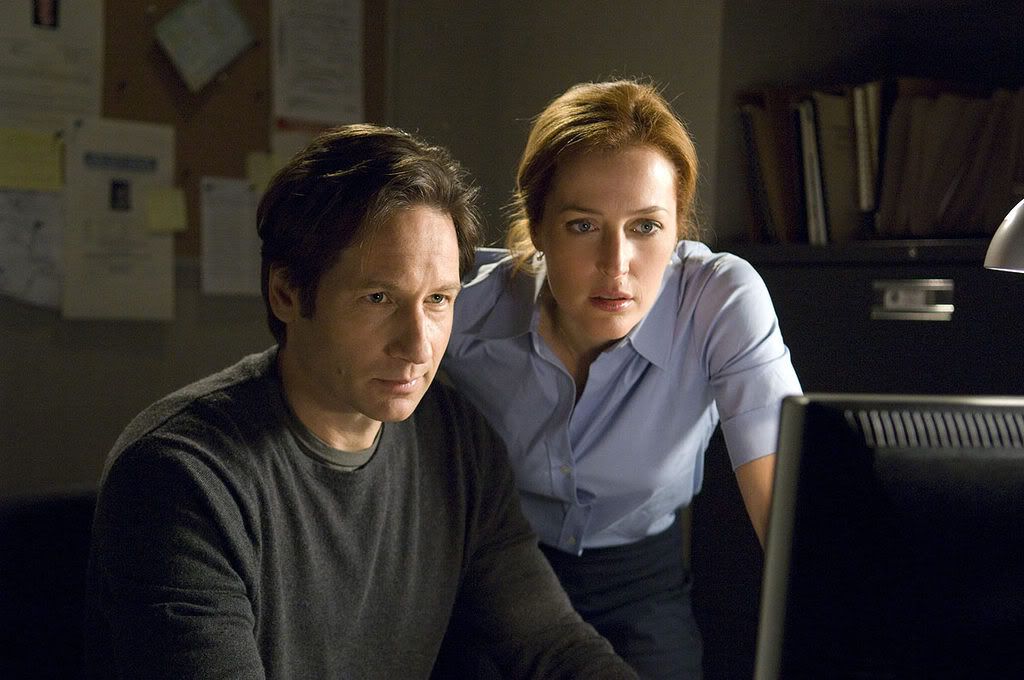
It's the '80s meets the '90s, and when they meet each other, they have to beat each other: Fox Mulder and Dana Scully (David Duchovny and Gillian Anderson, The X-Files) vs. Rick Hunter and Dee Dee McCall (Fred Dryer and Stepfanie Kramer, Hunter). Both are male-female TV cop teams with a ton of sexual tension that is only occasionally addressed. Will the '90s team pound the '80s back into the '70s, or will Football Fred and his Favorite Femme Flatten the Feds?


I am going to lean toward Hunter and McCall for the violence factor. McCall is the less violent of the two because she only kills a suspect every other week. Mulder and Scully are adequate at dealing with aliens and monsters, but they're not so well equipped to deal with violent gun-toting '80s sociopaths, not to mention big hair. (Not that Scully's hair is exactly timeless.) As Mulder is trying to explain the alien conspiracy behind the current conflict, Hunter shoots him. Works for me.

Sunday, May 03, 2009

Beach Boy Huddle!

After watching The Beach Boys' theme song for Karen (the song was written by Jack Lawrence and prolific creator/producer Bob Mosher), I had to go back to YouTube and see if they had my fondest Beach Boy memory, their work as backup band for Annette Funicello over the opening credits of Disney's The Monkey's Uncle. This is the only part of the movie (the last film that Annette and Tommy Kirk made for Disney) that anybody remembers.

It's there, the most 1965 clip you can possibly imagine, and another illustration of the Sherman Brothers' remarkable ability to write songs that scream "Disney" no matter what style they're writing in. I'm not even sure if the Shermans are even particularly good songwriters. When I hear the smart, intricately-rhymed, Kiplingian songs that Terry Gilkyson ("Marianne") originally wrote for The Jungle Book, and remember that he's the writer of "The Bare Necessities" and the "O'Malley the Alley Cat" song, I find it disappointing that Disney favored the Shermans over him for most projects. But they could put the Disney brand on any kind of song, whether it was a mid-'60s pop pastiche like this one or the My Fair Lady pastiche (a pastiche of a pastiche) in Mary Poppins.

But back to the clip: Beach Boy fans who hate Mike Love (I don't) apparently find this clip to be a particular source of satisfaction, because he looks like such an idiot: he doesn't have an instrument until Annette hands him the tambourine, and he occupies his hands by doing "dance" moves that make him look like he's trying to mime climbing up a rope ladder.


Friday, May 01, 2009

WKRP Episode: "Fish Story"

This is one of the most famous WKRP in Cincinnati episodes, and one whose backstory is pretty well known. It was the last episode of the initial 13-episode order, and CBS executives were telling Hugh Wilson that the show wasn't funny enough. In fairness, the previous two episodes in production order had been "Love Returns," the unfunniest (and worst) episode of the entire series, and "I Want To Keep My Baby," not a bad episode but a little short on laughs. So CBS wasn't wrong to think that the show needed to concentrate harder on the comedy. Network notes aren't always entirely wrong.

So when Hugh Wilson wrote this episode, perhaps figuring that this would be the last (since the show wasn't doing well), he wrote it -- or parts of it -- as a sort of parody of the kind of show he felt CBS was asking for, a broad farce with silly costumes, pratfalls, and contrived explanations. He disliked the finished product enough to take his name off it and use the pseudonym "Raoul Plager" instead.

The show was placed on hiatus before the episode could air; when it came back, with a run of episodes that struck the right balance between what CBS wanted and what Wilson wanted, "Fish Story" was not shown. It was finally burned off at the end of May, when the regular season was already over. But it got excellent ratings in the show's new post-M*A*S*H slot, and has always been one of the most popular episodes, because it's just funny. Though the best part of the episode is not the main story but the B story, which is a little less broad because it's based on a real radio thing (DJs really do these drunk-driving tests on the air; this just asks what would happen if someone's reflexes got better rather than worse).

The Hulu/DVD version strips out all the music; this version puts it all back in: "Drinkin' Wine Spo-Dee-O-Dee" by Jerry Lee Lewis, "I'm Torn Down" by Freddie King, "Blue Collar Man" by Styx, "Alabama Song" (aka "Whiskey Bar") and "Light My Fire" by the Doors.

Cold Opening and Act 1


Act 2 and Tag


Thursday, April 30, 2009

Robert Zemeckis, Evil Destroyer of Memories


If Robert Zemeckis really does follow through on his hints about a Roger Rabbit sequel, I will be sad and gloomy and inclined to kick things.

I'm aware that Who Framed Roger Rabbit? has many flaws, the most important flaw that most of the animated characters, old and new, come off as strident and unappealing. Roger, in particular, is so obnoxious that the filmmakers added a new scene after the previews to make him a little more sympathetic (the scene where he's crying over his wife's apparent infidelity). But the movie was an extraordinary experience in 1988 -- I remember I was at camp, and when we went for a movie night, we had a choice between Roger Rabbit and Big Top Pee-Wee; I was in the group that chose Roger, and we didn't regret it -- and I still like it a lot today.

The flaws don't matter so much because they serve the story: Roger is supposed to be an obnoxious, annoying person whose good qualities aren't immediately apparent, and Toontown is supposed to be a hellish place for any human being to visit, the incarnation of how horrible it would actually be to live in a cartoon universe instead of just watching it. The story is driven by the human actors, which is as it should be, because in an animation/live-action movie, the humans are the ones who inspire the animation (the animators have to react to whatever the humans are doing). None of its imitators have been as good because none of them had a comparably strong story, or live-action performances as memorable as those of Hoskins and Lloyd.

But that was Robert Zemeckis in the '80s. And the best argument that can be made for Zemeckis is that his fall from grace hasn't been quite as bad as Rob Reiner's. (Look for them in the upcoming retrospective on "guys who made some of the best movies of the '80s and some of the worst movies of our time.") You know the story: he made Used Cars, Romancing the Stone, Back to the Future and Roger Rabbit -- movies that were over-wrought and tried a little too hard, but were all a lot of fun -- but since 1990, he's been on a quest to make movies without people in them, using all the technical tools at his disposal to make that happen. The post-1990 Zemeckis is the last person you'd want making a Roger Rabbit type film, which can't work unless the human characters are really recognizably, identifiably human.

Zemeckis's comments on the technical side of a potential Roger Rabbit sequel don't fill me with confidence, either:


“I’ll tell you what is buzzing around in my head now that we have the ability—the digital tools, performance capture—I’m starting to think about ‘Roger Rabbit.’”


Because if there's one thing that can make Roger less unappealing, it's replacing him with a mo-cap version of a guy in a rabbit suit.

Tuesday, April 28, 2009

The Gandhi Joke Restored

The original "Mahatma Gandhi" joke from "Bugs Bunny Rides Again" (redubbed when the film was reissued after Gandhi's death) has been on YouTube for a while, but I decided to try and dub it back into the full cartoon. The change in sound quality is pretty obvious, but at least it's there.

I've said this before, but to me the key thing about Yosemite Sam and some of Freleng's other Bugs Bunny villains is that everyone, except for Bugs, is afraid of him. This cartoon has perhaps the most elaborate example of that along with "Wild and Wooly Hare" a decade later. When Sam appears, all the non-Bugs characters freak out and leave (well, they have to -- a short cartoon can afford to have only two or three characters on screen most of the time). Freleng balances this out by showing us immediately that Sam is a tiny man who thinks he's the biggest, toughest man in the world; this makes it funny that all these people are afraid of him. Sam is not scary to us -- that would make the cartoon less funny -- but he is scary to everyone who is not Bugs Bunny.

That gives Bugs a certain heroic quality without making him a goody-two-shoes. He is not particularly brave, or good; he's just the only person in the cartoon who is smart enough to see Sam for what he is (or Rocky and Hugo in "Racketeer Rabbit," or Rocky and Mugsy, or the Gas House Gorillas): an idiot who is only a threat to anyone who believes he's a threat. That's the biggest difference between Sam and Red Hot Ryder in Clampett's "Buckaroo Bugs." Sam and Red Hot are more or less equally stupid, but it's more fun to watch Sam get taken down by Bugs, because Sam is so full of himself and because everyone else buys into Sam's belief in his own toughness. He's a typical authority figure, and Bugs is the only person in the world who dares to point out that the authority figure is just a silly little man.


Oh, and this cartoon contains one of Carl Stalling's more obscure classical-music references: the music playing as Bugs and Sam have their showdown ("just like Gary Cooper, huh?") is the "Inflammatus" from Rossini's Stabat Mater. (Not exactly a rare piece, but not hugely well-known, especially in 1947.)


Monday, April 27, 2009

David Gerstein Reveals The Mysteries of "Hare-Um Scare-Um"


Did "Hare-um Scare-um" (the third cartoon with the crazy rabbit who is sort of, but not quite yet, Bugs Bunny) have an alternate, censored ending? David Gerstein says yes, and he tells us what it was.

Friday, April 24, 2009

WKRP Episode: "Jennifer and the Will"

This season 4 episode introduced (after several episodes showing the renovations) the new, re-designed version of the WKRP lobby. I don't know if the new set was a sign that the producers didn't expect to get canceled, or that they thought they'd have a better chance of renewal if they made the station look less dingy, but either way, it fit in with the overall theme of the season, the unlikely success of a station that was never intended to succeed.

The episode may originally have been intended as a sequel to an episode that was written but unproduced. Hugh Wilson conceived, and assigned Steve Marshall to write, an episode called "Jennifer's Wedding" where Jennifer would marry one of her elderly boyfriends. The idea was to have her married for a few weeks and then kill the husband off. CBS didn't like the wedding story and it was never shot, but "Jennifer and the Will" could easily have been about the death of Jennifer's husband, and probably was supposed to be.

The elderly man who names Jennifer his executrix is played by the veteran Pat O'Brien, who actually knew Loni Anderson from way back; he did a summer stock play in Minneapolis and she had a small part. O'Brien, who basically never stopped working, had just done what would become his last film (Ragtime) and this was his next-to-last television appearance before his death in 1983 (he did a Happy Days in 1982).

For those keeping track of such things, I think this is like the third or fourth WKRP in Cincinnati episode with a joke about the Hare Krishnas. Hugh Wilson must have had a fondness for that joke (along with Jerry Vale jokes and the phrase "that's hardball, not slow pitch").

Cold Opening and Act 1


Act 2


Wednesday, April 22, 2009

American "Golden Age" Cinematographers Who Kept Working After 1970?


The death of the great British cinematographer Jack Cardiff (he was 94) brings to mind a movie-history issue that I've always found kind of interesting. Cardiff, like most of the great cinematographers around the world, continued to get regular work for many decades; though a lot of things changed in terms of the way movies were shot, lit and processed, old masters like Cardiff and Sven Nykvist were always in demand. But one place where this wasn't true was America: when the U.S. film industry changed sharply in the late '60s, almost all the old-school cinematographers stopped working.

If you look at the filmographies of the great and prolific Hollywood cinematographers of the '30s, '40s, and '50s, you'll find that they continued working regularly throughout the '60s, but got little or no work in the '70s. A random example: Daniel Fapp. He did dozens of films as a contractee for Paramount (he did almost all the Martin and Lewis movies); when the studio system broke down, he went freelance and did pictures like West Side Story, One, Two, Three, and Lord Love a Duck, and after 1969, he never worked again, though he lived until 1986.

Or take Joe Ruttenberg, who was MGM's most-requested cinematographer from the '30s onward. In 1968, he retired from MGM and never did a movie again. Leon Shamroy, who was to Fox what Ruttenberg was to MGM, also left the studio in 1969 and, though he had done freelance work for other studios in the '60s, he never worked on another film until his death in 1974. Joseph La Shelle (Laura, The Apartment) worked steadily for three decades, but his last credit is in, you guessed it, 1969.

Those guys, presumably, could afford to retire; old-school cinematographers who needed to keep working after 1970 had to go into television, like Russell Metty, Universal's great cinematographer, who found himself assigned to Universal's TV shows instead of its features.

Now, some of this just has to do with age. William Daniels, one of two great cinematographers who has the same name as another celebrity (Arthur Miller is the other), died in 1970. And James Wong Howe, perhaps the most revered of the golden-agers, didn't do a lot of films in the '70s, but it wasn't because he wasn't in demand, it was because his health wasn't good. (He was the first choice to do The Godfather, but he wasn't up to it physically.) But the pattern is so clear, and so different from other countries, that it does seem like there was some kind of ageism involved here, or perhaps a perception that old-school cinematographers could not be depended on to deliver what the New Hollywood wanted. That perception might be true, of course. The old-school cinematographers mostly didn't think much of the new techniques that the Altmans and Coppolas and Scorseses demanded; Gordon Willis, who shot many of the most important films of the '70s, didn't get nominated for any of them because the old-timers at the Academy hated what he was doing.

One old-timer who did continue to work steadily into the '70s was Robert Surtees, who followed the same pattern as the other guys -- under contract to a studio for many years, went freelance in the '60s -- but was saved by one movie: he shot The Graduate, and (as noted in Pictures at a Revolution) Mike Nichols gave Surtees a lot of credit for delivering all the crazy things he asked for, as well as teaching Nichols a lot about lighting and camera angles. Surtees was very much an old-timer in many ways; when he shot The Last Picture Show, he refused to shoot a scene of dogs copulating, and Polly Platt shot it instead, imitating Surtees' techniques. But his superb work on Graduate and Last Picture Show gave him the kind of cred that other old cinematographers didn't have, so he continued to work well into the late '70s, on both new-school and old-school movies. (On the 1976 remake of A Star Is Born according to Frank Pierson's article in New York, Barbra Streisand was initially upset about having to work with an old cinematographer, until she saw that Surtees was making her look better than she had in any other movie.) It may also have helped that his son Bruce was a much-in-demand director of photography at that point.

Surtees was lucky; other old-timers were put out to pasture after successfully adapting to every other change in Hollywood style. Not to denigrate the work of the younger men who replaced them, but it seems a bit of a shame that the great American directors of photography did not get the same elder-statesman treatment accorded to the great cinematographers from other countries, like Cardiff, Nykvist, Freddie Young, Freddie Francis or Claude Renoir.

Monday, April 20, 2009

That's Nobody's Business But the Turks


For those who are wondering about the second DVD collection of Tiny Toons (comprising the second half of the 65-episode first season), yes, all the music appears to be intact in the "Tiny Toons Music Television" episode: the two They Might Be Giants songs, "Money" and "R-E-S-P-E-C-T." Hamton singing "Happy Feet" in a not-very-good episode called "Hero Hamton" is also intact. And in the second season of Freakazoid!, "We'll Meet Again" is also intact.

The "Music Television" episode is kind of typical of early Tiny Toons in that it's a mix of really good moments and moments that aren't so good at all. The first two videos, with the TMBG songs, are terrific, among the most enduringly popular tings WBTVA ever did. (The split-second gag that always kills me in "Particle Man," directed by Art Vitello and boarded by Bruce Timm and Doug McCarthy, is Plucky pulling a dog sled with the dogs whipping him; a throwaway reversal of an old cartoon cliché.) The next two segments aren't nearly as good, and the finale, a "Sorcerer's Apprentice" parody without the real "Sorcerer's Apprentice" music, is downright boring. The second-season follow-up to this episode, "Toon TV," was better overall, though I don't know if Warners has any plans for future DVDs; it's kind of a minor miracle that we got this and, best of all, the complete Freakazoid! series.

This Tiny Toons set also contains the episode that was so badly animated that the director took his name off two of the shorts. It's "Strange Tales of Weird Science," animated by a company called "Encore Cartoons" (though there's a one-minute unrelated prologue, probably originally intended for some other episode, animated by Kennedy Cartoons). That's the one where the gag credit reads: "Number of retakes: Don't ask!" In 2007, in comments on this blog, Tom Minton gave some background on this episode and how it was "buried deep for as long as possible".

The first of the three shorts in this episode, "Scentimental Pig," was written and directed by Eddie Fitzgerald, and is a rather gruesome but reasonably funny story where Plucky and Hamton literally try to eat each other. (Hamton also sings the original lyrics of "Merry Go Round Broke Down" in this one.) The other two shorts are credited to director "Allen Smithee"; I would suspect that Fitzgerald directed them too, since one director usually did all the shorts in a given episode, but I don't know that for a fact, and it might have been another director. Anyway, here is the last of the three, "Duck In the Muck" (written by Minton). Update: Minton, from comments: "It was not directed by Eddie, but the real director probably wouldn't care to be identified even now so I won't expose the person."


Minton, by the way, is pictured on the bottom left-hand corner in the staff caricature above, which appears in the Tiny Toons episode "K-ACME TV"; that caricature of Minton (by Bruce Timm) was also used for his cameo in the second season of Freakazoid!

Sunday, April 19, 2009

WKRP Episode: "Jennifer and Johnny's Charity"

Episode 14 of season four. This episode kicks off a sweeps period with an episode focusing on the two most popular characters at the time. CBS was always after the writers to put more emphasis on Loni Anderson and/or Howard Hesseman -- understandably, since they were the two most famous members of the cast -- which explains why their characters have a little more to do in the fourth season. As opposed to the previous season, when a third of the episodes were about Herb.

The episode is kind of a 1982 time capsule, with several Reagan jokes and a lot of oblique references to the rich vs. poor, charity vs. federal funding issues that were in the news at the time. But the most enduring part of the episode is the last and most elaborate of Les's news screw-ups, the "monster lizard" routine. The guest stars -- this is one of the few episodes that calls for a lot of guest actors -- include everybody's favorite TV bum, Carmen Filipi.

And for lovers of wardrobe trivia, the dress Loni Anderson wears in Act 1 appears to be the same design, if not necessarily the same dress, that Suzanne Pleshette wore in some early episodes of The Bob Newhart Show.

The music in the opening scene is, of course, "Come Together" by the Beatles, the third and last use of a Beatles song on this show. (The Beatles were usually too expensive to license, even with the lower rates for videotaped shows.) I don't remember what song is playing near the end of act 1.

Cold Opening and Act 1


Act 2


Wednesday, April 15, 2009

RINGS ON HER FINGERS: "Ye Gods, Have You Ever Seen Anything So Corny?"

Here's a movie on YouTube that hasn't been seen on TCM as far as I know (I guess the Fox Movie Channel might have shown it, but I don't get the FMC): the 1941 comedy Rings On Her Fingers, starring Gene Tierney, Henry Fonda and and Laird Cregar, directed by Rouben Mamoulian. Shame about the embedded subtitles, but until there's a DVD, it's the only way to see it.

Tierney, a good-hearted but covetous working girl, is taken under the wing of a team of middle-aged con artists, and used as bait for a gullible young man played by Fonda. But she falls in love with him, and... no, this isn't The Lady Eve, it's a Lady Eve knockoff rushed out by Fox, Fonda's home studio, after they'd seen what he could do in comedy for their rival Paramount.

Actually, the plot as it develops has its own identity (halfway between Lady Eve and one of those Fox musicals about reluctant gold-diggers), and The Lady Eve isn't one of my favorite Sturges movies anyway, but I can't claim that the writing in this movie is very strong. The good side of it is that it gives Tierney one of the strongest parts she ever got. (Leave Her To Heaven and this one were probably her two best parts, but at least in this one she doesn't disappear in the last half-hour of the movie.) It's a bigger part than usual, for one thing, and she gets to play a character with more dimension than usual. She was always beautiful, but she rarely got to be earthy or resourceful, or openly use her legendary looks to assert power over a man.

This scene kind of sums up the writing weaknesses and performance strengths of the movie: Henry Fonda, talking on the phone while looking at Tierney in a bathing suit, makes a series of corny unintentional double-entendres and even cornier Freudian slips ("how about her ankles... uh, anchors"). But it's Tierney, so I'm not sure that the writing is even an issue; nobody can concentrate any more than Fonda's character can.


Mamoulian, who had been one of the most legendary innovators in American film in the '30s, was no longer much of an innovator (the medium had caught up to him), and Andrew Sarris's description of him seems accurate: "The innovator who runs out of innovations." At this point he was a good film director -- his last two films for Fox were The Mark of Zorro and Blood and Sand -- but not really anything very special or easy to distinguish from the "house style" of whatever studio he was working for. He did better on stage, where there was still room to innovate: he directed Oklahoma! and Carousel and more or less changed everyone's conception of what a musical could be.

Monday, April 13, 2009

My "Bonnie and Clyde" Problem


Like most people who read Pictures At a Revolution, I wound up re-watching many of the 1967 movies mentioned in the book. (Can't bring myself to revisit Doctor Dolittle, though.) In particular, Bonnie and Clyde, one of those movies that I used to consider a masterpiece and now consider... something else.

The impact of watching Bonnie and Clyde for the first time is incredible, no matter where or when you see it. (I saw it for the first time on television with commercial breaks, and even that couldn't kill its momentum, the way it made you want to know what was going to happen next even though you already knew the ending.) So it's not just a relic of its time, the way Easy Rider is; it's a real, living movie that doesn't lose its power to confuse you. By that I mean that it set out from the beginning to make the audience feel unsure about how to respond to it: with no one in the movie to anchor the story in conventional morality or authority (like the cops in White Heat), and its constant, sudden shifts in tone, it makes us respond and then ask ourselves why we're responding the way we are. Every movie that tries to get us involved and then ask questions about the nature of our involvement and the nature of moviemaking and storytelling, from Taxi Driver to Observe and Report, owes a debt to Bonnie and Clyde, but more importantly, the movie still has that effect today, and carries it off better than most of the movies that imitated it. So in that sense, the movie still "holds up."

But while the movie still works, I don't know any more whether I think it's all that good. I don't even know if that makes any sense. (How can a movie not be good if it works?) But for one thing, I'm not terribly fond of most of the performances in the film. Well, Gene Wilder as the nervous undertaker is great. But Beatty is, as always, playing himself instead of getting into the character; Michael J. Pollard, same deal; Faye Dunaway does create a character, because she had no pre-set persona to fall back on, but I find her Bonnie to be kind of a depressing, dour doormat with no real joy in anything, even crime and guns. Gene Hackman and Estelle Parsons are stuck with under-written parts, which shouldn't be a problem; the movie is called Bonnie and Clyde, after all. So my problem comes back to Bonnie and Clyde; the way they're played, and the way they're written, they seem like vehicles for the filmmakers' ideas about style and tone and audience response. I can't really see them as people, not in the '30s, not in 1967, not now.


The obvious point of comparison for Bonnie and Clyde is Gun Crazy (as Harris notes in his book, Truffaut took the writers of the film to see Gun Crazy when he was considering directing it, and Godard, who also considered it, attended the same screening with Anna Karina). It's pointless to talk about which movie is "better"; they may both be Freudian melodramas about male-female gangsters teams, but they're very different movies. But the thing that amazes me now is that Bonnie, made 18 years after Gun Crazy, seems more dated than Gun Crazy. In part, this is my very personal reaction to many of the films from Hollywood's "Second Golden Age", roughly the late '60s through the late '70s: I find that films from this era, with exceptions of course, date faster and more badly than movies from any other era of Hollywood filmmaking. I'm talking not about bad films, which always date badly, but the good ones. In writing, acting and especially editing and photography (the ostentatious zooms, the music-free direct cuts where one sound effect is cut off and the next sound effect begins, with no attempt at seamless transition; the downbeat or ambiguous endings), these movies just feel very "old" to me in a way that the good films from earlier and later eras do not. I'm not sure if I can explain why, even if I took another post to do it.

Update: I should add, since I didn't make this clear, that I'm not just talking about the way these movies look, or the references. I'm also talking about the intangible quality that makes something transcend its time, and which I often find lacking in late '60s and early '70s classics. There are many films from all other eras -- even the '80s -- that I can watch without thinking too much about when they're from, but I find that when I watch even some of the best 1967-1975 movies, I'm completely conscious that they're period pieces. That's 100% subjective, of course.[/update]

(And again, I don't just mean the films that tried to be timely -- of course Taxi Driver seems dated in some ways; it's got things to say about the crumbling New York of 1976 and post-Vietnam rage -- but almost anything. Airplane! is a light comedy/spoof that happens to have been made in 1980. Blazing Saddles and Young Frankenstein are light comedy/spoofs that always leave me thinking that this must have been funnier in 1974/5. I'm not even saying that Airplane! is a better film than Young Frankenstein, just that I don't think it dates as badly.)

But there are other reasons why Bonnie and Clyde seems very creaky to me, reasons that are specific to the movie itself. One of them is its look. As Harris notes, Burnett Guffey was one of the few veterans who worked on Bonnie. He had shot many dark films, mostly in black-and-white, but when he worked in color, his movies had probably the brightest, cheeriest look in the business. In fact, Guffey was the first cinematogapher whose work I actually noticed: realizing that How To Succeed in Business Without Really Trying, The Silencers and Bonnie and Clyde were all shot by the same person, I understood how a director of photography could create a distinctive look. Guffey's color movies were the ultimate in candy-box artificiality, which may be one of the reasons Beatty and Penn wanted him for the film; making Bonnie look like a Matt Helm movie helped re-inforce the plan to start out as a light comedy and then gradually make the audience more and more uncomfortable with what it was seeing. But the look of the movie, which is virtually identical to The Silencers the year before, makes it feel like a '60s relic studio movie, as does the rear-projection in the car scenes. (As Penn says in Pictures At a Revolution, if they had done the movie two years later, they could have done it without rear-projection; it wasn't technically feasible to put cameras and sound equipment in the cars on the actual locations. On the other hand, couldn't he have taken a page from Gun Crazy and put a camera in the car for one robbery?) There's something disorienting about a movie that wants to be modern and cutting-edge but looks like a Dean Martin movie, and it's not the good kind of disorienting that the movie's going for, it's the bad kind of disorienting, where the technique takes you out of the film. (The Wild Bunch, two years later, has something similar going on, where the old-fashioned film grammar of a lot of the picture -- right down to the dissolves between scenes, which by then were out of date -- clashes with all the slow-motion and zooms. But in that movie, you can argue that the mix of old and new is built into the story.)

And so I get the feeling, overall, that this is another movie where Arthur Penn had interesting ideas and executed them in a sluggish, confused way. Penn was the real deal as a film director, unlike other '60s transplants from TV and stage like Arthur Hiller or Gene Saks or (I have no problem saying this) Mike Nichols. Penn clearly wanted American movies to be better than they had been, and he wanted to make movies that shook us up. But I don't think it's just bad luck that he made relatively few actually good movies (and after Bonnie, he didn't do much stage work, either, which may be a waste; he had a remarkable track record as a stage director). I find something smug and preachy in a lot of his work, as if he can't stop telling us what we're supposed to learn about life and ourselves, and won't commit himself to the characters. Bonnie and Clyde... I was going to say it "needed" something, but that would be silly; since it was a hit and became a classic, Penn clearly gave it what it needed. So I'll say that what I now want from Bonnie and Clyde is a movie that believes in the lovers and their pop-Freud problems, and also stands apart from it and comments on the story in a self-conscious way. I think Penn got the second half of that; I'm not sure he got the first half. So what I see now is two attractive late-'60s people play-acting at being young gangsters on the run. And I no longer see much reason to worry about the points the movie is trying to make, because I no longer think it's about people, the way other great lovers-on-the-run pictures (before and after) are about people.

Of the hit 1967 movies that used the past to comment on the present, and changed the way violence was portrayed in the movies, I think I prefer The Dirty Dozen, which at the time was sometimes used as an example of the "wrong" way to do this kind of film, bad cop to Bonnie's good cop. Pauline Kael in her review of Bonnie mentioned Dirty Dozen, "which isn't a work of art and whose violence offends me morally." But while there's nothing terribly thought-provoking about The Dirty Dozen, Robert Aldrich's angry misanthropy -- his attitude that we can root for thugs and murderers because that's all any of us are -- has the kind of passion, of sincerity, that I don't find in Penn's work.

But I changed my mind once; I could change my mind again.

One thing that I find interesting about Bosley Crowther's famous campaign against the movie, which didn't hurt Bonnie but cost Crowther his job as the New York Times movie critic, is that even though Crowther was the ultimate middlebrow critic, his attack on Bonnie and Clyde was very much in line with the things that highbrows used to criticize in Hollywood movies. He focused on two things: pandering to the lowest common denominator (in the form of goofy comedy and celebration of violence) and historical inaccuracy.

There was a time in the early '60s when you couldn't go wrong tut-tutting Hollywood for its tendency to change and prettify real-life events and people. So when Crowther wrote about Bonnie and Clyde's "ridiculous, camp-tinctured travesties of the kind of people these desperados were and of the way people lived in the dusty Southwest back in those barren years," he probably thought he was on safe ground. What he didn't get was that expectations had changed. It used to be that big-studio movies trivialized history, while tough little movies tried to tell the truth about the way things were. By 1967, historical accuracy was the province of safe, bland studio movies (the ones that spent millions of extra dollars to make every costume and hairstyle perfectly in-period), and it was now cool to use anachronisms and inaccuracies to make "historical" subjects apply to the modern era, the way Bonnie and Clyde and The Dirty Dozen did. Crowther missed that, and I get the impression that he really thought the argument from history would be a winning argument, because it used to work against Hollywood.

On the other hand, as mediocre and middlebrow a critic as Crowther was, the crusade against him for not liking Bonnie and Clyde was basically unfair. (Though he brought it on himself by repeatedly complaining about the movie; he either didn't know or didn't care that many people were looking for an excuse to force him out.) His moralistic attacks on Bonnie aren't really very different from Pauline Kael's attack on Dirty Harry, four years later, as a "deeply immoral movie." Both Crowther and Kael agreed on some level that movie violence can be immoral; they just disagreed on what movies went too far in their celebration of violence. And such moralizing isn't really a big problem as long as the critic isn't calling for censorship.

Sunday, April 12, 2009

Cartoons That Never Happened: THE DAFFY DUCK SHOW

Paul Rugg posted some pictures from his last day at Warner animation, and one of them is a reminder of an unproduced project that I was hearing a lot about in 1997-8: "The Daffy Duck Show," a proposed prime-time half-hour cartoon with Daffy as the star. Joe Alaskey was the likely choice to be the voice of Daffy, and the team that was working on the project included Spike Brandt, Tony Cervone, Doug Langdale, John McCann, and Rugg, who writes:

We had all worked months on the project. Jamie Kellner didn't like it. In all honesty, it was the best thing we had done at Warners.


As I recall, the idea started because the WB wanted a) a prime-time cartoon (attempts to retool Pinky and the Brain for prime time hadn't worked out) and b) a vehicle for Daffy, who was increasingly visible in the studio's marketing plans after Space Jam.

The format the writers came up with was similar to The Jack Benny Program, a show-within-a-show that would have allowed for both behind-the-scenes stories and "sketches" that would presumably have been more like typical Daffy Duck cartoons. Brandt described it this way:


Brandt: It was kind of a cross between Jack Benny and Larry Sanders. Instead of a talk show it was a variety show where you could put on skits. So you could have stuff happening both on stage as short-like things, and then all the shenanigans going on behind the scenes. That didn't go anywhere.


I've never seen any art that was created for the show, so I don't know what kind of look they were going for, but the project Brandt and Cervone later wound up doing, Duck Dodgers, probably had some similarities in character design.

The WB's attempts to find a prime-time cartoon -- this was after King of the Hill had become a hit and everybody finally realized that The Simpsons was not a fluke, leading to a huge investment in animation by almost every network -- were better than some of the other networks' (though nobody actually came up with a hit except Fox). Mission Hill wasn't a hit, but it was a pretty good show. But it was obvious that Jamie Kellner, a smart TV executive when it came to live-action programming, didn't like cartoons much or at least didn't know what kind of cartoons he wanted; hence the many animated projects, prime-time and Saturday morning, that were scrapped after a lot of time-consuming and expensive development when Kellner decided he didn't like what he'd ordered.

The Daffy Duck project may have been seen as a way of salvaging Warners' animation department. The whole animation department was set up to deliver cartoons that had a stylistic nod to the past (either in comedy or superheroes) and an audience with an all-ages mix. By 1997, everybody wanted cartoons that were more modern in look and feel and more specifically targeted at young children, and the WB network, their only patron, especially wanted that type of Saturday Morning cartoon. So there may have been some hope that they could continue with their house style by re-orienting it toward prime time.


Friday, April 10, 2009

WKRP Episode: "A Commercial Break"

This is the famous season 1 episode about the commercial for "Ferryman's Funeral Homes"; Richard Sanders and Michael Fairman wrote it very fast when Hugh Wilson didn't have a script for that week.

The '90s syndication version stripped out the music, and the DVD/Hulu version took out two music-related gags in Act 1. The music in Act 2 is "Young Blood" by the Coasters and "Heart of Glass" by Blondie; though only a few bars of "Heart of Glass" are played, this episode apparently helped make the song a hit because Johnny announces the title and artist, like a real DJ does. CBS was initially reluctant to allow the characters to mention the names of the songs and groups; you'll notice that in most of the earliest episodes, the DJs never identify the songs they're playing. (Networks back then were reluctant to do anything that smacked of free product placement; it was like giving away advertising time for nothing.) Finally the DJs were allowed to announce or back-announce the songs, and that sometimes helped songs to become more popular.

Cold Opening


Act 1


Act 2 and Tag


Wednesday, April 08, 2009

The Ever-Elusive (But Great) Early POGO

The promised "Complete Pogo" project from Fantagraphics never quite materializes. First it was supposed to start in 2007. Then Amazon had a "November 2009" release date. But now Fantagraphics says that "it will definitely NOT be out in 2009."


The problem since 2007 has been that the first year of Pogo Sunday strips is in poor shape, and they haven't yet been able to track down adequate-quality versions of all those strips. (The early daily strips, on the other hand, have already been reprinted and are fine, but since many Pogo fans already have those dailies, it's the Sundays that would be the real selling point of a collection.) Hopefully they'll find what they're looking for and get the project started eventually. I get a little sadder every time I look at that Amazon listing, with the cover for the first volume that was designed two years ago.

While I'm on the subject of the early Pogo, I think the early strips are underrated. They're often dismissed a bit because Kelly hadn't started doing political humor yet. (The first story that was sort of political was the 1950 story where the pup-dog disappears and everyone assumes Albert ate him; it never struck me that way, but apparently Kelly meant it as a comment on red-baiting, and he used it as the basis for a more directly political guilt-by-suspicion story the following year.) But I was introduced to Pogo through the 1949 dailies, and I still think they're some of the best. The characters have more of an edge than they later had, with stories that sometimes have to do with them trying to cheat or hurt each other. (Albert gets into an argument with a moose and ropes Pogo into fighting the creature; Owl and Turtle team up to trick Albert into giving up cigars so they can get all his cigars for themselves.) In some of the later strips, the lighthearted stories can seem like talky filler in between the political material; here the stories have the feel of very good theatrical cartoons, except extended across a longer period of time.

Kelly later simplified the character designs and backgrounds, which is normal and understandable, but I do like something about the more elaborate drawing style in these early strips, as well as the smaller lettering. I also like Porkypine (my favorite character) without the hat that Kelly later added to make him cuter. This 1949 strip is probably my favorite in the whole run.


Saturday, April 04, 2009

Grudge Match: Grudge M*A*S*H

It's a regular M*A*S*H-up as three characters from the early seasons team up to fight the three characters who were brought in to replace them. (With the first team, we're talking about the TV versions, not the original movie versions.)

Team One

Trapper John McIntyre (Wayne Rogers), Frank Burns (Larry Linville), Henry Blake (McLean Stevenson)


vs.

Team Two

B.J. Hunnicutt (Mike Farrell), Charles Winchester (David Ogden "Dropped after the pilot of Charlie's Angels" Stiers), Sherman Potter (Harry Morgan).


Hawkeye was originally going to be the referee, but both teams got so tired of his preaching about the evils of violence that they buried him under a pile of rocks that spelled out "GOODBYE." Now there is no referee and no rules, just two teams of three and a desperate desire to show who's really in charge at the 4077th.

Which set of sitcom surgeons will slaughter the second set?

A Trailer For A Kaput Comedy Team

This is the trailer for Martin and Lewis's last movie, Hollywood Or Bust. (The trailer for Artists and Models, unfortunately, is still nowhwere to be found.) It doesn't have any deleted scenes as some trailers do -- there is one alternate take in there, of Martin singing in long-shot when it's a close-up in the movie -- but it's interesting for its obvious half-heartedness. Hollywood Or Bust is a good film, but Martin and Lewis had already broken up by the time it came out, and Paramount was stuck with the task of selling a movie starring a now-nonexistent comedy team. Their solution, which is less evident in the trailer than in the marketing, was to build the campaign around Anita Ekberg. The trailer emphasizes the cross-country adventure aspect, suggesting that it's a stand-alone movie, and plays down M&L as a team, since they weren't a team any more. The announcer mostly just calls them "the boys."


Compare that to the trailer for their one film that isn't on DVD, Three Ring Circus, from two years earlier, directed by the prolific Joseph Pevney, who passed away last year at the age of 96. (It's on YouTube, and it's not very good, but I still don't get why Paramount didn't include it in their M&L boxes.) This trailer sells them as a popular team and tells us how lucky we are to see our beloved comedians in VistaVision for the first time.


One reason why I'm always annoyed at the absence of trailers from DVDs of old movies is that, for most of those films, trailers are the only place where you can even hope to see deleted scenes or alternate takes.

Friday, April 03, 2009

WKRP Episode: "Never Leave Me, Lucille"

This season 1 episode, where Herb breaks up with his wife Lucille (I'm not spoiling anything when I say everything's back to status quo by the end) was the 19th in production order, the 12th in airing order. I've always thought of this as one of the episodes where WKRP in Cincinnati really came together. Not that there weren't great episodes before this one, but here nearly all the characters have become what they're going to be for the rest of the series, both by themselves and in terms of their relationships with one another.

The episode has two musical sequences, both of which were eliminated on the DVD: "Heartbreak Hotel" (sung by Les); "Everybody Rock n' Roll the Place" by Eddie Money.

Cold Open and Act 1


Act 2


Wednesday, April 01, 2009

So Elvis makes the sun come up, and there's an owl with magical sorcery breath, and a kid who turns into a kitten with a speech impediment, and...


The Nostalgia Critic recently reviewed Don Bluth's Rock-a-Doodle, and while it's not as memorable as his review of Tom and Jerry: the Movie, the Christopher Plummer bit is good, and it's always good to see a full-length tirade against a bad '90s animated feature. Particularly one that has arguably the worst voice-over performance by any child actor in any film.

I don't agree with his statement that Bluth was an "animation god" in the '80s, but I know where he's coming from; I went to see An American Tail when I was a kid, and enjoyed it more than any Disney feature from the same era. Bluth's flaws are obvious enough in retrospect, but his '80s movies were interesting to kids in a way that most of the Disney product was not. The fact that he fell apart soon after as Disney got its act together just emphasizes the idea that he was necessary to give kids what they wanted until Disney could shape up.

Part of this, I think, is that most of Bluth's movies were basically similar to Saturday morning cartoons of the period -- better-animated, but similar in design, story structure, and the type of voices and characters they used. Even the scary bits were kind of like the scary moments on, say, My Little Pony. So kids who were being raised on Saturday morning cartoons could get some of the same things from Bluth's features.

And while Rock-a-Doodle may not have been the worst of the '90s animated features -- it may not even be Don Bluth's worst -- it does have probably the most incomprehensible plot in the history of animated features, starting with the plot point that drives the Nostalgia Critic around the bend: the whole story hinges on the idea that the Elvis Rooster's crowing makes the sun rise, but only after we've already seen that the sun will rise even if he doesn't crow.


He's not the only one driven insane by the plot of Rock-a-Doodle. I checked the movie's Wikipedia entry, and found this in the film's plot summary. I almost hope that no one changes it; it's the sort of thing I enjoy finding on Wikipedia. This is a direct cut-and-paste:


Chanticleer continues to try to crow, but The Duke, angered by this, then transforms into a giant and causes chaos in the form of a tornado. Chanticleer in the tornado starts to sink beneath the waves, listening to all the good and bad things said about him. Suddenly, hearing how the Duke mocked him with a "Cock-a-doodle-doo?" and listening to Patou, he regains his confidence, gathers his energy, and crows. The sun strikes the gigantic owl's twister and.... You know what? Fuck this plot; it's way too stupid for words. I'm done with this shit. You lose, good day sir.